Thank you for visiting SNEWPapers!
Sign up free
Editorial
September 1, 1843
Burlington Free Press
Burlington, Chittenden County, Vermont
What is this article about?
In the 1836 constitutional convention, a speaker rebuts claims of aristocratic conspiracy in proposing a Senate, defends wealth from industry as compatible with democracy, and asserts equal political rights for rich and poor without equalizing property.
Clipping
OCR Quality
95%
Excellent
Full Text
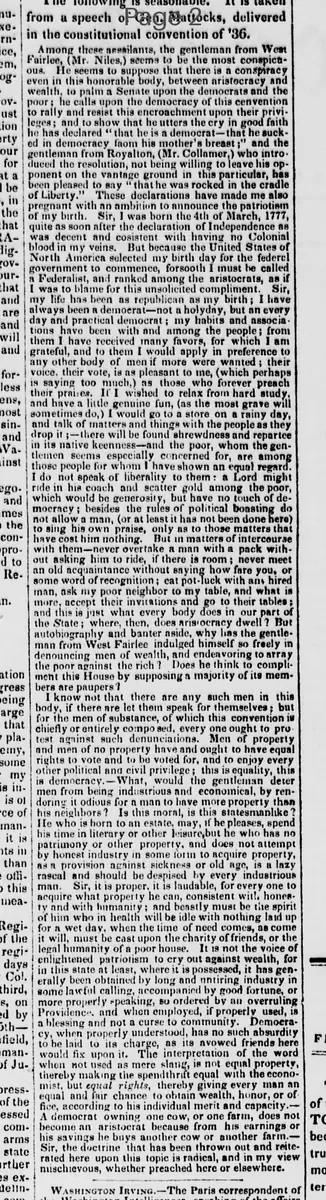
in the constitutional convention of '36.
Among these assailants, the gentleman from West Fairlee, (Mr. Niles,) seems to be the most conspicuous. He seems to suppose that there is a conspiracy even in this honorable body, between aristocracy and wealth, to palm a Senate upon the democrats and the poor; he calls upon the democracy of this convention to rally and resist this encroachment upon their privileges; and to show that he utters the cry in good faith he has declared ' that he is a democrat—that he sucked in democracy from his mother's breast;' and the gentleman from Royalton, (Mr. Collamer,) who introduced the resolution, not being willing to leave his opponent on the vantage ground in this particular, has been pleased to say 'that he was rocked in the cradle of Liberty.' These declarations have made me also pregnant with an ambition to announce the patriotism of my birth. Sir, I was born the 4th of March, 1777, quite as soon after the declaration of Independence as was decent and consistent with having no Colonial blood in my veins. But because the United States of North America selected my birth day for the federal government to commence, forsooth I must be called a Federalist, and ranked among the aristocrats, as if I was to blame for this unsolicited compliment. Sir, my life has been as republican as my birth: I have always been a democrat—not a holyday, but an every day and practical democrat: my habits and associations have been with and among the people; from them I have received many favors, for which I am grateful, and to them I would apply in preference to any other body of men if more were wanted; their voice, their vote, is as pleasant to me, (which perhaps is saying too much,) as those who forever preach their praises. If I wished to relax from hard study, and have a little genuine fun, (as the most grave will sometimes do,) I would go to a store on a rainy day, and talk of matters and things with the people as they drop in;—there will be found shrewdness and repartee in its native keenness—and the poor, whom the gentleman seems especially concerned for, are among those people for whom I have shown an equal regard. I do not speak of liberality to them: a Lord might ride in his coach and scatter gold among the poor, which would be generosity, but have no touch of democracy; besides the rules of political boasting do not allow a man, (or at least it has not been done here) to sing his own praise, only as to those matters that have cost him nothing. But in matters of intercourse with them—never overtake a man with a pack without asking him to ride, if there is room; never meet an old acquaintance without saying how fare you, or some word of recognition; eat pot-luck with any hired man, ask my poor neighbor to my table, and what is more, accept their invitations and go to their tables; and this is just what every body does in our part of the State; where, then, does aristocracy dwell? But autobiography and banter aside, why has the gentleman from West Fairlee indulged himself so freely in denouncing men of wealth, and endeavoring to array the poor against the rich? Does he think to compliment this House by supposing a majority of its members are paupers?
I know not that there are any such men in this body. if there are let them speak for themselves: but for the men of substance, of which this convention is chiefly or entirely composed, every one ought to protest against such denunciations. Men of property and men of no property have and ought to have equal rights to vote and to be voted for, and to enjoy every other political and civil privilege; this is equality, this is democracy.—What, would the gentleman deter men from being industrious and economical, by rendering it odious for a man to have more property than his neighbors? Is this moral, is this statesmanship? He who is born to an estate, may, if he pleases, spend his time in literary or other leisure, but he who has no patrimony or other property, and does not attempt by honest industry in some form to acquire property, as a provision against sickness or old age, is a lazy rascal and should be despised by every industrious man. Sir, it is proper, it is laudable, for every one to acquire what property he can, consistent with honesty and with humanity; and beastly must be the spirit of him who in health will be idle with nothing laid up for a wet day, when the time of need comes, as come it will, must be cast upon the charity of friends, or the legal humanity of a poor house. It is not the voice of enlightened patriotism to cry out against wealth, for in this state at least, where it is possessed, it has generally been obtained by long and untiring industry in some lawful calling, accompanied by good fortune, or more properly speaking, so ordered by an overruling Providence, and when employed, if properly used, is a blessing and not a curse to community. Democracy, when properly understood, has no such absurdity to be laid to its charge, as its avowed friends here would fix upon it. The interpretation of the word when not used as mere slang, is not equal property, thereby making the spendthrift equal with the economist, but equal rights, thereby giving every man an equal and fair chance to obtain wealth, honor, or office, according to his individual merit and capacity.—A democrat owning one cow, or one farm, does not become an aristocrat because from his earnings or his savings he buys another cow or another farm.—Sir, the doctrine that has been thrown out and reiterated here upon this topic is radical, and in my view mischievous, whether preached here or elsewhere.
Among these assailants, the gentleman from West Fairlee, (Mr. Niles,) seems to be the most conspicuous. He seems to suppose that there is a conspiracy even in this honorable body, between aristocracy and wealth, to palm a Senate upon the democrats and the poor; he calls upon the democracy of this convention to rally and resist this encroachment upon their privileges; and to show that he utters the cry in good faith he has declared ' that he is a democrat—that he sucked in democracy from his mother's breast;' and the gentleman from Royalton, (Mr. Collamer,) who introduced the resolution, not being willing to leave his opponent on the vantage ground in this particular, has been pleased to say 'that he was rocked in the cradle of Liberty.' These declarations have made me also pregnant with an ambition to announce the patriotism of my birth. Sir, I was born the 4th of March, 1777, quite as soon after the declaration of Independence as was decent and consistent with having no Colonial blood in my veins. But because the United States of North America selected my birth day for the federal government to commence, forsooth I must be called a Federalist, and ranked among the aristocrats, as if I was to blame for this unsolicited compliment. Sir, my life has been as republican as my birth: I have always been a democrat—not a holyday, but an every day and practical democrat: my habits and associations have been with and among the people; from them I have received many favors, for which I am grateful, and to them I would apply in preference to any other body of men if more were wanted; their voice, their vote, is as pleasant to me, (which perhaps is saying too much,) as those who forever preach their praises. If I wished to relax from hard study, and have a little genuine fun, (as the most grave will sometimes do,) I would go to a store on a rainy day, and talk of matters and things with the people as they drop in;—there will be found shrewdness and repartee in its native keenness—and the poor, whom the gentleman seems especially concerned for, are among those people for whom I have shown an equal regard. I do not speak of liberality to them: a Lord might ride in his coach and scatter gold among the poor, which would be generosity, but have no touch of democracy; besides the rules of political boasting do not allow a man, (or at least it has not been done here) to sing his own praise, only as to those matters that have cost him nothing. But in matters of intercourse with them—never overtake a man with a pack without asking him to ride, if there is room; never meet an old acquaintance without saying how fare you, or some word of recognition; eat pot-luck with any hired man, ask my poor neighbor to my table, and what is more, accept their invitations and go to their tables; and this is just what every body does in our part of the State; where, then, does aristocracy dwell? But autobiography and banter aside, why has the gentleman from West Fairlee indulged himself so freely in denouncing men of wealth, and endeavoring to array the poor against the rich? Does he think to compliment this House by supposing a majority of its members are paupers?
I know not that there are any such men in this body. if there are let them speak for themselves: but for the men of substance, of which this convention is chiefly or entirely composed, every one ought to protest against such denunciations. Men of property and men of no property have and ought to have equal rights to vote and to be voted for, and to enjoy every other political and civil privilege; this is equality, this is democracy.—What, would the gentleman deter men from being industrious and economical, by rendering it odious for a man to have more property than his neighbors? Is this moral, is this statesmanship? He who is born to an estate, may, if he pleases, spend his time in literary or other leisure, but he who has no patrimony or other property, and does not attempt by honest industry in some form to acquire property, as a provision against sickness or old age, is a lazy rascal and should be despised by every industrious man. Sir, it is proper, it is laudable, for every one to acquire what property he can, consistent with honesty and with humanity; and beastly must be the spirit of him who in health will be idle with nothing laid up for a wet day, when the time of need comes, as come it will, must be cast upon the charity of friends, or the legal humanity of a poor house. It is not the voice of enlightened patriotism to cry out against wealth, for in this state at least, where it is possessed, it has generally been obtained by long and untiring industry in some lawful calling, accompanied by good fortune, or more properly speaking, so ordered by an overruling Providence, and when employed, if properly used, is a blessing and not a curse to community. Democracy, when properly understood, has no such absurdity to be laid to its charge, as its avowed friends here would fix upon it. The interpretation of the word when not used as mere slang, is not equal property, thereby making the spendthrift equal with the economist, but equal rights, thereby giving every man an equal and fair chance to obtain wealth, honor, or office, according to his individual merit and capacity.—A democrat owning one cow, or one farm, does not become an aristocrat because from his earnings or his savings he buys another cow or another farm.—Sir, the doctrine that has been thrown out and reiterated here upon this topic is radical, and in my view mischievous, whether preached here or elsewhere.
What sub-type of article is it?
Constitutional
Partisan Politics
What keywords are associated?
Constitutional Convention
Democracy
Aristocracy
Property Rights
Wealth
Equal Rights
Class Division
What entities or persons were involved?
Mr. Niles (West Fairlee)
Mr. Collamer (Royalton)
Constitutional Convention Of 1836
Editorial Details
Primary Topic
Defense Of Property Rights And Equal Political Privileges In Democracy
Stance / Tone
Strongly Pro Property Rights And Equal Rights, Anti Class Warfare Rhetoric
Key Figures
Mr. Niles (West Fairlee)
Mr. Collamer (Royalton)
Constitutional Convention Of 1836
Key Arguments
Men Of Property And No Property Have Equal Rights To Vote And Privileges
Democracy Means Equal Rights And Fair Chance To Obtain Wealth, Not Equal Property
Wealth Obtained By Industry Is A Blessing, Not To Be Denounced
Criticizing Wealth Deters Industry And Economy
True Democrat Associates With The People In Daily Life