Thank you for visiting SNEWPapers!
Sign up free
Sioux City Register
Sioux City, Woodbury County, Iowa
What is this article about?
Historical note on the change of New Year's Day from March 25 to January 1 in British dominions, via an act of Parliament in the 24th year of George II's reign, effective after December 31, 1751, also correcting the calendar by omitting days in September 1752.
Clipping
OCR Quality
Full Text
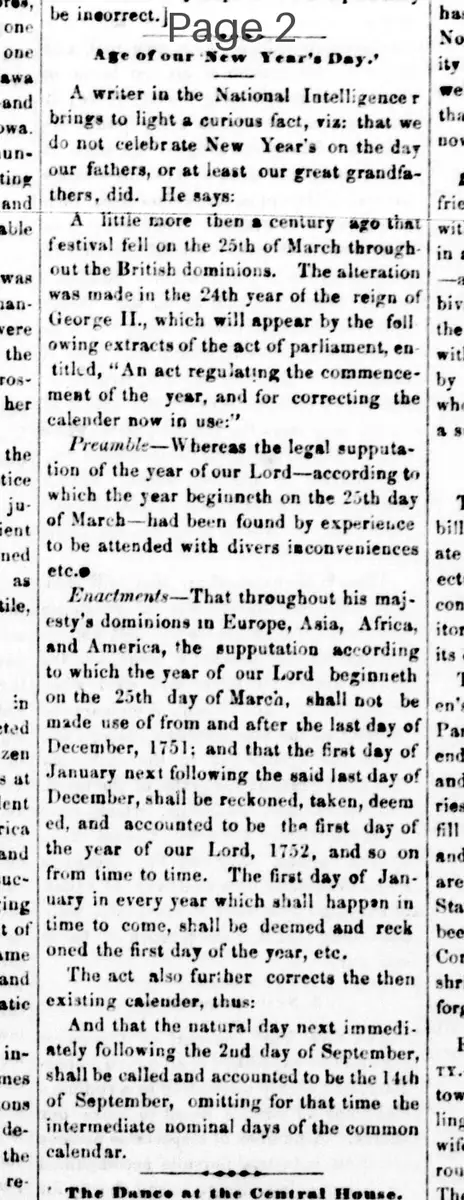
A writer in the National Intelligencer brings to light a curious fact, viz: that we do not celebrate New Year's on the day our fathers, or at least our great grandfathers, did. He says:
A little more than a century ago that festival fell on the 25th of March throughout the British dominions. The alteration was made in the 24th year of the reign of George II., which will appear by the following extracts of the act of parliament, entitled, "An act regulating the commencement of the year, and for correcting the calendar now in use:"
Preamble—Whereas the legal computation of the year of our Lord—according to which the year beginneth on the 25th day of March—had been found by experience to be attended with divers inconveniences etc.
Enactments—That throughout his majesty's dominions in Europe, Asia, Africa and America, the supputation according to which the year of our Lord beginneth on the 25th day of March, shall not be made use of from and after the last day of December, 1751: and that the first day of January next following the said last day of December, shall be reckoned, taken, deemed, and accounted to be the first day of the year of our Lord, 1752, and so on from time to time. The first day of January in every year which shall happen in time to come, shall be deemed and reckoned the first day of the year, etc.
The act also further corrects the then existing calendar, thus:
And that the natural day next immediately following the 2nd day of September shall be called and accounted to be the 14th of September, omitting for that time the intermediate nominal days of the common calendar.
What sub-type of article is it?
What themes does it cover?
What keywords are associated?
What entities or persons were involved?
Where did it happen?
Story Details
Key Persons
Location
British Dominions In Europe, Asia, Africa And America
Event Date
24th Year Of The Reign Of George Ii (Effective 1752)
Story Details
A curious historical fact revealing that New Year's Day was formerly March 25 in British territories, changed to January 1 by a 1751 parliamentary act under George II to correct calendar inconveniences, with further adjustment skipping 11 days in September 1752.