Thank you for visiting SNEWPapers!
Sign up free
The Enquirer
Richmond, Henrico County, Virginia
What is this article about?
This article, part IV of a series, details the Kentucky Spanish Association conspiracy involving figures like Gen. Wilkinson, aiming to separate Kentucky from the U.S. Union and ally with Spain. It discusses key participants, their motives, and historical context, while exonerating some like Mr. Breckenridge.
Clipping
OCR Quality
Full Text
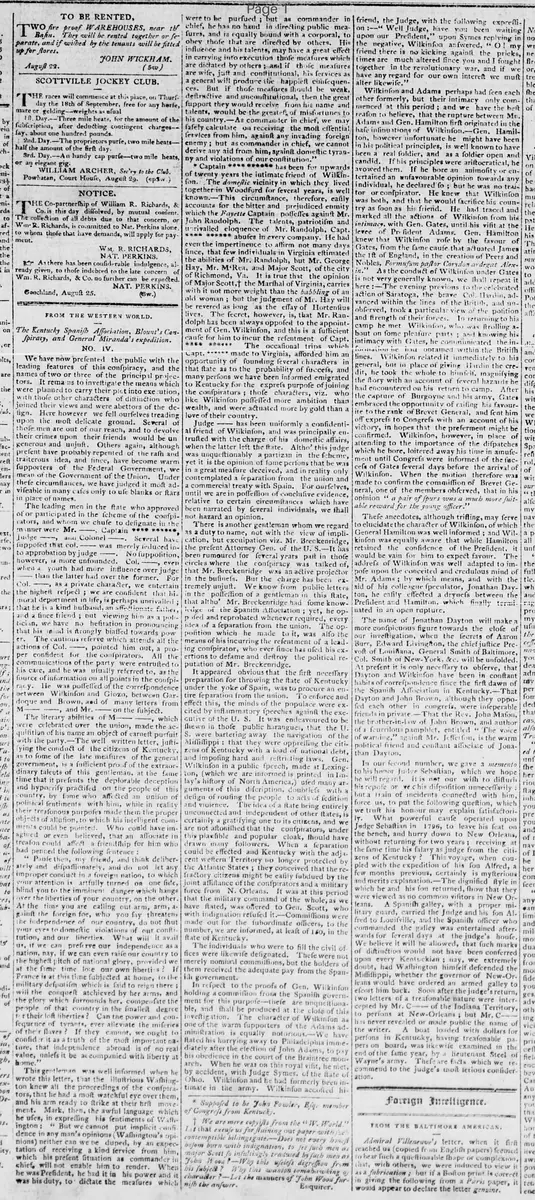
The Kentucky Spanish Association, Blount's Conspiracy, and General Miranda's expedition.
NO. IV.
We have now presented the public with the leading features of this conspiracy, and the names of two or three of the principal projectors. It remains to investigate the means which were planned to carry their plot into execution, with those other characters of distinction who joined their views and were abettors of the design. Here however we feel ourselves treading upon the most delicate ground. Several of those men are out of our reach, and to devolve their crimes upon their friends would be ungenerous and unjust. Others again, although present have probably repented of the rash and traitorous idea, and since, have become warm supporters of the Federal Government, we mean of the Government of the Union. Under these circumstances, we have judged it most advisable in many cases only to use blanks or stars in place of names.
The leading men in the state who approved of or participated in the scheme of the conspirators, and whom we choose to designate in the manner were Mr. ---. Captain **** ****** Judge -.-, and Col. -.-.
Several have supposed that col.---- was merely seduced into approbation by judge --. No supposition, however, is more unfounded. Col. -.-, even when a youth had more influence over judge than the latter had over the former. For Col. --, as a private character, we entertain the highest respect; we are confident that his moral deportment in life, is perhaps unrivalled ; that he is a kind husband, an affectionate father, and a sincere friend; but viewing him as a politician, we have no hesitation in pronouncing that his mind is strongly biassed towards power. The cautious reserve which attends all the actions of Col. -a-, pointed him out, a proper confident for the conspirators. All the communications of the party were entrusted to his care, and he was usually referred to, as the source of information on all points in the conspiracy. He was possessed of the correspondence between Wilkinson and Gizot, between Gardoqui and Brown, and of many letters from M , and Mr. ---- on the subject.
The literary abilities of M--- - , which were celebrated over the union, made the acquisition of his name an object of earnest pursuit with the party.--The well written letter, justifying the conduct of the citizens of Kentucky, as to some of the late measures of the general government, is a sufficient proof of the extraordinary talents of this gentleman, at the same time that it presents the deplorable deception and hypocrisy practised on the people of this country, by some who affected an union of political sentiments with him, while in reality their treasonous purposes made them the proper objects of allusion, to which his intelligent comments could be pointed. Who could have imagined or even believed, that an associate in treason could affect a friendship for him who had penned the following sentence :
" Pause then, my friend, and think deliberately and dispassionately, and do not let any improper conduct in a foreign nation, to which your attention is artfully turned on one side, blind you to the imminent danger which hangs over the liberties of your country, on the other. At the time you are calling out arm, arm, against the foreign foe, who you say threatens the independence of our country, do not Shut your eyes to domestic violations of our constitution, and our liberties. What will it avail us, if we can preserve our independence as a nation, nay, if we can even raise our country to the highest pitch of national glory, provided we at the same time lose our own liberties? If France is at this time subjected at home, to the military despotism which is said to reign there ; will the conquest achieved by her arms, and the glory which surrounds her, compensate the people of that country in the smallest degree for their lost liberties? Can the power and consequence of tyrants, ever alleviate the miseries of their slaves? If they cannot, we ought to consider it as a truth of the most important nature, that independence abroad is of no real value, unless it be accompanied with liberty at home."
This gentleman was well informed when he wrote this letter, that the illustrious Washington knew all the proceedings of the conspirators, that he had a most watchful eye over them, and his arm ready to strike at their first movement. Mark, then, the awful language which he uses, in expressing his sentiments of Washington: "But we cannot put implicit confidence in any man's opinions (Washington's opinions) neither can we be duped, by an expectation of receiving a kind service from him, which his present situation as commander in chief. will not enable him to render. When he was President, he had it in his power and it was his duty, to dictate the measures which were to be pursued : but as commander in chief, he has no hand in directing public measures, and is equally bound with a corporal, to obey those that are directed by others. His influence and his talents, may have a great effect in carrying into execution those measures which are dictated by others ; and if those measures are wise, just and constitutional, his services as a general will produce the happiest consequences. But if those measures should be weak, destructive and unconstitutional, then the great support they would receive from his name and talents, would be the greatest, of misfortunes to his country.-As commander in chief, we may safely calculate on receiving the most essential services from him, against any invading foreign enemy : but as commander in chief, we cannot derive any aid from him, against domestic tyranny and violations of our constitution."
* Captain **** ****** has been for upwards of twenty years the intimate friend of Wilkinson..The domestic vicinity in which they lived together in Woodford for several years, is well known.--This circumstance, therefore, easily accounts for the bitter and prejudiced enmity which the Fayette Captain possesses against Mr. John Randolph. The talents, patriotism and unrivalled eloquence of Mr. Randolph, Capt. **** ****** abuses in every company. He had even the impertinence to affirm not many days since, that few individuals in Virginia estimated the abilities of Mr. Randolph, but Mr. George Hay, Mr. M'Rea, and Major Scott, of the city of Richmond, Va. It is true that the opinion of Major Scott, the Marshal of Virginia, carries with it not more weight than the babbling of an old woman ; but the judgment of Mr. Hay will be revered as long as the essay of Hortensius lives. The secret, however, is, that Mr. Randolph has been always opposed to the appointment of Gen. Wilkinson, and this is a sufficient cause for him to incur the resentment of Capt.
The occasional trips which Capt. made to Virginia, afforded him an opportunity of sounding several characters in that state as to the probability of success, and many persons we have been informed emigrated to Kentucky for the express purpose of joining the conspirators; those characters, viz. who like Wilkinson possessed more ambition than wealth, and were actuated more by gold than a love of their country.
Judge - has been uniformly a confidential friend of Wilkinson, and was principally entrusted with the charge of his domestic affairs, when the latter left the state. Altho' this judge was unquestionably a partizan in the scheme, yet it is the opinion of some persons that he was in a great measure deceived, and in reality only contemplated a separation from the union and a commercial treaty with Spain. For ourselves, until we are in possession of conclusive evidence, relative to certain circumstances which have been narrated by several individuals, we shall not hazard an opinion.
There is another gentleman whom we regard as a duty to name, not with the view of implication, but exculpation viz. Mr. Breckenridge, the present Attorney Gen. of the U. S.--It has been rumoured for several years past in those circles where the conspiracy was talked of, that Mr. Breckenridge was an active projector in the business. But the charge has been extremely unjust. We know from public letters in the possession of a gentleman in this state, that altho' Mr. Breckenridge had some knowledge of the Spanish Association ; yet, he opposed and reprobated whenever required, every idea of a separation from the union. The opposition which he made to it, was also the means of his incurring the resentment of a leading conspirator, who ever since has used his exertions to defame and destroy the political reputation of Mr. Breckenridge.
It appeared obvious that the first necessary preparation for throwing the state of Kentucky under the yoke of Spain, was to procure an entire separation from the union. To enforce and effect this, the minds of the populace were excited by inflammatory speeches against the executive of the U. S. It was endeavoured to be shewn in those public harangues, that the U. S. were bartering away the navigation of the Mississippi : that they were oppressing the citizens of Kentucky with a load of national debt, and imposing hard and restricting laws. Gen. Wilkinson in a public speech, made at Lexington, (which we are informed is printed in Im lay's history of North America,) used many arguments of this description, doubtless with a design of rousing the people to acts of sedition and violence. The idea of a state being entirely unconnected and independent of other States, is certainly a gratifying one to its citizens, and we are not astonished that the conspirators, under this plausible and popular cloak, should have drawn many followers. When a separation could be effected and Kentucky with the adjacent western Territory no longer protected by the Atlantic States ; they conceived that the refractory citizens might be easily subdued by the joint assistance of the conspirators and a military force from N. Orleans. It was at this period that the military command of the whole, as we have stated, was offered to Gen. Scott, who with indignation refused it.--Commissions were made out for the subordinate officers, to the number, we are informed, at least of 150, in the state of Kentucky.
The individuals who were to fill the civil offices were likewise designated. These were not merely nominal commissions, but the holders of them received the adequate pay from the Spanish government.
In respect to the proofs of Gen. Wilkinson holding a commission from the Spanish government for this purpose-these are unquestionable, and shall be produced at the close of this investigation. The character of Wilkinson as one of the warm supporters of the Adams administration is equally notorious.-We have stated his hurrying away to Philadelphia immediately after the election of John Adams, to pay his obedience in the court of the Braintree monarch. When he was on this royal visit, he met, by accident, with Judge Symmes, of the state of Ohio. Wilkinson and he had formerly been intimate in the army. Wilkinson accosted him friend, the Judge, with the following expression :--" Well Judge, have you been waiting upon our President,"upon Symes replying in the negative, Wilkinson answered, "O! my friend there is no kicking against the pricks, times are much altered since you and I fought together in the revolutionary war, and if we have any regard for our own interest we must alter likewise."
Wilkinson and Adams perhaps had seen each other formerly, but their intimacy only commenced at this period: and we have the best reason to believe, that the rupture between Mr. Adams and Gen. Hamilton first originated in the base insinuations of Wilkinson.--Gen. Hamilton, however unfortunate he might have been in his political principles, is well known to have been a real soldier, and as a soldier open and candid. If his principles were aristocratical, he avowed them. If he bore an animosity or entertained an unfavourable opinion towards any individual, he declared it ; but he was no traitor or conspirator. He knew that Wilkinson was both, and that he would sacrifice his country as soon as his friend. He had traced and marked all the actions of Wilkinson from his intimacy. with Gen. Gates, until his visit at the levee of President Adams. Gen. Hamilton knew that Wilkinson rose by the favour of Gates, from the same cause that actuated James the I st of England, in the creation of Peers and Nobles, Formosum pastor Corydon ardebat Alex-
in."
As the conduct of Wilkinson under Gates is not very generally known, we shall repeat it here :-The evening previous to the celebrated action of Saratoga, the brave Col. Hardin. advanced within the lines of the British. and unobserved, took a particular view of the position and strength of their forces. In returning to his camp he met Wilkinson, who was strolling about on some pleasure party : and knowing his intimacy with Gates, he communicated the information he had obtained within the British lines. Wilkinson related it immediately to his general, but in place of giving Hardin the credit, he took the whole to himself, magnifying the story with an account of several hazards he had encountered on his return to camp.
After the capture of Burgoyne and his army, Gates embraced the opportunity of raising his favourite to the rank of Brevet General, and sent him off express to Congress with an account of his victory, in hopes that the preferment might be confirmed. Wilkinson, however, in place of attending to the importance of the dispatches which he bore, loitered away his time in amusement until Congress were informed of the success of Gates several days before the arrival of Wilkinson. When the motion therefore was made to confirm the commission of Brevet General, one of the members observed, that in his opinion "a pair of spurs was a much more suitable reward for the young officer?"
These anecdotes, although trifling, may serve to elucidate the character of Wilkinson, of which General Hamilton was well informed; and Wilkinson was equally aware that while Hamilton retained the confidence of the President, it would be vain for him to expect favour. The address of Wilkinson was well adapted to impose upon the conceited and credulous mind of Mr. Adams; by which means, and with the aid of his colleague peculator, Jonathan Dayton, he easily effected a dryness between the President and Hamilton. which finally terminated in an open rupture.
The name of Jonathan Dayton will make a more conspicuous figure towards the close of our investigation, when the secrets of Aaron Burr, Edward Livingston, the chief justice Provost of Louisiana, General Smith of Baltimore, Col. Smith of New-York, &c. will be unfolded.
At present it is only necessary to observe, that Dayton and Wilkinson have been in constant habits of correspondence since the first dawn of the Spanish Association in Kentucky.--That Dayton and John Brown, although they opposed each other in congress, were inseparable friends in private.-That the Rev. John Mason, the brother-in-law of John Brown, and author of a scurrilous pamphlet, entitled " The voice of warning," against Mr. Jefferson, is the warm political friend and constant associate of Jonathan Dayton.
In our second number, we gave a memento to his honor Judge Sebastian, which we hope he will regard. It is not our wish to disturb his repose or vex his disposition unnecessarily : but a train of incidents connected with him, force us, to put the following question, which we trust his honor may explain satisfactorily ? What powerful cause operated upon Judge Sebastian in 1796, to leave his seat on the bench, and hurry down to New Orleans, without returning for two years; receiving at the same time his salary as judge from the citizens of Kentucky ? This voyage, when coupled with the expedition of his son Alfred, a few months previous, Certainly is mysterious and merits explanation.-The dignified style in which he and his son returned, show that they were viewed as no common visitors in New Orleans. A Spanish galley, with a proper military guard, carried the Judge and his son Alfred to Louisville, and the Spanish officer who commanded the galley was entertained afterwards for several days at the judge's house.
We believe it will be allowed, that such marks of distinction would not have been conferred upon every Kentuckian; nay, we extremely doubt, had Washington himself descended the Mississippi, whether the governor of New-Orleans would have ordered an armed galley to escort him back. Soon after the judge's return, two letters of a treasonable nature were intercepted by Mr. C--- of the Indiana Territory, to persons at New-Orleans; but Mr. C--- has never revealed or made public the name of the writer. A boat loaded with dollars for persons in Kentucky, having treasonable pa. pers on board, was likewise examined in the end of the same year, by a lieutenant Steel of Wayne's army. These are facts which we recommend to the judge's most serious consideration.
What sub-type of article is it?
What keywords are associated?
What entities or persons were involved?
Where did it happen?
Domestic News Details
Primary Location
Kentucky
Event Date
1796
Key Persons
Outcome
conspiracy exposed through public writings; no direct casualties mentioned; some participants repented and supported the union; wilkinson held spanish commission and received pay.
Event Details
Series of articles exposes the Kentucky Spanish Association conspiracy to separate Kentucky from the U.S. Union and ally with Spain, involving inflammatory speeches, commissions from Spain, and key figures like Wilkinson who held a Spanish commission and influenced politics.