Thank you for visiting SNEWPapers!
Sign up free
The Cheyenne Daily Leader
Cheyenne, Laramie County, Wyoming
What is this article about?
Detailed comparison of Scottish and English jury systems in criminal and civil trials, praising Scottish procedures for precision, majority verdicts, and efficiency over English unanimous requirements.
Clipping
OCR Quality
Full Text
Albany Law Journal
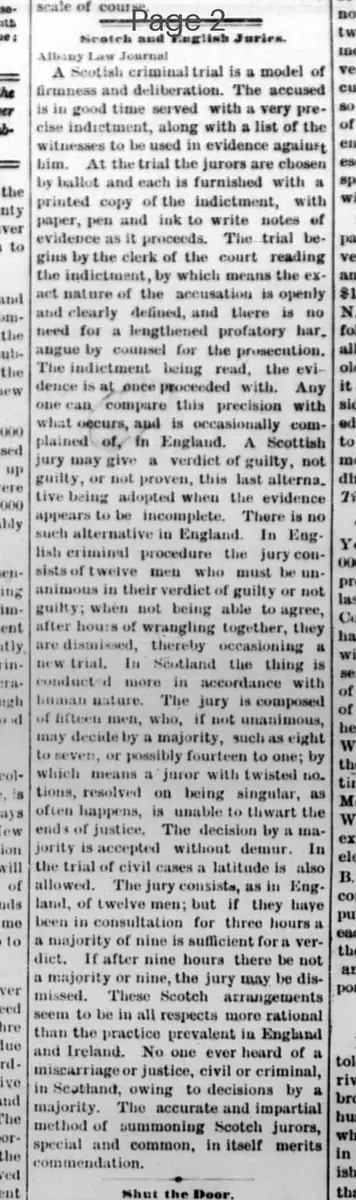
A Scottish criminal trial is a model of firmness and deliberation. The accused is in good time served with a very precise indictment, along with a list of the witnesses to be used in evidence against him. At the trial the jurors are chosen by ballot and each is furnished with a printed copy of the indictment, with paper, pen and ink to write notes of evidence as it proceeds. The trial begins by the clerk of the court reading the indictment, by which means the exact nature of the accusation is openly and clearly defined, and there is no need for a lengthened prefatory harangue by counsel for the prosecution. The indictment being read, the evidence is at once proceeded with. Any one can compare this precision with what occurs, and is occasionally complained of. In England. A Scottish jury may give a verdict of guilty, not guilty, or not proven, this last alternative being adopted when the evidence appears to be incomplete. There is no such alternative in England. In English criminal procedure the jury consists of twelve men who must be unanimous in their verdict of guilty or not guilty; when not being able to agree, after hours of wrangling together, they are dismissed, thereby occasioning a new trial. In Scotland the thing is conducted more in accordance with human nature. The jury is composed of fifteen men, who, if not unanimous, may decide by a majority, such as eight to seven, or possibly fourteen to one; by which means a juror with twisted notions, resolved on being singular, as often happens, is unable to thwart the ends of justice. The decision by a majority is accepted without demur. In the trial of civil cases a latitude is also allowed. The jury consists, as in England, of twelve men; but if they have been in consultation for three hours a majority of nine is sufficient for a verdict. If after nine hours there be not a majority of nine, the jury may be dismissed. These Scotch arrangements seem to be in all respects more rational than the practice prevalent in England and Ireland. No one ever heard of a miscarriage of justice, civil or criminal, in Scotland, owing to decisions by a majority. The accurate and impartial method of summoning Scotch jurors, special and common, in itself merits commendation.
What sub-type of article is it?
What keywords are associated?
Where did it happen?
Foreign News Details
Primary Location
Scotland
Event Details
Description of Scottish criminal trial procedures including precise indictment, ballot jury selection, note-taking, direct evidence presentation, verdicts of guilty, not guilty, or not proven, and majority decisions by 15 jurors. Comparison to English unanimous 12-juror system causing delays. Civil trials allow majority verdicts after consultation periods. Praises Scottish system as more rational and effective than English and Irish practices.