Thank you for visiting SNEWPapers!
Sign up free
Literary
March 13, 1841
The Polynesian (Honolulu
Honolulu, Honolulu County, Hawaii
What is this article about?
Satirical essay mockingly dissects the nursery rhyme 'Jack and Gill' as an epic poem, praising its simplicity, utility of fetching water over heroic violence, and moral on the instability of life, contrasting with classical epics like the Iliad.
Clipping
OCR Quality
98%
Excellent
Full Text
SELECTED.
Continued from page 154.
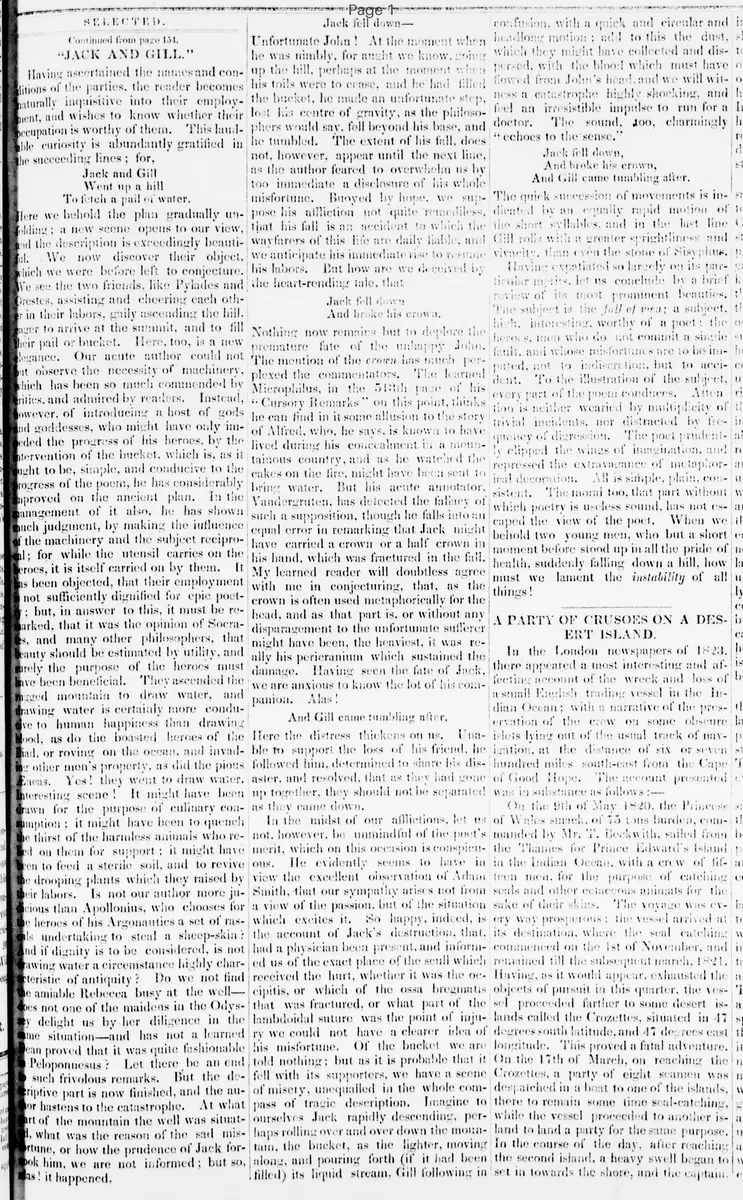
"JACK AND GILL."
Having ascertained the names and conditions of the parties, the reader becomes naturally inquisitive into their employment, and wishes to know whether their occupation is worthy of them. This laudable curiosity is abundantly gratified in the succeeding lines: for,
Jack and Gill
Went up a hill
To fetch a pail of water.
Here we behold the plan gradually unfolding; a new scene opens to our view, and the description is exceedingly beautiful. We now discover their object, which we were before left to conjecture. We see the two friends, like Pylades and Orestes, assisting and cheering each other in their labors, gaily ascending the hill, eager to arrive at the summit, and to fill their pail or bucket. Here, too, is a new elegance. Our acute author could not but observe the necessity of machinery, which has been so much commended by critics, and admired by readers. Instead, however, of introducing a host of gods and goddesses, who might have only impeded the progress of his heroes, by the intervention of the bucket, which is, as it ought to be, simple, and conducive to the progress of the poem, he has considerably improved on the ancient plan. In the management of it also, he has shown much judgment, by making the influence of the machinery and the subject reciprocal: for while the utensil carries on the heroes, it is itself carried on by them. It has been objected, that their employment is not sufficiently dignified for epic poetry: but, in answer to this, it must be remarked, that it was the opinion of Socrates, and many other philosophers, that beauty should be estimated by utility, and surely the purpose of the heroes must have been beneficial. They ascended the rugged mountain to draw water, and drawing water is certainly more conducive to human happiness than drawing blood, as do the boasted heroes of the Iliad, or roving on the ocean, and invading other men's property, as did the pious Aeneas. Yes! they went to draw water. Interesting scene! It might have been drawn for the purpose of culinary consumption: it might have been to quench the thirst of the harmless animals who relied on them for support: it might have been to feed a sterile soil, and to revive the drooping plants which they raised by their labors. Is not our author more judicious than Apollonius, who chooses for the heroes of his Argonautics a set of rascals undertaking to steal a sheep-skin? And if dignity is to be considered, is not drawing water a circumstance highly characteristic of antiquity? Do we not find the amiable Rebecca busy at the well? Does not one of the maidens in the Odyssey delight us by her diligence in the same situation—and has not a learned dean proved that it was quite fashionable in the Peloponnesus? Let there be an end to such frivolous remarks. But the descriptive part is now finished, and the author hastens to the catastrophe. At what part of the mountain the well was situated, what was the reason of the sad misfortune, or how the prudence of Jack forsook him, we are not informed; but so, alas! it happened,
Jack fell down—
Unfortunate John! At the moment when he was nimbly, for aught we know, spring up the hill, perhaps at the moment when his toils were to cease, and he had filled the bucket, he made an unfortunate step, lost his centre of gravity, as the philosophers would say, fell beyond his base, and be tumbled. The extent of his fall, does not, however, appear until the next line, as the author feared to overwhelm us by too immediate a disclosure of his whole misfortune. Buoyed by hope, we suppose his affliction not quite remediless, that his fall is an accident to which the wayfarers of this life are daily liable, and we anticipate his immediate rise to resume his labors. But how are we deceived by the heart-rending tale, that
Jack fell down
And broke his crown.
Nothing now remains but to deplore the premature fate of the unhappy John. The mention of the crown has much perplexed the commentators. The learned Microphilus, in the 58th page of his "Cursory Remarks" on this point, thinks he can find in it some allusion to the story of Alfred, who, he says, is known to have lived during his concealment in a mountainous country, and as he watched the cakes on the fire, might have been sent to bring water. But his acute annotator, Vandergruten, has detected the fallacy of such a supposition, though he falls into an equal error in remarking that Jack might have carried a crown or a half crown in his hand, which was fractured in the fall. My learned reader will doubtless agree with me in conjecturing, that, as the crown is often used metaphorically for the head, and as that part is, or without any disparagement to the unfortunate sufferer might have been, the heaviest, it was really his pericranium which sustained the damage. Having seen the fate of Jack, we are anxious to know the lot of his companion. Alas!
And Gill came tumbling after.
Here the distress thickens on us. Unable to support the loss of his friend, he followed him, determined to share his disaster, and resolved, that as they had gone up together, they should not be separated as they came down. In the midst of our afflictions, let us not, however, be unmindful of the poet's merit, which on this occasion is conspicuous. He evidently seems to have in view the excellent observation of Adam Smith, that our sympathy arises not from a view of the passion, but of the situation which excites it. So happy, indeed, is the account of Jack's destruction, that, had a physician been present, and informed us of the exact place of the skull which received the hurt, whether it was the occiput, or which of the ossa parietalis that was fractured, or what part of the lambdoidal suture was the point of injury, we could not have a clearer idea of his misfortune. Of the bucket we are told nothing: but as it is probable that it fell with its supporters, we have a scene of misery, unequalled in the whole compass of tragic description. Imagine to ourselves Jack rapidly descending, perhaps rolling over and over down the mountain, the bucket, as the lighter, moving along, and pouring forth (if it had been filled) its liquid stream, Gill following in confusion, with a quick and circular and headlong motion: add to this the dust, which they might have collected and dispersed, with the blood which must have flowed from John's head, and we will witness a catastrophe highly shocking, and feel an irresistible impulse to run for a doctor. The sound, too, charmingly "echoes to the sense."
Jack fell down,
And broke his crown.
And Gill came tumbling after.
The quick succession of movements is indicated by an equally rapid motion of the short syllables, and in the last line Gill rolls with a greater sprightliness and vivacity than even the stone of Sisyphus. Having expatiated so largely on its parts, let us conclude by a brief review of its most prominent beauties. The subject is the fall of man; a subject, high, interesting, worthy of a poet: the heroes, men who do not commit a single fault, and whose misfortunes are to be pitied, not to indiscretion, but to accident. To the illustration of the subject, every part of the poem conduces. Attention is neither wearied by multiplicity of trivial incidents, nor distracted by frequency of digression. The poet prudently clipped the wings of imagination, and repressed the extravagance of metaphorical decoration. All is simple, plain, consistent. The moral too, that part without which poetry is useless sound, has not escaped the view of the poet. When we behold two young men, who but a short moment before stood up in all the pride of health, suddenly falling down a hill, how must we lament the instability of all things!
Continued from page 154.
"JACK AND GILL."
Having ascertained the names and conditions of the parties, the reader becomes naturally inquisitive into their employment, and wishes to know whether their occupation is worthy of them. This laudable curiosity is abundantly gratified in the succeeding lines: for,
Jack and Gill
Went up a hill
To fetch a pail of water.
Here we behold the plan gradually unfolding; a new scene opens to our view, and the description is exceedingly beautiful. We now discover their object, which we were before left to conjecture. We see the two friends, like Pylades and Orestes, assisting and cheering each other in their labors, gaily ascending the hill, eager to arrive at the summit, and to fill their pail or bucket. Here, too, is a new elegance. Our acute author could not but observe the necessity of machinery, which has been so much commended by critics, and admired by readers. Instead, however, of introducing a host of gods and goddesses, who might have only impeded the progress of his heroes, by the intervention of the bucket, which is, as it ought to be, simple, and conducive to the progress of the poem, he has considerably improved on the ancient plan. In the management of it also, he has shown much judgment, by making the influence of the machinery and the subject reciprocal: for while the utensil carries on the heroes, it is itself carried on by them. It has been objected, that their employment is not sufficiently dignified for epic poetry: but, in answer to this, it must be remarked, that it was the opinion of Socrates, and many other philosophers, that beauty should be estimated by utility, and surely the purpose of the heroes must have been beneficial. They ascended the rugged mountain to draw water, and drawing water is certainly more conducive to human happiness than drawing blood, as do the boasted heroes of the Iliad, or roving on the ocean, and invading other men's property, as did the pious Aeneas. Yes! they went to draw water. Interesting scene! It might have been drawn for the purpose of culinary consumption: it might have been to quench the thirst of the harmless animals who relied on them for support: it might have been to feed a sterile soil, and to revive the drooping plants which they raised by their labors. Is not our author more judicious than Apollonius, who chooses for the heroes of his Argonautics a set of rascals undertaking to steal a sheep-skin? And if dignity is to be considered, is not drawing water a circumstance highly characteristic of antiquity? Do we not find the amiable Rebecca busy at the well? Does not one of the maidens in the Odyssey delight us by her diligence in the same situation—and has not a learned dean proved that it was quite fashionable in the Peloponnesus? Let there be an end to such frivolous remarks. But the descriptive part is now finished, and the author hastens to the catastrophe. At what part of the mountain the well was situated, what was the reason of the sad misfortune, or how the prudence of Jack forsook him, we are not informed; but so, alas! it happened,
Jack fell down—
Unfortunate John! At the moment when he was nimbly, for aught we know, spring up the hill, perhaps at the moment when his toils were to cease, and he had filled the bucket, he made an unfortunate step, lost his centre of gravity, as the philosophers would say, fell beyond his base, and be tumbled. The extent of his fall, does not, however, appear until the next line, as the author feared to overwhelm us by too immediate a disclosure of his whole misfortune. Buoyed by hope, we suppose his affliction not quite remediless, that his fall is an accident to which the wayfarers of this life are daily liable, and we anticipate his immediate rise to resume his labors. But how are we deceived by the heart-rending tale, that
Jack fell down
And broke his crown.
Nothing now remains but to deplore the premature fate of the unhappy John. The mention of the crown has much perplexed the commentators. The learned Microphilus, in the 58th page of his "Cursory Remarks" on this point, thinks he can find in it some allusion to the story of Alfred, who, he says, is known to have lived during his concealment in a mountainous country, and as he watched the cakes on the fire, might have been sent to bring water. But his acute annotator, Vandergruten, has detected the fallacy of such a supposition, though he falls into an equal error in remarking that Jack might have carried a crown or a half crown in his hand, which was fractured in the fall. My learned reader will doubtless agree with me in conjecturing, that, as the crown is often used metaphorically for the head, and as that part is, or without any disparagement to the unfortunate sufferer might have been, the heaviest, it was really his pericranium which sustained the damage. Having seen the fate of Jack, we are anxious to know the lot of his companion. Alas!
And Gill came tumbling after.
Here the distress thickens on us. Unable to support the loss of his friend, he followed him, determined to share his disaster, and resolved, that as they had gone up together, they should not be separated as they came down. In the midst of our afflictions, let us not, however, be unmindful of the poet's merit, which on this occasion is conspicuous. He evidently seems to have in view the excellent observation of Adam Smith, that our sympathy arises not from a view of the passion, but of the situation which excites it. So happy, indeed, is the account of Jack's destruction, that, had a physician been present, and informed us of the exact place of the skull which received the hurt, whether it was the occiput, or which of the ossa parietalis that was fractured, or what part of the lambdoidal suture was the point of injury, we could not have a clearer idea of his misfortune. Of the bucket we are told nothing: but as it is probable that it fell with its supporters, we have a scene of misery, unequalled in the whole compass of tragic description. Imagine to ourselves Jack rapidly descending, perhaps rolling over and over down the mountain, the bucket, as the lighter, moving along, and pouring forth (if it had been filled) its liquid stream, Gill following in confusion, with a quick and circular and headlong motion: add to this the dust, which they might have collected and dispersed, with the blood which must have flowed from John's head, and we will witness a catastrophe highly shocking, and feel an irresistible impulse to run for a doctor. The sound, too, charmingly "echoes to the sense."
Jack fell down,
And broke his crown.
And Gill came tumbling after.
The quick succession of movements is indicated by an equally rapid motion of the short syllables, and in the last line Gill rolls with a greater sprightliness and vivacity than even the stone of Sisyphus. Having expatiated so largely on its parts, let us conclude by a brief review of its most prominent beauties. The subject is the fall of man; a subject, high, interesting, worthy of a poet: the heroes, men who do not commit a single fault, and whose misfortunes are to be pitied, not to indiscretion, but to accident. To the illustration of the subject, every part of the poem conduces. Attention is neither wearied by multiplicity of trivial incidents, nor distracted by frequency of digression. The poet prudently clipped the wings of imagination, and repressed the extravagance of metaphorical decoration. All is simple, plain, consistent. The moral too, that part without which poetry is useless sound, has not escaped the view of the poet. When we behold two young men, who but a short moment before stood up in all the pride of health, suddenly falling down a hill, how must we lament the instability of all things!
What sub-type of article is it?
Satire
Essay
What themes does it cover?
Moral Virtue
Death Mortality
What keywords are associated?
Nursery Rhyme
Satire
Literary Criticism
Jack And Gill
Fall Of Man
Instability
Epic Parody
Literary Details
Title
Jack And Gill.
Subject
Satirical Analysis Of The Nursery Rhyme
Form / Style
Satirical Prose Essay
Key Lines
Jack And Gill
Went Up A Hill
To Fetch A Pail Of Water.
Jack Fell Down
And Broke His Crown.
And Gill Came Tumbling After.