Thank you for visiting SNEWPapers!
Sign up free
Editorial
August 15, 1792
Gazette Of The United States
New York, New York County, New York
What is this article about?
An editorial urging honest exercise of suffrage, critiquing partisan opposition as hostile to the US Constitution and government, portraying them as self-interested hypocrites fulfilling British predictions of American failure, while praising the nation's prosperous union.
Clipping
OCR Quality
97%
Excellent
Full Text
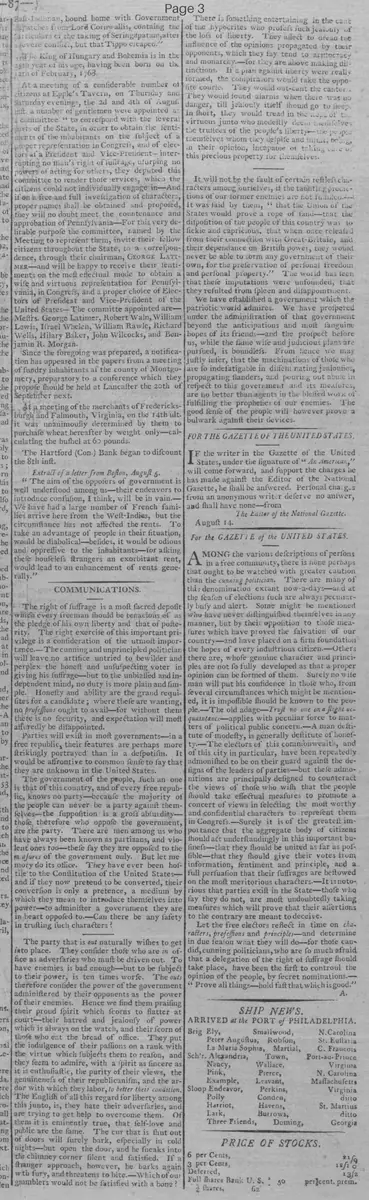
The right of suffrage is a most sacred deposit which every freeman should be tenacious of as the pledge of his own liberty and that of posterity. The right exercise of this important privilege is a consideration of the utmost importance.—The cunning and unprincipled politician will leave no artifice untried to bewilder and perplex the honest and unsuspecting voter in giving his suffrage—but to the unbiased and independent mind, no duty is more plain and simple. Honesty and ability are the grand requisites for a candidate; where these are wanting, no professions ought to avail—for without them there is no security, and expectation will most assuredly be disappointed.
Parties will exist in most governments—in a free republic, their features are perhaps more strikingly portrayed than in a despotism. It would be affrontive to common sense to say that they are unknown in the United States.
The government of the people, such as one is that of this country, and of every free republic, knows no party—because the majority of the people can never be a party against themselves—the supposition is a gross absurdity—those therefore who oppose the government, are the party. There are men among us who have always been known as partizans, and violent ones too—these say they are opposed to the measures of the government only. But let memory do its office. They have ever been hostile to the Constitution of the United States—and if they now pretend to be converted, their conversion is only a pretence, a medium by which they mean to introduce themselves into power—to administer a government they are in heart opposed to.—Can there be any safety in trusting such characters?
The party that is out naturally wishes to get into place. They consider those who are in office as adversaries who must be driven out. To have enemies is bad enough—but to be subject to their power, is ten times worse. The outs therefore consider the power of the government administered by their opponents as the power of their enemies. Hence we find them praising their proud spirit which scorns to flatter at court—their hatred and jealousy of power which is always on the watch, and their scorn of those who eat the bread of office. They put the indulgence of their passions on a rank with the virtue which subjects them to reason, and they seem to admire, with a spirit as sincere as it is enthusiastic, the purity of their views, the genuineness of their republicanism, and the ardor with which they labor, to better their condition.
The English of all this regard for liberty among this junto, is, they hate their adversaries, and are trying to get help to overcome them. Of them it is eminently true, that self-love and public are the same. The cur that is shut out of doors will surely bark, especially in cold nights—but open the door, and he sneaks into the chimney corner silent and satisfied. If a stranger approach, however, he barks again with fury, and threatens to bite.—Which of our grumblers would not be satisfied with a bone?
There is something entertaining in the cant of the hypocrites who profess such jealousy of the loss of liberty. They affect to dread the influence of the opinions propagated by their opponents, which they say tend to aristocracy and monarchy.—for they are above making distinctions. If a plan against liberty were really formed, the conspirators would take the opposite course. They would out-cant the canter. They would sound alarms when there was no danger, till jealousy itself should go to sleep. In short, they would tread in the steps of that virtuous junto who modestly deem themselves the trustees of the people's liberty—the people themselves whom they despise and insult, being in their opinion, incapable of taking care of this precious property for themselves.
It will not be the fault of certain restless characters among ourselves, if the taunting predictions of our former enemies are not fully verified.—It was said by them, "that the Union of the States would prove a rope of sand—that the disposition of the people of this country was so fickle and capricious, that when once released from their connection with Great-Britain, and their dependance on British power, they would never be able to form any government of their own, for the preservation of personal freedom and personal property." The world has seen that these imputations were unfounded, that they resulted from spleen and disappointment. We have established a government which the patriotic world admires. We have prospered under the administration of that government beyond the anticipations and most sanguine hopes of its friends—and the prospect before us, while the same wise and judicious plans are pursued, is boundless. From hence we may justly infer, that the machinations of those who are so indefatigable in disseminating jealousies, propagating slanders, and pouring out abuse in respect to this government and its measures, are no better than agents in the blessed work of fulfilling the prophecies of our enemies. The good sense of the people will however prove a bulwark against their devices.
Parties will exist in most governments—in a free republic, their features are perhaps more strikingly portrayed than in a despotism. It would be affrontive to common sense to say that they are unknown in the United States.
The government of the people, such as one is that of this country, and of every free republic, knows no party—because the majority of the people can never be a party against themselves—the supposition is a gross absurdity—those therefore who oppose the government, are the party. There are men among us who have always been known as partizans, and violent ones too—these say they are opposed to the measures of the government only. But let memory do its office. They have ever been hostile to the Constitution of the United States—and if they now pretend to be converted, their conversion is only a pretence, a medium by which they mean to introduce themselves into power—to administer a government they are in heart opposed to.—Can there be any safety in trusting such characters?
The party that is out naturally wishes to get into place. They consider those who are in office as adversaries who must be driven out. To have enemies is bad enough—but to be subject to their power, is ten times worse. The outs therefore consider the power of the government administered by their opponents as the power of their enemies. Hence we find them praising their proud spirit which scorns to flatter at court—their hatred and jealousy of power which is always on the watch, and their scorn of those who eat the bread of office. They put the indulgence of their passions on a rank with the virtue which subjects them to reason, and they seem to admire, with a spirit as sincere as it is enthusiastic, the purity of their views, the genuineness of their republicanism, and the ardor with which they labor, to better their condition.
The English of all this regard for liberty among this junto, is, they hate their adversaries, and are trying to get help to overcome them. Of them it is eminently true, that self-love and public are the same. The cur that is shut out of doors will surely bark, especially in cold nights—but open the door, and he sneaks into the chimney corner silent and satisfied. If a stranger approach, however, he barks again with fury, and threatens to bite.—Which of our grumblers would not be satisfied with a bone?
There is something entertaining in the cant of the hypocrites who profess such jealousy of the loss of liberty. They affect to dread the influence of the opinions propagated by their opponents, which they say tend to aristocracy and monarchy.—for they are above making distinctions. If a plan against liberty were really formed, the conspirators would take the opposite course. They would out-cant the canter. They would sound alarms when there was no danger, till jealousy itself should go to sleep. In short, they would tread in the steps of that virtuous junto who modestly deem themselves the trustees of the people's liberty—the people themselves whom they despise and insult, being in their opinion, incapable of taking care of this precious property for themselves.
It will not be the fault of certain restless characters among ourselves, if the taunting predictions of our former enemies are not fully verified.—It was said by them, "that the Union of the States would prove a rope of sand—that the disposition of the people of this country was so fickle and capricious, that when once released from their connection with Great-Britain, and their dependance on British power, they would never be able to form any government of their own, for the preservation of personal freedom and personal property." The world has seen that these imputations were unfounded, that they resulted from spleen and disappointment. We have established a government which the patriotic world admires. We have prospered under the administration of that government beyond the anticipations and most sanguine hopes of its friends—and the prospect before us, while the same wise and judicious plans are pursued, is boundless. From hence we may justly infer, that the machinations of those who are so indefatigable in disseminating jealousies, propagating slanders, and pouring out abuse in respect to this government and its measures, are no better than agents in the blessed work of fulfilling the prophecies of our enemies. The good sense of the people will however prove a bulwark against their devices.
What sub-type of article is it?
Partisan Politics
Suffrage
Constitutional
What keywords are associated?
Suffrage
Partisan Politics
Us Constitution
Government Opposition
Liberty
Republicanism
British Predictions
What entities or persons were involved?
Constitution Of The United States
Us Government
Partisans
Former Enemies
Great Britain
Editorial Details
Primary Topic
Defense Of Us Government Against Partisan Opposition
Stance / Tone
Strongly Pro Government And Anti Partisan Opposition
Key Figures
Constitution Of The United States
Us Government
Partisans
Former Enemies
Great Britain
Key Arguments
Honesty And Ability Are Essential For Candidates
Opposition To Government Equates To Hostility Toward The Constitution
Partisans Seek Power For Self Interest, Not Public Good
Opposition Hypocrisy In Claiming To Protect Liberty
Us Has Prospered Under Its Government, Disproving British Predictions
People's Good Sense Will Resist Partisan Machinations