Thank you for visiting SNEWPapers!
Sign up free
Literary
March 17, 1790
Gazette Of The United States
New York, New York County, New York
What is this article about?
An essay from The Tablet, No. XCVII, critiques deceit and cunning as temporary expedients that lead to disgrace, advocating sincerity and truth as the foundation for genuine respect and success in society.
Clipping
OCR Quality
98%
Excellent
Full Text
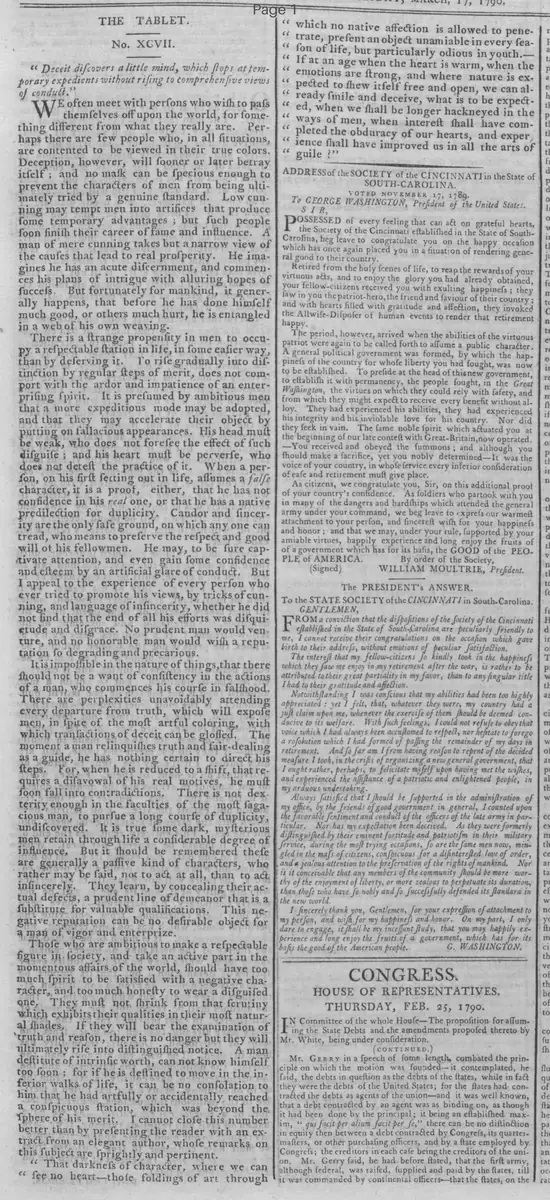
THE TABLET.
No. XCVII.
"The Deceit discovers a little mind, which stops at temporary expedients without rising to comprehensive views of conduct."
We often meet with persons who wish to pass for something different from what they really are. Perhaps there are few people who, in all situations, are contented to be viewed in their true colors. Deception, however, will sooner or later betray itself; and no mask can be precious enough to prevent the characters of men from being ultimately tried by a genuine standard. Low cunning may tempt men into artifices that produce some temporary advantages; but such people soon finish their career of fame and influence. A man of mere cunning takes but a narrow view of the causes that lead to real prosperity. He imagines he has an acute discernment, and commences his plans of intrigue with alluring hopes of success. But fortunately for mankind, it generally happens, that before he has done himself much good, or others much hurt, he is entangled in a web of his own weaving.
There is a strange propensity in men to occupy a respectable station in life, in some easier way, than by deserving it. To rise gradually into distinction by regular steps of merit, does not comport with the ardor and impatience of an enterprising spirit. It is presumed by ambitious men that a more expeditious mode may be adopted, and that they may accelerate their object by putting on fallacious appearances. His head must be weak, who does not foresee the effect of such disguise; and his heart must be perverse, who does not detest the practice of it. When a person, on his first setting out in life, assumes a false character, it is a proof, either, that he has not confidence in his real one, or that he has a native predilection for duplicity. Candor and sincerity are the only safe ground, on which any one can tread, who means to preserve the respect and good will of his fellowmen. He may, to be sure captivate attention, and even gain some confidence and esteem by an artificial glare of conduct. But I appeal to the experience of every person who ever tried to promote his views, by tricks of cunning, and language of insincerity, whether he did not find that the end of all his efforts was disquietude and disgrace. No prudent man would venture, and no honorable man would wish a reputation so degrading and precarious.
It is impossible in the nature of things, that there should not be a want of consistency in the actions of a man, who commences his course in falsehood. There are perplexities unavoidably attending every departure from truth, which will expose men, in spite of the most artful coloring, with which transactions of deceit can be glossed. The moment a man relinquishes truth and fair-dealing as a guide, he has nothing certain to direct his steps. For, when he is reduced to a shift, that requires a disavowal of his real motives, he must soon fall into contradictions. There is not dexterity enough in the faculties of the most sagacious man, to pursue a long course of duplicity, undiscovered. It is true some dark, mysterious men retain through life a considerable degree of influence, But it should be remembered these are generally a passive kind of characters, who rather may be said, not to act at all, than to act insincerely. They learn, by concealing their actual defects, a prudent line of demeanor that is a substitute for valuable qualifications. This negative reputation can be no desirable object for a man of vigor and enterprise.
Those who are ambitious to make a respectable figure in society, and take an active part in the momentous affairs of the world, should have too much spirit to be satisfied with a negative character, and too much honesty to wear a disguised one, They must not shrink from that scrutiny which exhibits their qualities in their most natural shades. If they will bear the examination of truth and reason, there is no danger but they will ultimately rise into distinguished notice. A man destitute of intrinsic worth, can not know himself too soon ; for if he is destined to move in the inferior walks of life, it can be no consolation to him that he had artfully or accidentally reached a conspicuous station, which was beyond the sphere of his merit. I cannot close this number better than by presenting the reader with an extract from an elegant author, whose remarks on this subject are sprightly and pertinent.
" That darkness of character, where we can see no heart—those foldings of art through which no native affection is allowed to penetrate, present an object unamiable in every season of life, but particularly odious in youth. If at an age when the heart is warm, when the emotions are strong, and where nature is expected to show itself free and open, we can already smile and deceive, what is to be expected, when we shall be longer hackneyed in the ways of men, when interest shall have completed the obduracy of our hearts, and experience shall have improved us in all the arts of guile ?"
No. XCVII.
"The Deceit discovers a little mind, which stops at temporary expedients without rising to comprehensive views of conduct."
We often meet with persons who wish to pass for something different from what they really are. Perhaps there are few people who, in all situations, are contented to be viewed in their true colors. Deception, however, will sooner or later betray itself; and no mask can be precious enough to prevent the characters of men from being ultimately tried by a genuine standard. Low cunning may tempt men into artifices that produce some temporary advantages; but such people soon finish their career of fame and influence. A man of mere cunning takes but a narrow view of the causes that lead to real prosperity. He imagines he has an acute discernment, and commences his plans of intrigue with alluring hopes of success. But fortunately for mankind, it generally happens, that before he has done himself much good, or others much hurt, he is entangled in a web of his own weaving.
There is a strange propensity in men to occupy a respectable station in life, in some easier way, than by deserving it. To rise gradually into distinction by regular steps of merit, does not comport with the ardor and impatience of an enterprising spirit. It is presumed by ambitious men that a more expeditious mode may be adopted, and that they may accelerate their object by putting on fallacious appearances. His head must be weak, who does not foresee the effect of such disguise; and his heart must be perverse, who does not detest the practice of it. When a person, on his first setting out in life, assumes a false character, it is a proof, either, that he has not confidence in his real one, or that he has a native predilection for duplicity. Candor and sincerity are the only safe ground, on which any one can tread, who means to preserve the respect and good will of his fellowmen. He may, to be sure captivate attention, and even gain some confidence and esteem by an artificial glare of conduct. But I appeal to the experience of every person who ever tried to promote his views, by tricks of cunning, and language of insincerity, whether he did not find that the end of all his efforts was disquietude and disgrace. No prudent man would venture, and no honorable man would wish a reputation so degrading and precarious.
It is impossible in the nature of things, that there should not be a want of consistency in the actions of a man, who commences his course in falsehood. There are perplexities unavoidably attending every departure from truth, which will expose men, in spite of the most artful coloring, with which transactions of deceit can be glossed. The moment a man relinquishes truth and fair-dealing as a guide, he has nothing certain to direct his steps. For, when he is reduced to a shift, that requires a disavowal of his real motives, he must soon fall into contradictions. There is not dexterity enough in the faculties of the most sagacious man, to pursue a long course of duplicity, undiscovered. It is true some dark, mysterious men retain through life a considerable degree of influence, But it should be remembered these are generally a passive kind of characters, who rather may be said, not to act at all, than to act insincerely. They learn, by concealing their actual defects, a prudent line of demeanor that is a substitute for valuable qualifications. This negative reputation can be no desirable object for a man of vigor and enterprise.
Those who are ambitious to make a respectable figure in society, and take an active part in the momentous affairs of the world, should have too much spirit to be satisfied with a negative character, and too much honesty to wear a disguised one, They must not shrink from that scrutiny which exhibits their qualities in their most natural shades. If they will bear the examination of truth and reason, there is no danger but they will ultimately rise into distinguished notice. A man destitute of intrinsic worth, can not know himself too soon ; for if he is destined to move in the inferior walks of life, it can be no consolation to him that he had artfully or accidentally reached a conspicuous station, which was beyond the sphere of his merit. I cannot close this number better than by presenting the reader with an extract from an elegant author, whose remarks on this subject are sprightly and pertinent.
" That darkness of character, where we can see no heart—those foldings of art through which no native affection is allowed to penetrate, present an object unamiable in every season of life, but particularly odious in youth. If at an age when the heart is warm, when the emotions are strong, and where nature is expected to show itself free and open, we can already smile and deceive, what is to be expected, when we shall be longer hackneyed in the ways of men, when interest shall have completed the obduracy of our hearts, and experience shall have improved us in all the arts of guile ?"
What sub-type of article is it?
Essay
What themes does it cover?
Moral Virtue
What keywords are associated?
Deceit
Cunning
Sincerity
Moral Conduct
Duplicity
Ambition
Literary Details
Title
The Tablet. No. Xcvii.
Subject
On Deceit And The Value Of Sincerity
Form / Style
Prose Essay On Moral Conduct
Key Lines
"The Deceit Discovers A Little Mind, Which Stops At Temporary Expedients Without Rising To Comprehensive Views Of Conduct."
Candor And Sincerity Are The Only Safe Ground, On Which Any One Can Tread, Who Means To Preserve The Respect And Good Will Of His Fellowmen.
" That Darkness Of Character, Where We Can See No Heart—Those Foldings Of Art Through Which No Native Affection Is Allowed To Penetrate, Present An Object Unamiable In Every Season Of Life, But Particularly Odious In Youth."