Thank you for visiting SNEWPapers!
Sign up free
Daily National Intelligencer
Washington, District Of Columbia
What is this article about?
The first anniversary of the American Colonization Society on January 1, 1818, in Washington, DC, featured addresses by President Bushrod Washington, annual report by Secretary E.B. Caldwell, letters from Thomas Jefferson, speeches by Henry Clay and John Mercer, resolutions, and election of officers. The society aims to colonize free people of color in Africa voluntarily, with agents sent to explore the west coast.
Merged-components note: This is a continuation of the full narrative article on the proceedings of the American Colonization Society across pages 2 and 3. The second component was initially labeled 'domestic_news' but fits better as a 'story' due to its narrative structure.
Clippings
1 of 2
OCR Quality
Full Text
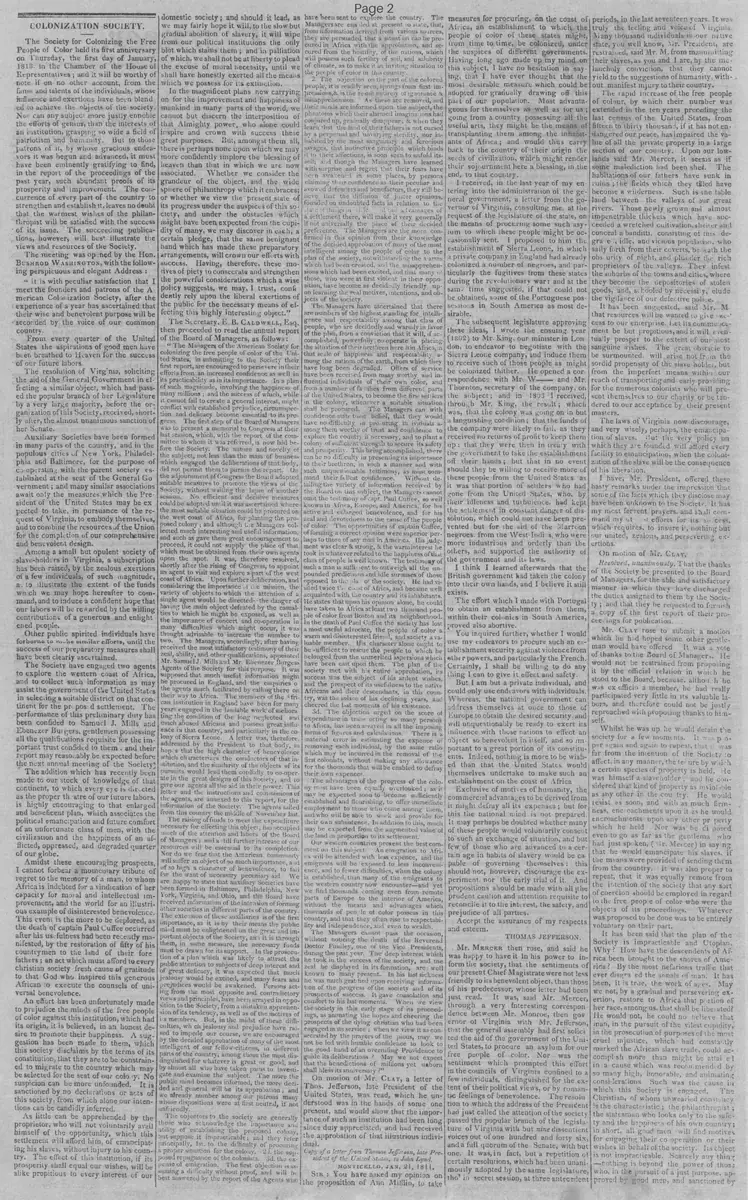
The Society for Colonizing the Free People of Color held its first anniversary on Thursday, the first day of January, 1818, in the Chamber of the House of Representatives; and it will be worthy of note if on no other account, from the fame and talents of the individuals whose influence and exertions have been blended to achieve the objects of the society. Nor can any subject more justly ennoble the efforts of genius, than the interests of an institution, grasping so wide a field of patriotism and humanity. But to those patrons of it, by whose gracious endeavors it was begun and advanced, it must have been eminently gratifying to find, in the report of the proceedings of the past year, such abundant proofs of its prosperity and improvement. The concurrence of every part of the country to strengthen and establish it, leaves no doubt that the warmest wishes of the philanthropist will be satisfied with the success of its issue. The succeeding publications, however, will best illustrate the views and resources of the Society.
The meeting was opened by the Hon. Bushrod Washington, with the following perspicuous and elegant Address:
"It is with peculiar satisfaction that I meet the founders and patrons of the American Colonization Society, after the experience of a year has ascertained that their wise and benevolent purpose will be seconded by the voice of our common country.
From every quarter of the United States the aspirations of good men have been breathed to Heaven for the success of our future labors.
The resolution of Virginia, soliciting the aid of the General Government in effecting a similar object, which had passed the popular branch of her Legislature by a very large majority, before the organization of this Society, received, shortly after, the almost unanimous sanction of her Senate.
Auxiliary Societies have been formed in many parts of the country, and in the populous cities of New York, Philadelphia and Baltimore, for the purpose of co-operating with the parent society established at the seat of the General Government; and many similar associations await only the measures which the President of the United States may be expected to take, in pursuance of the request of Virginia, to embody themselves, and to combine the resources of the Union for the completion of our comprehensive and benevolent design.
Among a small but opulent society of slave-holders in Virginia, a subscription has been raised, by the zealous exertions of a few individuals, of such magnitude, as to illustrate the extent of the funds which we may hope hereafter to command, and to induce a confident hope that our labors will be rewarded by the willing contributions of a generous and enlightened people.
Other public spirited individuals have forborne to make similar efforts, until the success of our preparatory measures shall have been clearly ascertained.
The Society have engaged two agents to explore the western coast of Africa, and to collect such information as may assist the government of the United States in selecting a suitable district on that continent for the proposed settlement. The performance of this preliminary duty has been confided to Samuel J. Mills and Ebenezer Burgess, gentlemen possessing all the qualifications requisite for the important trust confided to them, and their report may reasonably be expected before the next annual meeting of the Society.
The addition which has recently been made to our stock of knowledge of that continent, to which every eye is directed as the proper theatre of our future labors, is highly encouraging to that enlarged and beneficent plan, which associates the political emancipation and future comfort of an unfortunate class of men, with the civilization and the happiness of an afflicted, oppressed, and degraded quarter of our globe.
Amidst these encouraging prospects, I cannot forbear a momentary tribute of regret to the memory of a man, to whom Africa is indebted for a vindication of her capacity for moral and intellectual improvement, and the world for an illustrious example of disinterested benevolence.
This event is the more to be deplored, as the death of captain Paul Cuffee occurred after his usefulness had been recently manifested, by the restoration of fifty of his countrymen to the land of their forefathers; an act which must afford to every christian society fresh cause of gratitude to that God who inspired this generous African to execute the counsels of universal benevolence.
An effort has been unfortunately made to prejudice the minds of the free people of color against this institution, which had its origin, it is believed, in an honest desire to promote their happiness. A suggestion has been made to them, which this society disclaims by the terms of its constitution, that they are to be constrained to migrate to the country which may be selected for the seat of our colony. No suspicion can be more unfounded. It is sanctioned by no declarations or acts of this society, from which alone our intentions can be candidly inferred.
As little can be apprehended by the proprietor, who will not voluntarily avail himself of the opportunity, which this settlement will afford him, of emancipating his slaves, without injury to his country. The effect of this institution, if its prosperity shall equal our wishes, will be alike propitious to every interest of our domestic society; and should it lead, as we may fairly hope it will, to the slow but gradual abolition of slavery, it will wipe from our political institutions the only blot which stains them; and in palliation of which, we shall not be at liberty to plead the excuse of moral necessity, until we shall have honestly exerted all the means which we possess for its extinction.
In the magnificent plans now carrying on for the improvement and happiness of mankind in many parts of the world, we cannot but discern the interposition of that Almighty power, who alone could inspire and crown with success these great purposes. But, amongst them all, there is perhaps none upon which we may more confidently implore the blessing of heaven than that in which we are now associated. Whether we consider the grandeur of the object, and the wide sphere of philanthropy which it embraces; or whether we view the present state of its progress under the auspices of this society, and under the obstacles which might have been expected from the cupidity of many, we may discover in each, a certain pledge, that the same benignant hand which has made these preparatory arrangements, will crown our efforts with success. Having, therefore, these motives of piety to consecrate and strengthen the powerful considerations which a wise policy suggests, we may, I trust, confidently rely upon the liberal exertions of the public for the necessary means of effecting this highly interesting object."
The Secretary, E. B. Caldwell, Esq. then proceeded to read the annual report of the Board of Managers, as follows:
"The Managers of the American Society for colonizing the free people of color of the United States, in submitting to the Society their first report, are encouraged to persevere in their efforts from an increased confidence as well in its practicability as in its importance. In a plan of such magnitude, involving the happiness of many millions; and the success of which, while it cannot fail to create a general interest, might conflict with established prejudice, circumspection and delicacy become essential to its progress. The first step of the Board of Managers was to present a memorial to Congress at their last session, which, with the report of the committee to whom it was referred, is now laid before the Society. The nature and novelty of the subject, not less than the mass of business which engaged the deliberations of that body, did not permit them to pursue the report. On the adjournment of Congress the Board adopted suitable measures to promote the views of the Society, without waiting the lapse of another session. No efficient and decisive measures could be adopted until it was ascertained where the most suitable situation could be procured on the west coast of Africa, for planting the proposed colony; and although the Managers collected much interesting and useful information, and such as gave them great encouragement to proceed, it could not supply the place of that which must be obtained from their own agents upon the spot. It was, therefore resolved, shortly after the rising of Congress, to appoint an agent to visit and explore a part of the west coast of Africa. Upon further deliberation, and considering the importance of the mission, the variety of objects to which the attention of a single agent would be directed—the danger of having the main object defeated by the casualties to which he might be exposed, as well as the importance of concert and co-operation in many difficulties which might occur, it was thought advisable to increase the number to two. The Managers, accordingly, after having received the most satisfactory testimony of their zeal, ability, and other qualifications, appointed Mr. Samuel J. Mills and Mr. Ebenezer Burgess Agents of the Society for this purpose. It was supposed that much useful information might be procured in England, and the enquiries of the agents much facilitated by calling there on their way to Africa. The members of the African institution in England have been for many years engaged in the laudable work of meliorating the condition of the long neglected and much abused Africans and possess great influence in that country, and particularly in the colony of Sierra Leone. A letter was, therefore, addressed by the President to that body, in hopes that the high character of benevolence which characterizes the conductors of that institution, and the similarity of the objects of its pursuits would lead them cordially to co-operate in the great designs of this Society, and to give our agents all the aid in their power. This letter and the instructions and commissions of the agents, are annexed to this report, for the information of the Society. The agents sailed from this country the middle of November last.
The raising of funds to meet the expenditure necessary for effecting this object, has occupied much of the attention and labors of the Board of Managers; and a still further increase of our resources will be essential to its completion. Nor do we fear that the American community will suffer an object of so much importance, and of so high a character of benevolence, to fail for the want of necessary pecuniary aid. We are happy to state that auxiliary Societies have been formed in Baltimore, Philadelphia, New York, Virginia, and Ohio, and the Board have received information of the intention of forming other societies in different parts of the country. The extension of these auxiliaries is of the first importance, as it is by their means the public mind must be enlightened on the great and important objects of the Society, and it is through them, in some measure, the necessary funds must be drawn for its support. In the prosecution of a plan which was likely to attract the public attention to subjects of deep interest and of great delicacy, it was expected that much jealousy would be excited, and many fears and prejudices would be awakened. Persons acting from the most opposite and contradictory views and principles, have been arrayed in opposition to the Society, from a mistaken apprehension of its tendency, as well as of the motives of its members. But, in the midst of these difficulties, which jealousy and prejudice have raised to impede our course, we are encouraged by the decided approbation of many of the most intelligent of our fellow-citizens, in different parts of the country, among those the most distinguished for whatever is great or good, and by almost all who have taken pains to investigate and examine the subject. The more the public mind becomes informed, the more decided and general will be its approbation; and we already number among our patrons many whose dispositions were at first neutral, if not unfriendly.
The objectors to the society are generally those who acknowledge the importance and utility of establishing the proposed colony, but suppose it impracticable; and they refer principally, 1st. to the difficulty of procuring a proper situation for the colony. 2d. the supposed repugnance of the colonists. 3d. the expense of emigration. The first objection is assuming a difficulty without proof, and will be best answered by the report of the Agents who Managers are enabled at present to state, that, from information derived from various sources, they are persuaded that a situation can be procured in Africa with the approbation, and secured from the hostility, of the nations, which will possess such fertility of soil, and salubrity of climate, as to make it an inviting situation to the people of color in this country.
2. The objection on the part of the colored people, it is readily seen, springs from first impressions, & is the result entirely of ignorance & misapprehension. As these are removed, and their minds are informed upon the subject, the phantoms which their alarmed imaginations had conjured up, gradually disappear; & when they learn that the land of their fathers is not cursed by a perpetual and unvarying sterility, nor inhabited by the most sanguinary and ferocious savages, that instinctive principle which binds it to their affections, is soon seen to unfold itself; and though the Managers have learned with surprise and regret that their fears have been awakened in some places, by persons claiming their confidence as their peculiar and avowed defenders and benefactors, they still believe that the diffusion of juster opinions, founded on undoubted facts in relation to the state of things in Africa, and the advantages of a settlement there, will make it very generally if not universally the place of their decided preference. The Managers are the more confirmed in this opinion from their knowledge of the decided approbation of many of the most intelligent among the people of color to the plan of the society, notwithstanding the alarms which had been created, and the misapprehensions which had been excited, and that many of those, who were at first violent in their opposition, have become as decidedly friendly upon learning the real motives, intentions, and objects of the society.
The Managers have ascertained that there are numbers of the highest standing for intelligence and respectability among that class of people, who are decidedly and warmly in favor of the plan, from a conviction that it will, if accomplished, powerfully co-operate in placing the situation of their brethren here & in Africa, in that scale of happiness and respectability among the nations of the earth, from which they have long been degraded. Offers of service have been received from many worthy and influential individuals of their own color, and from a number of families from different parts of the United States, to become the first settlers in the colony, whenever a suitable situation shall be procured. The Managers can with confidence state their belief, that they would have no difficulty in procuring individuals among them worthy of trust and confidence to explore the country if necessary, and to plant a colony of sufficient strength to secure its safety and prosperity. This being accomplished, there can be no difficulty in presenting its importance to their brethren, in such a manner and with such unquestionable testimony, as must command their fullest confidence. Without detailing the variety of information received by the Board on this subject, the Managers cannot omit the testimony of capt. Paul Cuffee, so well known in Africa, Europe, and America, for his active and enlarged benevolence, and for his zeal and devotedness to the cause of the people of color. The opportunities of captain Cuffee, of forming a correct opinion were superior perhaps to those of any man in America. His judgment was clear & strong, & the warm interest he took in whatever related to the happiness of that class of people is well known. The testimony of such a man is sufficient to outweigh all the unfounded predictions and idle surmises of those opposed to the plan of the society. He had visited twice the coast of Africa, and became well acquainted with the country and its inhabitants. He states that upon his opinion alone, he could have taken to Africa at least two thousand people of color from Boston and its neighborhood.
In the death of Paul Cuffee the society has lost a most useful advocate, the people of color a warm and disinterested friend, and society a valuable member. His character alone ought to be sufficient to rescue the people to which he belonged from the unmerited aspersions which have been cast upon them. The plan of the society met with his entire approbation, its success was the subject of his ardent wishes, and the prospect of its usefulness to the native Africans and their descendants, in this country, was the solace of his declining years, and cheered the last moments of his existence.
3d. The objection urged on the score of expenditure in transporting so many persons to Africa, has been arrayed in all the imposing forms of figures and calculations. There is a material error in estimating the expense of removing each individual, by the same ratio which may be incurred in the removal of the first colonists, without making any allowance for the thousands that will be enabled to defray their own expenses.
The advantages of the progress of the colony must have been equally overlooked; as it may be expected soon to become sufficiently established and flourishing, to offer immediate employment to those who come among them, and who will be able to work and provide for their own subsistence. In addition to this, much may be expected from the augmented value of the land in proportion to its settlement.
Our western countries present the best comment on this subject. An emigration to Africa will be attended with less expense, and the emigrants will be exposed to less inconvenience, and to fewer difficulties, when the colony is established, than many of the emigrants to the western country now encounter—and yet we find thousands coming even from remote parts of Europe to the interior of America, without the means and advantages which thousands of people of color possess in this country, and that they often rise to respectability and independence, and even to wealth.
The Managers cannot pass the occasion, without noticing the death of the Reverend Doctor Findley, one of the Vice Presidents, during the past year. The deep interest which he took in the success of the society, and the zeal he displayed in its formation, are well known to many present. In his last sickness he was much gratified upon receiving information of the progress of the society and of its prospects of success. It gave consolation and comfort to his last moments. When we view the society in this early stage of its proceedings, as animating the hopes and cheering the prospects of the dying christian who had been engaged in its service; when we view it as consecrated by the prayers of the pious, may we not be led with humble confidence to look to the good hand of an overruling Providence to guide its deliberations? May we not expect that the benedictions of millions yet unborn shall bless its anniversary?"
On motion of Mr. Clay, a letter of Thos. Jefferson, late President of the United States, was read, which he understood was in the hands of some one present, and would show that the importance of such an institution had been long since duly appreciated, and had received the approbation of that illustrious individual.
Copy of a letter from Thomas Jefferson, late President of the United States, to John Lynd.
MONTICELLO, JAN. 21, 1811.
Sir: You have asked my opinion on the proposition of Ann Mifflin, to take measures for procuring, on the coast of Africa, an establishment to which the people of color of these states might, from time to time, be colonized, under the auspices of different governments. Having long ago made up my mind on this subject, I have no hesitation in saying, that I have ever thought that the most desirable measure which could be adopted for gradually drawing off this part of our population. Most advantageous for themselves as well as for us; going from a country possessing all the useful arts, they might be the means of transplanting them among the inhabitants of Africa; and would thus carry back to the country of their origin the seeds of civilization, which might render their sojournment here a blessing, in the end, to that country.
I received, in the last year of my entering into the administration of the general government, a letter from the governor of Virginia, consulting me, at the request of the legislature of the state, on the means of procuring some such asylum to which these people might be occasionally sent. I proposed to him the establishment of Sierra Leone, in which a private company in England had already colonized a number of negroes, and particularly the fugitives from these states during the revolutionary war: and at the same time suggested, if that could not be obtained, some of the Portuguese possessions in South America as most desirable.
The subsequent legislature approving these ideas, I wrote the ensuing year (1802) to Mr. King, our minister in London, to endeavor to negotiate with the Sierra Leone company, and induce them to receive such of those people as might be colonized thither. He opened a correspondence with Mr. W-- and Mr. Thornton, secretary of the company, on the subject; and in 1803 I received, through Mr. King, the result; which was, that the colony was going on in but a languishing condition; that the funds of the company were likely to fail, as they received no returns of profit to keep them up: that they were then in treaty with the government to take the establishment off their hands; but that in no event should they be willing to receive more of these people from the United States as it was that portion of settlers who had gone from the United States, who, by their idleness and turbulence, had kept the settlement in constant danger of dissolution, which could not have been prevented but for the aid of the Maroon negroes from the West-Indies, who were more industrious and orderly than the others, and supported the authority of the government and its laws.
I think I learned afterwards that the British government had taken the colony into their own hands, and I believe it still exists.
The effort which I made with Portugal to obtain an establishment from them, within their colonies in South America, proved also abortive.
You inquired further, whether I would use my endeavors to procure such an establishment secure against violence from ether powers, and particularly the French. Certainly, I shall be willing to do any thing I can to give it effect and safety. But I am but a private individual, and could only use endeavors with individuals. Whereas, the national government can address themselves at once to those of Europe to obtain the desired security, and will unquestionably be ready to exert its influence with those nations to effect an object so benevolent in itself, and so important to a great portion of its constituents. Indeed, nothing is more to be wished than that the United States would themselves undertake to make such an establishment on the coast of Africa. Exclusive of motives of humanity, the commercial advantages to be derived from it might deray all its expenses; but for this the national mind is not prepared. It may perhaps be doubted whether many of these people would voluntarily consent to such an exchange of situation, and but few of those who are advanced to a certain age in habits of slavery would be capable of governing themselves: this should not, however, discourage the experiment, nor the early trial of it. And propositions should be made with all the prudent caution and attention requisite to reconcile it to the interest, the safety, and prejudice of all parties.
Accept the assurance of my respects and esteem.
THOMAS JEFFERSON.
Mr. Mercer then rose, and said he was happy to have it in his power to inform the society, that the sentiments of our present Chief Magistrate were not less friendly to its benevolent object, than those of his predecessor, whose letter had been just read. It was, said Mr. Mercer, through a very interesting correspondence between Mr. Monroe, then governor of Virginia with Mr. Jefferson, that the general assembly had first solicited the aid of the government of the United States, to procure an asylum for our free people of color. Nor was the sentiment which prompted this effort in the councils of Virginia confined to a few individuals, distinguished for the extent of their political views, or by romantic feelings of benevolence. The resolution to which the address of the President had just called the attention of the society passed the popular branch of the legislature of Virginia with but nine dissentient voices out of one hundred and forty six, and a full quorum of the Senate, with but one. It was, in fact, but a repetition of certain resolutions, which had been unanimously adopted by the same legislature tho' in secret session, at three antecedent periods, in the last seventeen years. It was truly the feeling and voice of Virginia.
Many thousand individuals in our native state, you well know, Sir. President, are restrained, said Mr. M. from manumitting their slaves, as you and I are, by the melancholy conviction, that they cannot yield to the suggestions of humanity, without manifest injury to their country.
The rapid increase of the free people of colour, by which their number was extended in the ten years preceding the last census of the United States, from fifteen to thirty thousand, if it has not endangered our peace, has impaired the value of all the private property in a large section of our country. Upon our low-lands said Mr. Mercer, it seems as if some malediction had been shed. The habitations of our fathers have sunk in ruins; the fields which they tilled have become a wilderness. Such is the table land between the valleys of our great rivers. Those newly grown and almost impenetrable thickets which have succeeded a wretched cultivation, shelter and conceal a banditti, consisting of this degraded, idle, and vicious population, who sally forth from their coverts, beneath the obscurity of night, and plunder the rich proprietors of the valleys. They infest the suburbs of the towns and cities, where they become the depositories of stolen goods, and, schooled by necessity, elude the vigilance of our defective police.
It has been suggested, said Mr. M. that resources will be wanted to give access to our enterprise. Let its commencement be but propitious, and it will eventually prosper to the extent of our most sanguine wishes. The great obstacle to be surmounted, will arise not from the sordid propensity of the slave-holder, but from the imperfect means within our reach of transporting and early providing for the numerous colonists who will present themselves to our charity or be tendered to our acceptance by their present masters.
The laws of Virginia now discourage, and very wisely, perhaps, the emancipation of slaves. But the very policy on which they are founded will afford every facility to emancipation, when the colonization of the slave will be the consequence of his liberation.
I have, Mr. President, offered these hasty remarks under the impression that some of the facts which they disclose may have been unknown to the Society. It has my most fervent prayers, and shall command my utmost efforts for its success, which requires, to insure it, nothing but our united, zealous, and persevering exertions.
On motion of Mr. Clay,
Resolved, unanimously, That the thanks of the Society be presented to the Board of Managers, for the able and satisfactory manner in which they have discharged the duties assigned to them by the Society; and that they be requested to furnish a copy of the first report of their proceedings for publication.
Mr. Clay rose to submit a motion which he had hoped some other gentleman would have offered. It was a vote of thanks to the Board of Managers. He would not be restrained from proposing it by the official relation in which he stood to the Board, because, although he was ex officio a member, he had really participated very little in its valuable labors, and therefore could not be justly reproached with proposing thanks to himself.
Whilst he was up he would detain the society for a few moments. It was proper again and again to repeat, that it was far from the intention of the Society to affect, in any manner, the tenure by which a certain species of property is held. He was himself a slaveholder, and he considered that kind of property as inviolable as any other in the country. He would resist as soon, and with as much firmness, encroachments upon it as he would encroachments upon any other property which he held. Nor was he disposed even to go as far as the gentleman who had just spoken, (Mr. Mercer) in saying that he would emancipate his slaves, if the means were provided of sending them from the country. It was also proper to repeat, that it was equally remote from the intention of the society that any sort of coercion should be employed in regard to the free people of color who were the objects of its proceedings. Whatever was proposed to be done was to be entirely voluntary on their part.
It has been said that the plan of the Society is impracticable and Utopian. Why? How have the descendants of Africa been brought to the shores of America? By the most nefarious traffic that ever disgraced the annals of man. It has been, it is true, the work of ages. May we not, by a gradual and persevering exertion, restore to Africa that portion of her race, among us, that shall be liberated?
He would not, he could not believe that man, in the pursuit of the vilest cupidity, in the prosecution of purposes of the most cruel injustice, which had constantly marked the African slave trade, could accomplish more than might be attained in a cause which was recommended by so many high, honorable, and animating considerations. Such was the cause in which this Society is engaged. The Christian, of whom unwearied constancy is the characteristic; the philanthropist; the statesman who looks only to the safety and the happiness of his own country; in short, all good men will find motives for engaging their co-operation or their wishes in behalf of the society. Its object is not impracticable. Scarcely anything—nothing is beyond the power of those who, in the pursuit of a just purpose, approved by good men, and sanctioned by
Providence, boldly and resolutely determine to command success. But the persons, the amelioration of whose condition is the object of the Society, will not, it is said, accept the proffered favor. Mr. C. believed, at first, that, from want of information, very few of them would—not perhaps one in a hundred, in the interior. He was inclined to believe, however, that a number amply sufficient for the commencement of a colonial establishment would go. These would be drawn principally from the cities, which would act as a sort of depot from the country for the colony. Let five in a hundred only, of that portion of our population, be induced to migrate, and a number abundantly sufficient to begin with will be obtained. The first difficulties obviated, and all will be obviated. Let the colony be once firmly established and in prosperity, and all the obstacles will disappear. Why should they not go? Look at the earliest history of man; follow him through all his subsequent progress, and you find him continually migrating. What is the motive of this unceasing change of abode? To better his condition. What brought our fathers voluntarily to these shores, then savage and forbidding, not less savage and forbidding perhaps than those of Africa itself? To render themselves more happy. This word happiness, Mr. C. said, comprised many items. It comprehended what were hardly less important than subsistence, political and social considerations. These the men of color never can enjoy here, but are what he would find in the contemplated colony. And can there be any thing, to a reflecting freeman, (and some among the class of persons to whom he alluded were doubtless capable of reflection) more humiliating, more dark and cheerless, than to see himself, and to trace in imagination his posterity, through all succeeding time, degraded and debased, aliens to the society of which they are members, and cut off from all its higher blessings?
Further; several of the slave-holding states already had, and perhaps all of them would, prohibit entirely emancipation, without some such outlet was created. A sense of their own safety required the painful prohibition. Experience proved that persons turned loose who were neither freemen nor slaves, constituted a great moral evil threatening to contaminate all parts of society. Let the colony once be successfully planted, and legislative bodies, who have been grieved at the necessity of passing those prohibitory laws, which at a distance might appear to stain our codes, will hasten to remove the impediments to the exercise of benevolence & humanity. They will annex the condition that the emancipated shall leave the country; and he has placed a false estimate upon liberty who believes that there are many who would refuse the boon, when coupled even with such a condition.
But, Mr. C. said, he would not longer digress from the object of his motion. He was persuaded he should meet the unanimous concurrence of the society in the proposition that its thanks be tendered to the Board of Managers for the able and satisfactory manner in which they had executed their duties.
On motion of Mr. KEY,
Resolved, unanimously, That the thanks of the Society be presented to the President of the Society for his aid and influence in promoting the objects of the Society; and that he be requested to furnish a copy of his address for publication.
On motion of Mr. BAYARD,
Resolved, unanimously, That the thanks of this Society be presented to the members of those Auxiliary Societies that have been formed in various parts of the United States, to forward the plan and to contribute to the funds of this institution.
On motion of Mr. HERBERT,
Resolved, unanimously, That the future annual meeting of this Society be held on the last Saturday of December.
The Society then proceeded to the appointment of officers for the present year, when the following persons were elected:
The Hon. Bushrod Washington was unanimously elected President.
Vice Presidents.
Hon. William H. Crawford, of Georgia.
Hon. Henry Clay, of Kentucky.
Hon. William Phillips, of Massachusetts.
Col. Henry Rutgers, of New York.
Hon. John E. Howard,
Hon. Samuel Smith,
of Maryland.
Hon. John C. Herbert,
John Taylor, of Caroline, Esq. of Virginia,
Gen. Andrew Jackson, of Tennessee.
Robert Ralston, Esq.
of Pennsylvania.
Richard Rush, Esq.
Gen. John Mason, District of Columbia.
Samuel Bayard, New Jersey.
Managers.
Francis S. Key
Benjamin G. Orr,
Walter Jones
John Peter.
John Laird,
Edmund J. Lee,
Rev. Dr. James Laurie,
William Thornton,
Rev. Stephen B. Balch, Wm. H. Fitzhugh,
Rev. Obad. B. Brown,
Henry Carroll.
E. B. Caldwell, Esq. Secretary.
John G. McDonald, Recording Secretary.
David English, Treasurer,
To Samuel J. Mills and Ebenezer Burgess.
You have been appointed the agents of the "Board of Managers of the American Society for Colonizing the free people of Colour of the United States" for the purpose of visiting England and Africa, on a mission of inquiry. The object which you will keep in view while engaged in this mission, is to obtain that information which will enable the Board to concert their future measures with a prospect of succeeding in their design. Your general conduct will be governed by the following instructions.
1. You will make the necessary preparation for leaving this country, and embrace the first favorable opportunity which shall present, for England.
2. Upon your arrival in London you will present your instructions and letters to such gentlemen as shall be named by the Board, and to others to whom you may have letters of introduction.
3. You will endeavor to procure information from those gentlemen relative to the state of the west coast of Africa, the best means of prosecuting your inquiries when you arrive there, and to obtain letters of introduction from the proper persons to the Governor of the Sierra Leone Colony, and to any other gentlemen on the coast who may probably aid you in your object.
4. When you have made the necessary preparations, which you are requested to do with the least possible delay, you will embark for the coast of Africa. You will make the Sierra Leone colony, with the approbation of the governor thereof, your principal station while you remain on the coast.
5. You will make yourselves acquainted with the Sierra Leone colony, particularly of its history, progress, improvement and prospects, with a view to furnish such information as may be useful in forming a colony on the coast.
6. You will visit the coast above & below the colony of Sierra Leone, to as great an extent as shall be deemed expedient, & give a description of that part of the coast visited by you; and endeavor to procure as much information as possible of other parts of the coast, and of the interior. And we would particularly direct your attention to the climate, soil, and healthiness, of the country, and its fitness for agricultural improvements, as it is in contemplation to turn the attention of the new colonists mostly to agriculture. As connected with this object, you will procure all the information in your power as to the extent of the rivers on the coast, their sources and how far navigable, the mountains and general face of the country, and finally every thing that may be considered interesting and useful to the Society, to enable it to form an opinion as to the most eligible spot for the colony, and the prospect of its success when established. It would be particularly desirable to ascertain the character of the different nations or tribes on the coast, and more especially of those in the neighborhood of the place you may recommend as a proper situation for the colony.
7. You will direct your attention particularly to the Sherbro country, which country it is expected you will visit. By means of native interpreters you will endeavor to consult with the native chiefs of the different tribes and explain to them the design which the Board have in view. Should circumstances permit, you will obtain from them a pledge that they will promote the designs of the colony, should one be established, and that as far as they have the possession of the country, that a section of it shall be given up to the government of the United States, or the Society, at a fair price, should Congress or the Board hereafter make the request; for the purpose of colonizing the free people of color, as the Board propose.
8. After you shall have completed your inquiries and as far as possible attained the object of your mission, you will return to America direct, or by the way of England, as shall be deemed proper. It is desired that you would return direct to this country, unless the inducements to revisit England are strong.
9. You will obtain as particular and accurate an account of the territories and their limits, claimed by the different European nations, on the west coast of Africa, as possible; together with the character of the different nations on the coast, and in the interior, and the boundaries of their territories. On your return you will present to the Board a full account of your expedition, and of the information procured by you, and improve every opportunity which may present to inform the Board of your progress.
10. You will keep an account of your expenses for the inspection of the Board.
In addition to these instructions you will be furnished with copies of the constitution of this Society, and of the memorial of the board of managers, which was addressed to the Congress of the United States, during their session of 1816-17.
BUSHROD WASHINGTON,
President of American Colonization Society
E. B. CALDWELL, Secretary.
Washington, Nov. 5, 1817
To Samuel J. Mills and Ebenezer Burgess.
Gentlemen—The Board of Managers of the American Society for colonizing the free people of color of the United States, have appointed you their agents on a mission to explore a part of the west coast of Africa, for the purpose of ascertaining the best situation which can be procured for colonizing the free people of color of the United States. You will act in conjunction as much as possible: but should you be separated to forward the objects of the mission, or by a dispensation of Providence, you will act as if you had a separate commission, taking care, in case of acting separately, not to let your engagements interfere with each other. The situation to which you have been called, is one of great importance and responsibility, and will require from you the greatest diligence, skill, and prudence, as the success of the benevolent designs of the Society may, in a great measure, depend upon your mission. General instructions will be given with this commission, but very much must be left to your own discretion and prudence, on which the Board place the greatest reliance. The objects of the Society are of that enlarged benevolence, affecting, as they believe, not only the temporal and spiritual interests of thousands of our fellow-creatures in this country, but in Africa likewise, that they calculate upon the cordial aid and co-operation of the philanthropist of every clime and country, whose assistance you may need in the prosecution of your design; and they are the more sanguine in their calculations for this friendly support, from the attention which this class of the human family have received from the most distinguished individuals in Europe, and particularly in Great Britain. But whilst we thus say "be ye wise as serpents, and harmless as doves," and recommend you to the benevolent and feeling stranger, your principal reliance will be on Him who has made of one blood all the nations of the earth, and in whose hands are the hearts of all the children of men, to turn them as he pleaseth. May he be your protector, and preserve you from "the arrow that flieth by day," and "the pestilence that walketh in darkness," and "the destruction that wasteth at noon day." May that "Saviour who is to receive Egypt as a ransom, and Ethiopia and Seba to himself"—who hath promised to "call his sons from far, and his daughters from the ends of the earth," "make for you a way in the sea" and in "the wilderness, and a path in the mighty waters," that all may issue to his honor and glory, and the spread of the Redeemer's kingdom.
BUSH. WASHINGTON,
President of American Colonization Society
E. B. CALDWELL, Sec'y,
To his Royal Highness the Duke of Gloucester,
Patron and President of the African Institution.
I have the honor to inform your Royal Highness that an association of a number of persons, residing in various parts of the United States, has been recently formed at the city of Washington, under the denomination of "The American Society for colonizing the free people of color of the United States." The object of this institution, indicated by its name, is to promote the colonizing of those persons, with their own consent. In the accomplishment of that object, it is necessary to determine upon a proper country wherein to plant the proposed colony. Africa, and particularly the western coast of it, has, with this view, hitherto principally engaged the attention of the Society; and, in order to acquire all the information which it may be material to possess, in fixing its judgment on that important point, it has deputed to Europe and to Africa the bearers hereof, Samuel J. Mills and Ebenezer Burgess.
Aware that the African institution has been long occupied with schemes of benevolence, connected with Africa, and the people and descendants of Africa, the American Society has directed me to address your Royal Highness, as the Patron and President of the African institution, and respectfully to solicit any aid and assistance which it may be convenient to render to those deputies, in the business with which they are thus charged. These gentlemen will promptly afford any further explanations which your Royal Highness may require, relative to the nature and prospects of the American Society.
I am sure that it would be quite unnecessary to trespass further upon the time of your Royal Highness, in expatiating and insisting upon the benefits which may result from the successful establishment of the contemplated colony, to the colonists themselves, to their descendants, and to Africa. Restored to the land of their fathers, and carrying with them a knowledge of our religion, of letters, and of the arts, may they not powerfully co-operate with the benevolent and enlightened efforts of the African institution, in the introduction into Africa of christianity and civilization? If the exertions of the two institutions are directed in channels somewhat different, they both have the same common character of humanity and benevolence—the same common aim at ameliorating the condition of the race of Africa. From this affinity in object, the American Society cherishes the hope of friendly intercourse, and an interchange of good offices with the African institution.
I have the honor to be, with great respect,
your Royal Highness's obedient servant,
BUSH. WASHINGTON,
President of the American Colonization Society.
What sub-type of article is it?
What themes does it cover?
What keywords are associated?
What entities or persons were involved?
Where did it happen?
Story Details
Key Persons
Location
Washington, Dc; West Coast Of Africa
Event Date
January 1, 1818
Story Details
The American Colonization Society holds its first anniversary meeting, featuring an address by President Bushrod Washington on progress and divine support, annual report on appointing agents to explore Africa, reading of Thomas Jefferson's supportive letter, speeches defending the voluntary colonization plan for free people of color, resolutions of thanks, and election of officers.