Thank you for visiting SNEWPapers!
Sign up free
Literary
January 30, 1790
Gazette Of The United States
New York, New York County, New York
What is this article about?
An essay exploring the nature of happiness, arguing that people often derive more pleasure from gratifications than anticipated, especially natural ones over artificial luxuries. It advocates making the most of one's situation without complaint, as happiness is more equally distributed than supposed.
Clipping
OCR Quality
95%
Excellent
Full Text
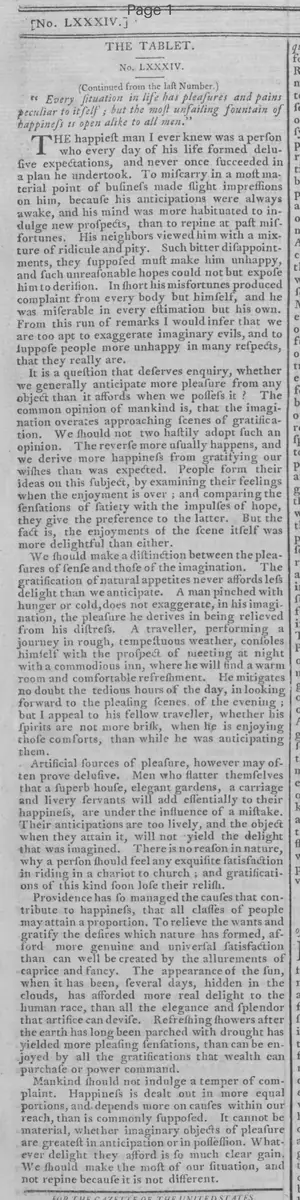
[No. LXXXIV.]
THE TABLET.
No. LXXXIV.
(Continued from the last Number.)
In every situation in life has pleasures and pains peculiar to itself; but the most unfailing fountain of happiness is open alike to all men.
THE happiest man I ever knew was a person who every day of his life formed delusive expectations, and never once succeeded in a plan he undertook. To miscarry in a most material point of business made slight impressions on him, because his anticipations were always awake, and his mind was more habituated to indulge new prospects, than to repine at past misfortunes. His neighbors viewed him with a mixture of ridicule and pity. Such bitter disappointments, they supposed must make him unhappy, and such unreasonable hopes could not but expose him to derision. In short his misfortunes produced complaint from every body but himself, and he was miserable in every estimation but his own.
From this train of remarks I would infer that we are too apt to exaggerate imaginary evils, and to suppose people more unhappy in many respects, than they really are.
It is a question that deserves enquiry, whether we generally anticipate more pleasure from any object than it affords when we possess it? The common opinion of mankind is, that the imagination overrates approaching scenes of gratification. We should not too hastily adopt such an opinion. The reverse more usually happens, and we derive more happiness from gratifying our wishes than was expected. People form their ideas on this subject, by examining their feelings when the enjoyment is over; and comparing the sensations of satiety with the impulses of hope, they give the preference to the latter. But the fact is, the enjoyments of the scene itself was more delightful than either.
We should make a distinction between the pleasures of sense and those of the imagination. The gratification of natural appetites never affords less delight than we anticipate. A man pinched with hunger or cold, does not exaggerate, in his imagination, the pleasure he derives in being relieved from his distress. A traveller, performing a journey in rough, tempestuous weather, consoles himself with the prospect of meeting at night with a commodious inn, where he will find a warm room and comfortable refreshment. He mitigates no doubt the tedious hours of the day, in looking forward to the pleasing scenes of the evening; but I appeal to his fellow traveller, whether his spirits are not more brisk, when he is enjoying those comforts, than while he was anticipating them.
Artificial sources of pleasure, however may often prove delusive. Men who flatter themselves that a superb house, elegant gardens, a carriage and livery servants will add essentially to their happiness, are under the influence of a mistake. Their anticipations are too lively, and the object when they attain it, will not yield the delight that was imagined. There is no reason in nature, why a person should feel any exquisite satisfaction in riding in a chariot to church; and gratifications of this kind soon lose their relish.
Providence has so managed the causes that contribute to happiness, that all classes of people may attain a proportion. To relieve the wants and gratify the desires which nature has formed, afford more genuine and universal satisfaction than can well be created by the allurements of caprice and fancy. The appearance of the sun, when it has been several days hidden in the clouds, has afforded more real delight to the human race, than all the elegance and splendor that artifice can devise. Refreshing showers after the earth has long been parched with drought has yielded more pleasing sensations, than can be enjoyed by all the gratifications that wealth can purchase or power command.
Mankind should not indulge a temper of complaint. Happiness is dealt out in more equal portions, and depends more on causes within our reach, than is commonly supposed. It cannot be material, whether imaginary objects of pleasure are greatest in anticipation or in possession. Whatever delight they afford is so much clear gain.
We should make the most of our situation, and not repine because it is not different.
THE TABLET.
No. LXXXIV.
(Continued from the last Number.)
In every situation in life has pleasures and pains peculiar to itself; but the most unfailing fountain of happiness is open alike to all men.
THE happiest man I ever knew was a person who every day of his life formed delusive expectations, and never once succeeded in a plan he undertook. To miscarry in a most material point of business made slight impressions on him, because his anticipations were always awake, and his mind was more habituated to indulge new prospects, than to repine at past misfortunes. His neighbors viewed him with a mixture of ridicule and pity. Such bitter disappointments, they supposed must make him unhappy, and such unreasonable hopes could not but expose him to derision. In short his misfortunes produced complaint from every body but himself, and he was miserable in every estimation but his own.
From this train of remarks I would infer that we are too apt to exaggerate imaginary evils, and to suppose people more unhappy in many respects, than they really are.
It is a question that deserves enquiry, whether we generally anticipate more pleasure from any object than it affords when we possess it? The common opinion of mankind is, that the imagination overrates approaching scenes of gratification. We should not too hastily adopt such an opinion. The reverse more usually happens, and we derive more happiness from gratifying our wishes than was expected. People form their ideas on this subject, by examining their feelings when the enjoyment is over; and comparing the sensations of satiety with the impulses of hope, they give the preference to the latter. But the fact is, the enjoyments of the scene itself was more delightful than either.
We should make a distinction between the pleasures of sense and those of the imagination. The gratification of natural appetites never affords less delight than we anticipate. A man pinched with hunger or cold, does not exaggerate, in his imagination, the pleasure he derives in being relieved from his distress. A traveller, performing a journey in rough, tempestuous weather, consoles himself with the prospect of meeting at night with a commodious inn, where he will find a warm room and comfortable refreshment. He mitigates no doubt the tedious hours of the day, in looking forward to the pleasing scenes of the evening; but I appeal to his fellow traveller, whether his spirits are not more brisk, when he is enjoying those comforts, than while he was anticipating them.
Artificial sources of pleasure, however may often prove delusive. Men who flatter themselves that a superb house, elegant gardens, a carriage and livery servants will add essentially to their happiness, are under the influence of a mistake. Their anticipations are too lively, and the object when they attain it, will not yield the delight that was imagined. There is no reason in nature, why a person should feel any exquisite satisfaction in riding in a chariot to church; and gratifications of this kind soon lose their relish.
Providence has so managed the causes that contribute to happiness, that all classes of people may attain a proportion. To relieve the wants and gratify the desires which nature has formed, afford more genuine and universal satisfaction than can well be created by the allurements of caprice and fancy. The appearance of the sun, when it has been several days hidden in the clouds, has afforded more real delight to the human race, than all the elegance and splendor that artifice can devise. Refreshing showers after the earth has long been parched with drought has yielded more pleasing sensations, than can be enjoyed by all the gratifications that wealth can purchase or power command.
Mankind should not indulge a temper of complaint. Happiness is dealt out in more equal portions, and depends more on causes within our reach, than is commonly supposed. It cannot be material, whether imaginary objects of pleasure are greatest in anticipation or in possession. Whatever delight they afford is so much clear gain.
We should make the most of our situation, and not repine because it is not different.
What sub-type of article is it?
Essay
What themes does it cover?
Moral Virtue
What keywords are associated?
Happiness
Expectations
Imagination
Pleasure
Misfortune
Natural Appetites
Artificial Luxuries
Providence
Literary Details
Title
The Tablet. No. Lxxxiv.
Key Lines
The Happiest Man I Ever Knew Was A Person Who Every Day Of His Life Formed Delusive Expectations, And Never Once Succeeded In A Plan He Undertook.
We Should Make A Distinction Between The Pleasures Of Sense And Those Of The Imagination.
Providence Has So Managed The Causes That Contribute To Happiness, That All Classes Of People May Attain A Proportion.
Happiness Is Dealt Out In More Equal Portions, And Depends More On Causes Within Our Reach, Than Is Commonly Supposed.
We Should Make The Most Of Our Situation, And Not Repine Because It Is Not Different.