Thank you for visiting SNEWPapers!
Sign up free
Kentucky Gazette
Lexington, Fayette County, Kentucky
What is this article about?
On February 28, the U.S. House of Representatives, in committee of the whole, debated the Missouri Bill. Amendments on slavery exclusion north of 36°30' were rejected, along with proposals on delegate voting, racial restrictions, and state admission conditions. Debates involved key figures like Storrs, Randolph, Clay, and Taylor.
Merged-components note: The second component is a continuation of the congressional proceedings on the Missouri bill, including the adjournment; relabeling from notice to domestic_news as it fits the context of legislative reporting.
Clipping
OCR Quality
Full Text
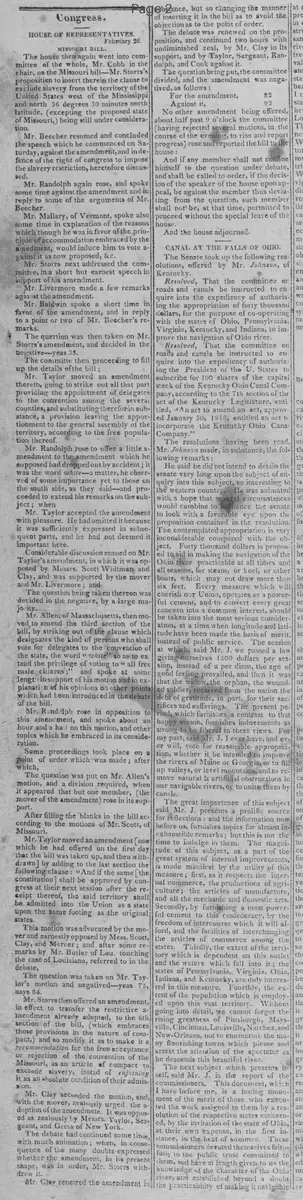
HOUSE OF REPRESENTATIVES,
February 28.
MISSOURI BILL.
The house then again went into committee of the whole, Mr. Cobb in the chair, on the Missouri bill—Mr. Storrs's proposition to insert therein the clause to exclude slavery from the territory of the United States west of the Mississippi and north 36 degrees 30 minutes north latitude, (excepting the proposed state of Missouri,) being still under consideration.
Mr. Beecher resumed and concluded the speech which he commenced on Saturday, against the amendment, and in defence of the right of congress to impose the slavery restriction, heretofore discussed.
Mr. Randolph again rose, and spoke some time against the amendment and in reply to some of the arguments of Mr. Beecher.
Mr. Mallary, of Vermont, spoke also some time in explanation of the reasons which though he was in favor of the principle of accommodation embraced by the amendment, would induce him to vote against it as now proposed, &c.
Mr. Storrs next addressed the committee, in a short but earnest speech in support of his amendment.
Mr. Livermore made a few remarks against the amendment.
Mr. Baldwin spoke a short time in favor of the amendment, and in reply to a point or two of Mr. Beecher's remarks.
The question was then taken on Mr. Storrs's amendment, and decided in the negative—yeas 38.
The committee then proceeding to fill up the details of the bill;
Mr. Taylor moved an amendment thereto, going to strike out all that part providing the appointment of delegates to the convention among the several counties, and substituting therefor in substance, a provision leaving the apportionment to the general assembly of the territory, according to the free population thereof.
Mr. Randolph rose to offer a little amendment to the amendment which he supposed had dropped out by accident; it was the word white—a matter, he observed of some importance yet to those of the south side, as they said—and proceeded to extend his remarks on the subject; when
Mr. Taylor accepted the amendment with pleasure. He had omitted it because it was sufficiently expressed in subsequent parts, and he had not deemed it important here.
Considerable discussion ensued on Mr. Taylor's amendment, in which it was opposed by Messrs. Scott, Whitman and Clay, and was supported by the mover and Mr. Livermore; and
The question being taken thereon was decided in the negative, by a large majority.
Mr. Allen, of Massachusetts, then moved to amend the third section of the bill, by striking out of the clause which designates the kind of persons who shall vote for delegates to the convention of the state, the word "white" so as to extend the privilege of voting to "all free male citizens;" and spoke at some length in support of his motion and in explanation of his opinions on other points which had been introduced in the debate of the bill.
Mr. Randolph rose in opposition to this amendment, and spoke about an hour and a half on this motion, and other topics which he embraced in its consideration.
Some proceedings took place on a point of order which was made; after which,
The question was put on Mr. Allen's motion, and a division required, when it appeared that but one member, (the mover of the amendment) rose in its support.
After filling the blanks in the bill according to the motions of Mr. Scott, of Missouri.
Mr. Taylor moved an amendment one which he had offered on the first day that the bill was taken up, and then withdrawn] by adding to the last section the following clause: "And if the same [the constitution] shall be approved by congress at their next session after the receipt thereof, the said territory shall be admitted into the Union as a state upon the same footing as the original states."
This motion was advocated by the mover and earnestly opposed by Mess. Scott, Clay, and Mercer; and after some remarks by Mr. Butler of Lou. touching the case of Louisiana, referred to in the debate,
The question was taken on Mr. Taylor's motion and negatived—yeas 75, nays 84.
Mr. Storrs then offered an amendment, in effect to transfer the restrictive amendment already adopted, to the 6th section of the bill, (which embraces those provisions in the nature of compact,) and so modify it as to make it a recommendation for the free acceptance or rejection of the convention of the Missouri, as an article of compact to exclude slavery, instead of enjoining it as an absolute condition of their admission.
Mr. Clay seconded the motion, and, with the mover, zealously urged the adoption of the amendment. It was opposed as zealously by Messrs. Taylor, Sergeant, and Gross of New York.
The debate had continued some time, with much animation; when, in consequence of the many doubts expressed whether the amendment, in its present shape, was in order, Mr. Storrs withdrew it.
Mr. Clay renewed the amendment in
And if any member shall not confine himself to the question under debate, and shall be called to order, if the decision of the speaker of the house upon appeal, be against the member thus deviating from the question, such member shall not be, at that time, permitted to proceed without the special leave of the house.
And the house adjourned.
What sub-type of article is it?
What keywords are associated?
What entities or persons were involved?
Where did it happen?
Domestic News Details
Primary Location
Washington
Event Date
February 28
Key Persons
Outcome
mr. storrs's slavery restriction amendment rejected (yeas 38); mr. taylor's delegate apportionment amendment rejected by large majority; mr. allen's removal of 'white' from voting clause supported by only one member; mr. taylor's state admission clause rejected (yeas 75, nays 84); mr. storrs's modified restriction amendment withdrawn.
Event Details
The House in committee of the whole debated the Missouri Bill, focusing on amendments regarding slavery exclusion in territories north of 36°30', delegate selection, voting rights, and admission conditions. Speeches and discussions occurred among members, leading to votes on various proposals.