Thank you for visiting SNEWPapers!
Sign up free
Story
April 30, 1851
The Charlotte Journal
Charlotte, Mecklenburg County, North Carolina
What is this article about?
During the Mexican-American War, Colonel D. trains his volunteer regiment to stand against a cavalry charge by charging at them on horseback. In a drill, a soldier's bayonet wounds the colonel's horse, earning praise for all involved.
Clipping
OCR Quality
95%
Excellent
Full Text
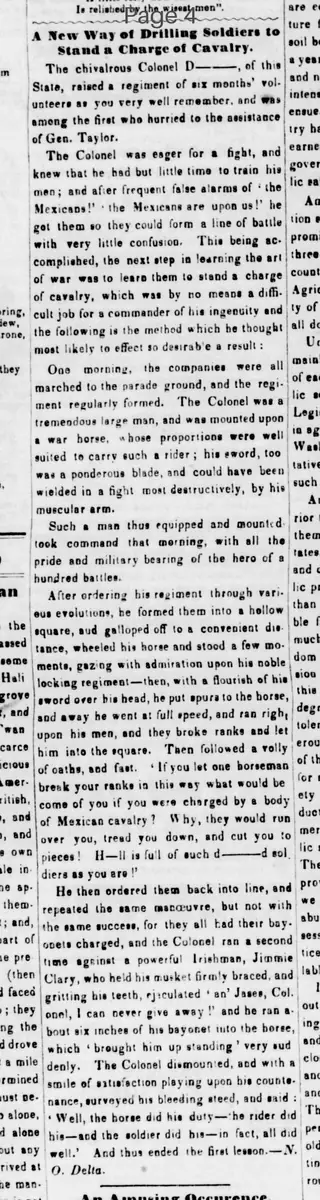
A New Way of Drilling Soldiers to
Stand a Charge of Cavalry.
The chivalrous Colonel D.,
of this
State, raised a regiment of six months' vol-
unteers as you very well remember, and was
among the first who hurried to the assistance
of Gen. Taylor.
The Colonel was eager for a fight, and
knew that he had but little time to train his
men; and after frequent false alarms of 'the
Mexicans! the Mexicans are upon us!' he
got them so they could form a line of battle
with very little confusion. This being ac-
complished, the next step in learning the art
of war was to learn them to stand a charge
of cavalry, which was by no means a diffi-
cult job for a commander of his ingenuity and
the following is the method which he thought
most likely to effect so desirable a result:
One morning, the companies were all
marched to the parade ground, and the regi-
ment regularly formed. The Colonel was a
tremendous large man, and was mounted upon
a war horse, whose proportions were well
suited to carry such a rider; his sword, too
was a ponderous blade, and could have been
wielded in a fight most destructively, by his
muscular arm.
Such a man thus equipped and mounted.
took command that morning, with all the
pride and military bearing of the hero of a
hundred battles.
After ordering his regiment through vari-
ous evolutions, he formed them into a hollow
square, and galloped off to a convenient dis-
tance, wheeled his horse and stood a few mo-
ments, gazing with admiration upon his noble
looking regiment—then, with a flourish of his
sword over his head, he put spurs to the horse,
and away he went at full speed, and ran right
upon his men, and they broke ranks and let
him into the square. Then followed a volley
of oaths, and fast. 'If you let one horseman
break your ranks in this way what would be
come of you if you were charged by a body
of Mexican cavalry? Why, they would run
over you, tread you down, and cut you to
pieces! Hell is full of such d—d sol-
n.
di ers as you are!'
He then ordered them back into line, and
repeated the same manoeuvre, but not with
the same success, for they all had their bay-
onets charged, and the Colonel ran a second
time against a powerful Irishman, Jimmie
Clary, who held his musket firmly braced, and
gritting his teeth, ejaculated 'an' Jasus, Col-
onel, I can never give way!' and he ran a-
bout six inches of his bayonet into the horse.
which 'brought him up standing' very sud-
denly. The Colonel dismounted, and with a
smile of satisfaction playing upon his counte-
nance, surveyed his bleeding steed, and said:
Well, the horse did his duty—the rider did
his—and the soldier did his—in fact, all did
well.' And thus ended the first lesson.—N.
O. Delta.
Stand a Charge of Cavalry.
The chivalrous Colonel D.,
of this
State, raised a regiment of six months' vol-
unteers as you very well remember, and was
among the first who hurried to the assistance
of Gen. Taylor.
The Colonel was eager for a fight, and
knew that he had but little time to train his
men; and after frequent false alarms of 'the
Mexicans! the Mexicans are upon us!' he
got them so they could form a line of battle
with very little confusion. This being ac-
complished, the next step in learning the art
of war was to learn them to stand a charge
of cavalry, which was by no means a diffi-
cult job for a commander of his ingenuity and
the following is the method which he thought
most likely to effect so desirable a result:
One morning, the companies were all
marched to the parade ground, and the regi-
ment regularly formed. The Colonel was a
tremendous large man, and was mounted upon
a war horse, whose proportions were well
suited to carry such a rider; his sword, too
was a ponderous blade, and could have been
wielded in a fight most destructively, by his
muscular arm.
Such a man thus equipped and mounted.
took command that morning, with all the
pride and military bearing of the hero of a
hundred battles.
After ordering his regiment through vari-
ous evolutions, he formed them into a hollow
square, and galloped off to a convenient dis-
tance, wheeled his horse and stood a few mo-
ments, gazing with admiration upon his noble
looking regiment—then, with a flourish of his
sword over his head, he put spurs to the horse,
and away he went at full speed, and ran right
upon his men, and they broke ranks and let
him into the square. Then followed a volley
of oaths, and fast. 'If you let one horseman
break your ranks in this way what would be
come of you if you were charged by a body
of Mexican cavalry? Why, they would run
over you, tread you down, and cut you to
pieces! Hell is full of such d—d sol-
n.
di ers as you are!'
He then ordered them back into line, and
repeated the same manoeuvre, but not with
the same success, for they all had their bay-
onets charged, and the Colonel ran a second
time against a powerful Irishman, Jimmie
Clary, who held his musket firmly braced, and
gritting his teeth, ejaculated 'an' Jasus, Col-
onel, I can never give way!' and he ran a-
bout six inches of his bayonet into the horse.
which 'brought him up standing' very sud-
denly. The Colonel dismounted, and with a
smile of satisfaction playing upon his counte-
nance, surveyed his bleeding steed, and said:
Well, the horse did his duty—the rider did
his—and the soldier did his—in fact, all did
well.' And thus ended the first lesson.—N.
O. Delta.
What sub-type of article is it?
Military Action
Curiosity
What themes does it cover?
Bravery Heroism
Moral Virtue
What keywords are associated?
Military Training
Cavalry Charge
Volunteer Regiment
Bayonet Drill
Mexican War
What entities or persons were involved?
Colonel D.
Jimmie Clary
Gen. Taylor
Where did it happen?
Parade Ground
Story Details
Key Persons
Colonel D.
Jimmie Clary
Gen. Taylor
Location
Parade Ground
Story Details
Colonel D. trains his regiment by charging at them on horseback to simulate a cavalry attack. After they break ranks once, on the second try, soldier Jimmie Clary stands firm and bayonets the colonel's horse, which the colonel praises as successful training.