Thank you for visiting SNEWPapers!
Sign up free
The North Carolina Standard
Raleigh, Wake County, North Carolina
What is this article about?
The newspaper introduces and publishes a letter from Secretary of State James Buchanan, dated August 25, 1847, declining an invitation to a Democratic event in Berks County, PA, while urging vigilance in the upcoming election and advocating extension of the Missouri Compromise to new territories to counter the Wilmot Proviso and preserve the Union and Democratic Party.
Clipping
OCR Quality
Full Text
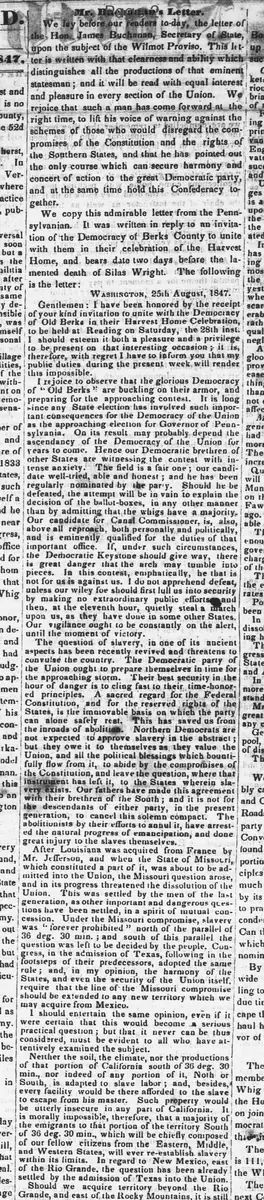
We copy this admirable letter from the Pennsylvanian. It was written in reply to an invitation of the Democracy of Berks County to unite with them in their celebration of the Harvest Home, and bears date two days before the lamented death of Silas Wright. The following is the letter:
WASHINGTON, 25th August, 1847.
Gentlemen: I have been honored by the receipt of your kind invitation to unite with the Democracy of Old Berks in their Harvest Home Celebration, to be held at Reading on Saturday, the 28th inst. I should esteem it both a pleasure and a privilege to be present on that interesting occasion; it is, therefore, with regret I have to inform you that my public duties during the present week, will render this impossible.
I rejoice to observe that the glorious Democracy of 'Old Berks' are buckling on their armor, and preparing for the approaching contest. It is long since any State election has involved such important consequences for the Democracy of the Union as the approaching election for Governor of Pennsylvania. On its result may probably depend the ascendancy of the Democracy of the Union for years to come. Hence our Democratic brethren of other States are witnessing the contest with intense anxiety. The field is a fair one; our candidate well-tried, able and honest; and he has been regularly nominated by the party. Should he be defeated, the attempt will be in vain to explain the decision of the ballot-boxes, in any other manner than by admitting that the whigs have a majority.
Our candidate for Canal Commissioner, is, also, above all reproach, both personally and politically, and is eminently qualified for the duties of that important office. If, under such circumstances, the Democratic Keystone should give way, there is great danger that the arch may tumble into pieces. In this contest, emphatically, he that is not for us is against us. I do not apprehend defeat, unless our wily foe should first lull us into security by making no extraordinary public efforts and then, at the eleventh hour, quietly steal a march upon us, as they have done in some other States.
Our vigilance ought to be constantly on the alert, until the moment of victory.
The question of slavery, in one of its ancient aspects has been recently revived and threatens to convulse the country. The Democratic party of the Union ought to prepare themselves in time for the approaching storm. Their best security in the hour of danger is to cling fast to their time-honored principles. A sacred regard for the Federal Constitution, and for the reserved rights of the States, is the immovable basis on which the party can alone safely rest. This has saved us from the inroads of abolition. Northern Democrats are not expected to approve slavery in the abstract; but they owe it to themselves as they value the Union, and all the political blessings which bountifully flow from it, to abide by the compromises of the Constitution, and leave the question, where that instrument has left it, to the States wherein slavery exists. Our fathers have made this agreement with their brethren of the South; and it is not for the descendants of either party, in the present generation, to cancel this solemn compact. The abolitionists by their efforts to annul it, have arrested the natural progress of emancipation, and done great injury to the slaves themselves.
After Louisiana was acquired from France by Mr. Jefferson, and when the State of Missouri which constituted a part of it, was about to be admitted into the Union, the Missouri question arose, and in its progress threatened the dissolution of the Union. This was settled by the men of the last generation, as other important and dangerous questions have been settled, in a spirit of mutual concession. Under the Missouri compromise, slavery was 'forever prohibited' north of the parallel of 36 deg. 30 min.; and south of this parallel the question was left to be decided by the people. Congress, in the admission of Texas, following in the footsteps of their predecessors, adopted the same rule; and, in my opinion, the harmony of the States, and even the security of the Union itself, require that the line of the Missouri compromise should be extended to any new territory which we may acquire from Mexico.
I should entertain the same opinion, even if it were certain that this would become a serious practical question; but that it never can be thus considered, must be evident to all who have attentively examined the subject.
Neither the soil, the climate, nor the productions of that portion of California south of 36 deg. 30 min., nor indeed of any portion of it, North or South, is adapted to slave labor; and, besides, every facility would be there afforded to the slave to escape from his master. Such property would be utterly insecure in any part of California. It is morally impossible, therefore, that a majority of the emigrants to that portion of the territory South of 36 deg. 30 min., which will be chiefly composed of our fellow citizens from the Eastern, Middle and Western States, will ever re-establish slavery within its limits. In regard to New Mexico, east of the Rio Grande, the question has been already settled by the admission of Texas into the Union.
Should we acquire territory beyond the Rio Grande, and east of the Rocky Mountains, it is still more improbable that a majority of the people of that region would consent to re-establish slavery. They are, themselves, in a large proportion, a colored population; and among them the negro does not socially belong to a degraded race.
The question is, therefore, not one of practical importance. Its agitation, however honestly intended, can produce no effect but to alienate the people of different portions of the Union from each other; to excite sectional divisions and jealousies; and to distract and possibly destroy the democratic party, on the ascendancy of whose principles and measures depends, as I firmly believe, the success of our grand experiment of self-government.
Such have been my individual opinions, openly and freely expressed, ever since the commencement of the present unfortunate agitation; and of all places in the world, I prefer to put them on record before the incorruptible Democracy of Old Berks. I, therefore, beg leave to offer you the following sentiment
The Missouri Compromise, Its adoption in 1820 saved the Union from threatened convulsion. Its extension in 1848 to any new territory which we may acquire, will secure the like happy result.
Yours very respectfully,
JAMES BUCHANAN.
Charles Kessler, Esq. President, and George F. Spayd and Jacob Livingood, Esquires, Secretaries
What sub-type of article is it?
What themes does it cover?
What keywords are associated?
What entities or persons were involved?
Letter to Editor Details
Author
James Buchanan
Recipient
Charles Kessler, Esq. President, And George F. Spayd And Jacob Livingood, Esquires, Secretaries
Main Argument
the democratic party must adhere to constitutional compromises on slavery, extending the missouri compromise line to new territories from mexico to preserve union harmony, as the wilmot proviso would disrupt it; slavery is impractical in california and new mexico anyway.
Notable Details