Thank you for visiting SNEWPapers!
Sign up free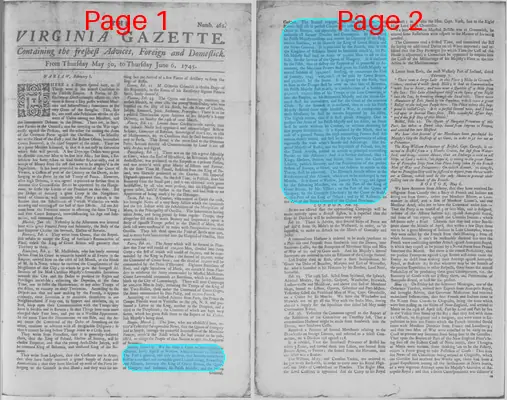
The Virginia Gazette
Richmond, Williamsburg, Richmond County, Virginia
What is this article about?
Report from The Hague on the Quadruple Alliance signed at Warsaw on January 8, 1745, between Great Britain, Hungary-Bohemia, Poland, and the States General, outlining mutual defense, subsidies, and invitations for others to join amid European conflicts.
Merged-components note: Continuation of the same article detailing the Quadruple Alliance across pages.
Clippings
1 of 2
OCR Quality
Full Text
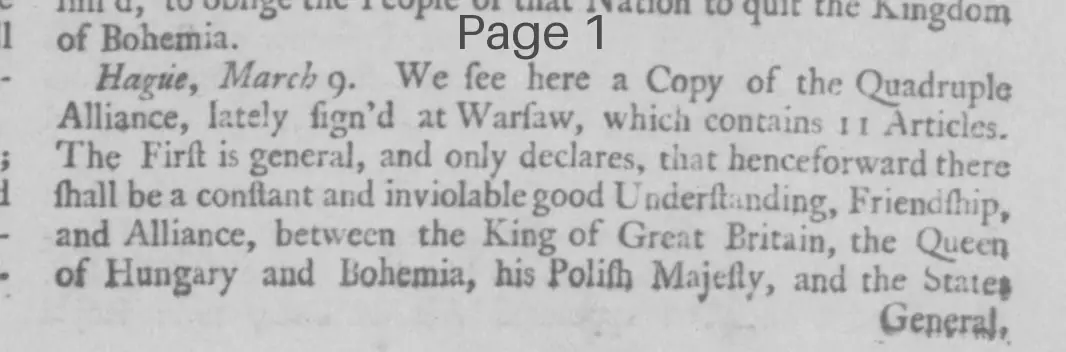
General. The Second engages, that the High contracting Powers shall act in perfect Concert, for restoring Peace and good Order in Europe, and especially in the Empire, as well as to maintain all former Treaties and Guarantees. By the Third his Polish Majesty confirms and renews his Guaranty of the Pragmatic Sanction, as do likewise the King of Great Britain and the States General. It is provided by the Fourth, that in case the Kingdom of Bohemia should be hereafter attack'd, his Polish Majesty shall send an Army of 30,000 Men to act on that Side, for the Service of the Queen of Hungary. It is declared by the Fifth, that to defray the Expence of so powerful an Armament, the Maritime Powers shall grant his Polish Majesty an annual Subsidy of 150,000 l. Sterling, to commence the First of January, 1745. 100,000 l. to be paid by Great Britain, and 50,000 l. by the States. It is agreed by the Sixth, that as soon as the Danger shall be over on that Side of Bohemia, his Polish Majesty shall march, in Consideration of a Subsidy of 90,000 l. 10,000 Men of his Troops in the Low Countries, or into the Empire, as his Britannick Majesty and the States General shall see convenient, and for the Good of the common Cause. By the Seventh it is declared, that in case his Polish Majesty should draw upon himself a War, in consequence of these Measures, he shall be therein supported by his Allies. The Eighth recites, that if it shall please Almighty God to prosper the Arms of his Polish Majesty and his Allies, no Peace shall be made without his Consent, or without obtaining for him proper Satisfaction. It is stipulated by the Ninth, that in case of a general Peace, the high contracting Powers shall still remain closely united, and shall let slip no Opportunity of acting vigorously for each other's Benefit and Advantage. Her Imperial Majesty of Russia, and the Republick of Poland, are, by the Tenth Article, invited to accede as principal contracting Parties to this Alliance : And it is further declared, that all Kings, Electors, Princes and States, that have the Cause of Liberty, publick Security, and the Preservation of the present System of Europe, at Heart, and are desirous to accede to this Treaty, shall be admitted. The Eleventh Article relates to the Ratifications of this Alliance, which are to be exchanged in two Months. It is dated at Warsaw, January 8th, 1745, and signed by the following Ministers, viz. on the Part of the King of Great Britain, by Mr. Villiers ; on the Part of the Queen of Hungary, by the Count de Esterhazi; by the Count de Bruhl, on the Part of the King of Poland; and by M. Kalkoen, on the Part of the States General of the United Provinces.
What sub-type of article is it?
What keywords are associated?
What entities or persons were involved?
Where did it happen?
Foreign News Details
Primary Location
Warsaw
Event Date
January 8th, 1745
Key Persons
Outcome
signing of the quadruple alliance with 11 articles establishing perpetual alliance, mutual defense commitments, subsidies, guarantees of the pragmatic sanction, and invitations for russia and poland to accede.
Event Details
The Quadruple Alliance was signed at Warsaw containing 11 articles: declaring perpetual friendship among Great Britain, Hungary-Bohemia, Poland, and States General; committing to restore peace in Europe and maintain treaties; renewing guarantee of Pragmatic Sanction; Poland to send 30,000 men to defend Bohemia with subsidy of 150,000 l. from maritime powers; post-danger, 10,000 Polish troops to Low Countries or Empire with 90,000 l. subsidy; support for Poland if war ensues; no peace without Poland's consent; continued union post-peace; invitation to Russia and Poland to join, and others supporting European liberty; ratifications in two months.