Thank you for visiting SNEWPapers!
Sign up free
Letter to Editor
September 23, 1800
The New Hampshire Gazette
Portsmouth, Rockingham County, New Hampshire
What is this article about?
Surgeon I. Park recounts the yellow fever outbreak on the USS Warren from June to July 1800, attributing it to climate and poor nutrition rather than contagion. He describes symptoms, treatments using calomel and stimuli, and outcomes: 100 cases, 39 deaths. The crew recovered upon reaching Havana.
Clipping
OCR Quality
98%
Excellent
Full Text
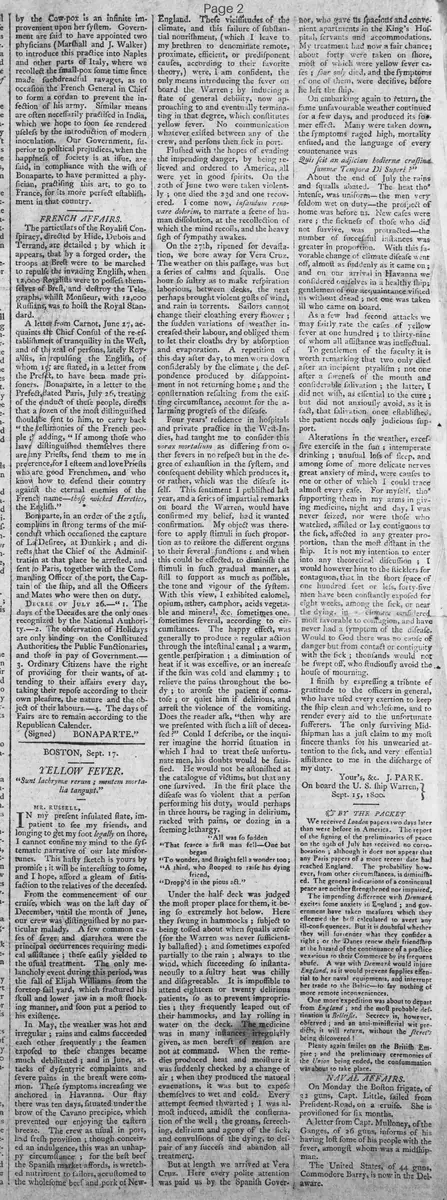
BOSTON, Sept. 17.
YELLOW FEVER.
"Sunt lachrymæ rerum; mentem mortalia tangunt."
MR. RUSSELL,
In my present insulated state, impatient to see my friends, and longing to get my foot legally on shore, I cannot confine my mind to the systematic narrative of our late misfortunes. This hasty sketch is yours by promise; it will be interesting to some, and I hope, afford a gleam of satisfaction to the relatives of the deceased.
From the commencement of our cruise, which was on the 1st day of December, until the month of June, our crew was distinguished by no particular malady. A few common cases of fever and diarrhoea were the principal occurrences requiring medical assistance; these easily yielded to the usual treatment. The only melancholy event during this period, was the fall of Elijah Williams from the foretop-sail yard, which fractured his skull and lower jaw in a most shocking manner, and soon put a period to his existence.
In May, the weather was hot and irregular; rains and calms succeeded each other frequently; the seamen exposed to these changes became much debilitated; and in June, attacks of dysenteric complaints and severe pains in the breast were common. These symptoms increasing we anchored in Havana. Our stay there was ten days, situated under the brow of the Havana precipice, which prevented our enjoying the eastern breeze. The crew as usual in port, had fresh provision; though conceived an indulgence, this was an unhappy circumstance; for the best beef the Spanish market affords, is wretched nutriment to sailors, accustomed to the wholesome beef and pork of New England. These vicissitudes of the climate, and this failure of substantial nourishment, (which I leave to my brethren to denominate remote, proximate, efficient, or predisponent causes, according to their favorite theory,) were, I am confident, the only means introducing the fever on board the Warren; by inducing a state of general debility, now approaching to and eventually terminating in that degree, which constitutes yellow fever. No communication whatever existed between any of the crew, and persons then sick in port.
Flushed with the hopes of evading the impending danger, by being relieved and ordered to America, all were yet in good spirits. On the 20th of June two were taken violently; one died the 23d and one recovered. I come now, infandum renovare dolorem, to narrate a scene of human dissolution, at the recollection of which the mind recoils, and the heavy sigh of sympathy awakes.
On the 27th, ripened for devastation, we bore away for Vera Cruz. The weather on this passage, was but a series of calms and squalls. One hour so sultry as to make respiration laborious, between decks, the next perhaps brought violent gusts of wind, and rain in torrents. Sailors cannot change their clothing every shower; the sudden variations of weather increased their labour, and obliged them to let their clothes dry by absorption and evaporation. A repetition of this day after day, to men worn down considerably by the climate; the despondence produced by disappointment in not returning home; and the consternation resulting from the existing circumstance, account for the alarming progress of the disease.
Four years' residence in hospital and private practice in the West-Indies, had taught me to consider this vorax mortalium as differing from other fevers in no respect but in the degree of exhaustion in the system, and consequent debility which produces it, or rather, which was the disease itself. This sentiment I published last year, and a series of impartial remarks on board the Warren, would have confirmed my belief, had it wanted confirmation. My object was therefore to apply stimuli in such proportion as to restore the different organs to their several functions; and when this could be effected, to diminish the stimuli in such gradual manner, as still to support as much as possible, the tone and vigour of the system.
With this view, I exhibited calomel, opium, ether, camphor, acids vegetable and mineral, &c. sometimes one, sometimes several, according to circumstances. The happy effect, was generally to produce a regular action through the intestinal canal; a warm, gentle perspiration; a diminution of heat if it was excessive, or an increase if the skin was cold and clammy; to relieve the pains throughout the body; to arouse the patient if comatose: or quiet him if delirious, and arrest the violence of the vomiting.
Does the reader ask, "then why are we presented with such a list of deceased?" Could I describe, or the inquirer imagine the horrid situation in which I had to treat these unfortunate men, his doubts would be satisfied. He would not be astonished at the catalogue of victims, but that any one survived. In the first place the disease was so violent that a person performing his duty, would perhaps in three hours, be raging in delirium, racked with pains, or dozing in a seeming lethargy.
"All was so sudden
That scarce a first man fell—One but began
To wonder, and straight fell a wonder too;
A third, who stooped to raise his dying friend,
Dropp'd in the pious act."
Under the half deck was judged the most proper place for them, it being so extremely hot below. Here they swung in hammocks; subject to being tossed about when squalls arose (for the Warren was never sufficiently ballasted); and sometimes exposed partially to the rain; always to the wind, which succeeding so instantaneously to a sultry heat was chilly and disagreeable. It is impossible to attend eighteen or twenty delirious patients, so as to prevent improprieties; they frequently leaped out of their hammocks, and lay rolling in water on the deck. The medicine was in many instances irregularly given, as men bereft of reason are not at command. When the remedies produced heat and moisture it was suddenly checked by a change of air; when they produced the natural evacuations, it was but to expose themselves to wet and cold. Every attempt seemed thwarted; I was almost induced, amidst the consternation of the well; the groans, screeching, delirium and agony of the sick, and convulsions of the dying, to despair of any success and abandon all treatment.
But at length we arrived at Vera Cruz. Here every polite attention was paid us by the Spanish Governor, who gave us spacious and convenient apartments in the King's Hospital, servants and accommodations. My treatment had now a fair chance; about forty were taken on shore, most of which were yellow fever cases; four only died, and the symptoms of one of them, were decisive, before he left the ship.
On embarking again to return, the same unfavourable weather continued for a few days, and produced its former effect. Many were taken down, the symptoms raged high, mortality ensued, and the language of every countenance was
Quis cit an adjiciam hodiernae crastina summa
Tempora di superi?
About the end of July the rains and squalls abated. The heat though intense, was uniform—the men very seldom wet on duty—the prospect of home was before us. New cases were rare; the sickness of those who did not survive, was protracted—the number of successful instances was greater in proportion. With this favorable change of climate disease went off, almost as suddenly as it came on; and on our arrival in Havana we considered ourselves in a healthy ship; gentlemen of our acquaintance visited us without dread; not one was taken ill who came on board.
As a few had second attacks we may fairly rate the cases of yellow fever at one hundred; to thirty-nine of whom all assistance was ineffectual. To gentlemen of the faculty it is worth remarking that two only died after an incipient ptyalism; not one after a soreness of the mouth and considerable salivation: the latter, I did not wish, as essential to the cure; but did not anxiously avoid, as it is fact, that salivation once established, the patient needs only judicious support.
Alterations in the weather, excessive exercise in the sun: intemperate drinking; unusual loss of sleep, and among some of more delicate nerves great anxiety of mind, were causes to one or other of which I could trace almost every case. For myself, though supporting them in my arms in giving medicine, night and day, I was never seized, nor were those who watched, assisted or lay contiguous to the sick, affected in any greater proportion, than the most distant in the ship. It is not my intention to enter into any theoretical discussion: I would however hint to the sticklers for contagion, that in the short space of one hundred feet or less, forty-five men have been constantly exposed for eight weeks, among the sick, or near the dying, in a climate considered most favorable to contagion, and have never had a symptom of the disease.
Would to God there was no cause of danger but from contact or contiguity with the sick; thousands would not be swept off, who studiously avoid the house of mourning.
I finish by expressing a tribute of gratitude to the officers in general, who have used every exertion to keep the ship clean and wholesome, and to render every aid to the unfortunate sufferers. The only surviving Midshipman has a just claim to my most sincere thanks for his unwearied attention to the sick, and very essential assistance to me in the discharge of my duty.
Your's, &c. I. PARK.
On board the U. S. ship Warren, Sept. 15, 1800.
YELLOW FEVER.
"Sunt lachrymæ rerum; mentem mortalia tangunt."
MR. RUSSELL,
In my present insulated state, impatient to see my friends, and longing to get my foot legally on shore, I cannot confine my mind to the systematic narrative of our late misfortunes. This hasty sketch is yours by promise; it will be interesting to some, and I hope, afford a gleam of satisfaction to the relatives of the deceased.
From the commencement of our cruise, which was on the 1st day of December, until the month of June, our crew was distinguished by no particular malady. A few common cases of fever and diarrhoea were the principal occurrences requiring medical assistance; these easily yielded to the usual treatment. The only melancholy event during this period, was the fall of Elijah Williams from the foretop-sail yard, which fractured his skull and lower jaw in a most shocking manner, and soon put a period to his existence.
In May, the weather was hot and irregular; rains and calms succeeded each other frequently; the seamen exposed to these changes became much debilitated; and in June, attacks of dysenteric complaints and severe pains in the breast were common. These symptoms increasing we anchored in Havana. Our stay there was ten days, situated under the brow of the Havana precipice, which prevented our enjoying the eastern breeze. The crew as usual in port, had fresh provision; though conceived an indulgence, this was an unhappy circumstance; for the best beef the Spanish market affords, is wretched nutriment to sailors, accustomed to the wholesome beef and pork of New England. These vicissitudes of the climate, and this failure of substantial nourishment, (which I leave to my brethren to denominate remote, proximate, efficient, or predisponent causes, according to their favorite theory,) were, I am confident, the only means introducing the fever on board the Warren; by inducing a state of general debility, now approaching to and eventually terminating in that degree, which constitutes yellow fever. No communication whatever existed between any of the crew, and persons then sick in port.
Flushed with the hopes of evading the impending danger, by being relieved and ordered to America, all were yet in good spirits. On the 20th of June two were taken violently; one died the 23d and one recovered. I come now, infandum renovare dolorem, to narrate a scene of human dissolution, at the recollection of which the mind recoils, and the heavy sigh of sympathy awakes.
On the 27th, ripened for devastation, we bore away for Vera Cruz. The weather on this passage, was but a series of calms and squalls. One hour so sultry as to make respiration laborious, between decks, the next perhaps brought violent gusts of wind, and rain in torrents. Sailors cannot change their clothing every shower; the sudden variations of weather increased their labour, and obliged them to let their clothes dry by absorption and evaporation. A repetition of this day after day, to men worn down considerably by the climate; the despondence produced by disappointment in not returning home; and the consternation resulting from the existing circumstance, account for the alarming progress of the disease.
Four years' residence in hospital and private practice in the West-Indies, had taught me to consider this vorax mortalium as differing from other fevers in no respect but in the degree of exhaustion in the system, and consequent debility which produces it, or rather, which was the disease itself. This sentiment I published last year, and a series of impartial remarks on board the Warren, would have confirmed my belief, had it wanted confirmation. My object was therefore to apply stimuli in such proportion as to restore the different organs to their several functions; and when this could be effected, to diminish the stimuli in such gradual manner, as still to support as much as possible, the tone and vigour of the system.
With this view, I exhibited calomel, opium, ether, camphor, acids vegetable and mineral, &c. sometimes one, sometimes several, according to circumstances. The happy effect, was generally to produce a regular action through the intestinal canal; a warm, gentle perspiration; a diminution of heat if it was excessive, or an increase if the skin was cold and clammy; to relieve the pains throughout the body; to arouse the patient if comatose: or quiet him if delirious, and arrest the violence of the vomiting.
Does the reader ask, "then why are we presented with such a list of deceased?" Could I describe, or the inquirer imagine the horrid situation in which I had to treat these unfortunate men, his doubts would be satisfied. He would not be astonished at the catalogue of victims, but that any one survived. In the first place the disease was so violent that a person performing his duty, would perhaps in three hours, be raging in delirium, racked with pains, or dozing in a seeming lethargy.
"All was so sudden
That scarce a first man fell—One but began
To wonder, and straight fell a wonder too;
A third, who stooped to raise his dying friend,
Dropp'd in the pious act."
Under the half deck was judged the most proper place for them, it being so extremely hot below. Here they swung in hammocks; subject to being tossed about when squalls arose (for the Warren was never sufficiently ballasted); and sometimes exposed partially to the rain; always to the wind, which succeeding so instantaneously to a sultry heat was chilly and disagreeable. It is impossible to attend eighteen or twenty delirious patients, so as to prevent improprieties; they frequently leaped out of their hammocks, and lay rolling in water on the deck. The medicine was in many instances irregularly given, as men bereft of reason are not at command. When the remedies produced heat and moisture it was suddenly checked by a change of air; when they produced the natural evacuations, it was but to expose themselves to wet and cold. Every attempt seemed thwarted; I was almost induced, amidst the consternation of the well; the groans, screeching, delirium and agony of the sick, and convulsions of the dying, to despair of any success and abandon all treatment.
But at length we arrived at Vera Cruz. Here every polite attention was paid us by the Spanish Governor, who gave us spacious and convenient apartments in the King's Hospital, servants and accommodations. My treatment had now a fair chance; about forty were taken on shore, most of which were yellow fever cases; four only died, and the symptoms of one of them, were decisive, before he left the ship.
On embarking again to return, the same unfavourable weather continued for a few days, and produced its former effect. Many were taken down, the symptoms raged high, mortality ensued, and the language of every countenance was
Quis cit an adjiciam hodiernae crastina summa
Tempora di superi?
About the end of July the rains and squalls abated. The heat though intense, was uniform—the men very seldom wet on duty—the prospect of home was before us. New cases were rare; the sickness of those who did not survive, was protracted—the number of successful instances was greater in proportion. With this favorable change of climate disease went off, almost as suddenly as it came on; and on our arrival in Havana we considered ourselves in a healthy ship; gentlemen of our acquaintance visited us without dread; not one was taken ill who came on board.
As a few had second attacks we may fairly rate the cases of yellow fever at one hundred; to thirty-nine of whom all assistance was ineffectual. To gentlemen of the faculty it is worth remarking that two only died after an incipient ptyalism; not one after a soreness of the mouth and considerable salivation: the latter, I did not wish, as essential to the cure; but did not anxiously avoid, as it is fact, that salivation once established, the patient needs only judicious support.
Alterations in the weather, excessive exercise in the sun: intemperate drinking; unusual loss of sleep, and among some of more delicate nerves great anxiety of mind, were causes to one or other of which I could trace almost every case. For myself, though supporting them in my arms in giving medicine, night and day, I was never seized, nor were those who watched, assisted or lay contiguous to the sick, affected in any greater proportion, than the most distant in the ship. It is not my intention to enter into any theoretical discussion: I would however hint to the sticklers for contagion, that in the short space of one hundred feet or less, forty-five men have been constantly exposed for eight weeks, among the sick, or near the dying, in a climate considered most favorable to contagion, and have never had a symptom of the disease.
Would to God there was no cause of danger but from contact or contiguity with the sick; thousands would not be swept off, who studiously avoid the house of mourning.
I finish by expressing a tribute of gratitude to the officers in general, who have used every exertion to keep the ship clean and wholesome, and to render every aid to the unfortunate sufferers. The only surviving Midshipman has a just claim to my most sincere thanks for his unwearied attention to the sick, and very essential assistance to me in the discharge of my duty.
Your's, &c. I. PARK.
On board the U. S. ship Warren, Sept. 15, 1800.
What sub-type of article is it?
Informative
Historical
Reflective
What themes does it cover?
Health Medicine
Military War
What keywords are associated?
Yellow Fever
Uss Warren
Naval Outbreak
Medical Treatment
Contagion Debate
Climate Causes
Havana
Vera Cruz
What entities or persons were involved?
I. Park
Mr. Russell
Letter to Editor Details
Author
I. Park
Recipient
Mr. Russell
Main Argument
yellow fever on the uss warren resulted from climate vicissitudes and poor nutrition causing debility, not contagion; treatments with stimuli like calomel were effective when conditions allowed, leading to 100 cases and 39 deaths.
Notable Details
Quotes Virgil: 'Sunt Lachrymæ Rerum; Mentem Mortalia Tangunt.'
References Prior Publication On Yellow Fever
Treatments: Calomel, Opium, Ether, Camphor, Acids
Argues Against Contagion Based On Non Transmission To Caregivers
Mentions Elijah Williams' Accidental Death