Thank you for visiting SNEWPapers!
Sign up free
Editorial
November 30, 1888
The Seattle Post Intelligencer
Seattle, King County, Washington
What is this article about?
Editorial critiques Prof. Goldwin Smith's support for commercial union between the US and British-American provinces, arguing it would disadvantage US industries, particularly in Washington Territory, by introducing competition without benefits.
Clipping
OCR Quality
98%
Excellent
Full Text
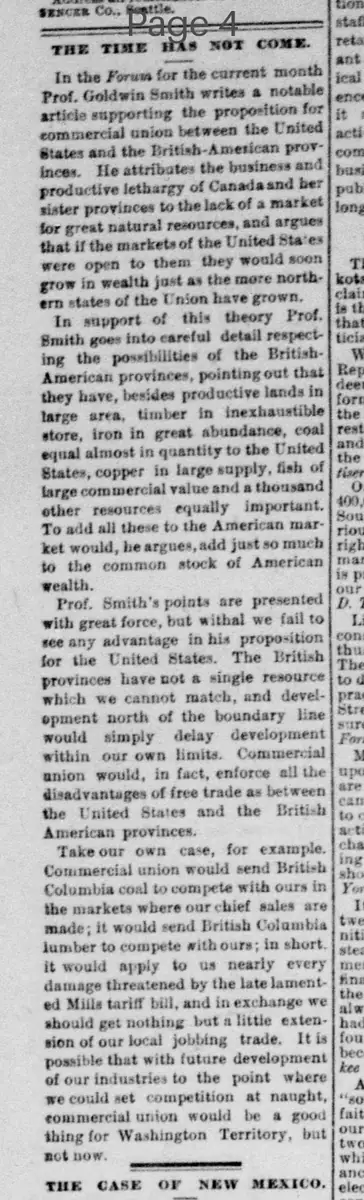
THE TIME HAS NOT COME.
In the Forum for the current month Prof. Goldwin Smith writes a notable article supporting the proposition for commercial union between the United States and the British-American provinces. He attributes the business and productive lethargy of Canada and her sister provinces to the lack of a market for great natural resources, and argues that if the markets of the United States were open to them they would soon grow in wealth just as the more northern states of the Union have grown.
In support of this theory Prof. Smith goes into careful detail respecting the possibilities of the British-American provinces, pointing out that they have, besides productive lands in large area, timber in inexhaustible store, iron in great abundance, coal equal almost in quantity to the United States, copper in large supply, fish of large commercial value and a thousand other resources equally important.
To add all these to the American market would, he argues, add just so much to the common stock of American wealth.
Prof. Smith's points are presented with great force, but withal we fail to see any advantage in his proposition for the United States. The British provinces have not a single resource which we cannot match, and development north of the boundary line would simply delay development within our own limits. Commercial union would, in fact, enforce all the disadvantages of free trade as between the United States and the British American provinces.
Take our own case, for example. Commercial union would send British Columbia coal to compete with ours in the markets where our chief sales are made; it would send British Columbia lumber to compete with ours; in short, it would apply to us nearly every damage threatened by the late lamented Mills tariff bill, and in exchange we should get nothing but a little extension of our local jobbing trade. It is possible that with future development of our industries to the point where we could set competition at naught, commercial union would be a good thing for Washington Territory, but not now.
In the Forum for the current month Prof. Goldwin Smith writes a notable article supporting the proposition for commercial union between the United States and the British-American provinces. He attributes the business and productive lethargy of Canada and her sister provinces to the lack of a market for great natural resources, and argues that if the markets of the United States were open to them they would soon grow in wealth just as the more northern states of the Union have grown.
In support of this theory Prof. Smith goes into careful detail respecting the possibilities of the British-American provinces, pointing out that they have, besides productive lands in large area, timber in inexhaustible store, iron in great abundance, coal equal almost in quantity to the United States, copper in large supply, fish of large commercial value and a thousand other resources equally important.
To add all these to the American market would, he argues, add just so much to the common stock of American wealth.
Prof. Smith's points are presented with great force, but withal we fail to see any advantage in his proposition for the United States. The British provinces have not a single resource which we cannot match, and development north of the boundary line would simply delay development within our own limits. Commercial union would, in fact, enforce all the disadvantages of free trade as between the United States and the British American provinces.
Take our own case, for example. Commercial union would send British Columbia coal to compete with ours in the markets where our chief sales are made; it would send British Columbia lumber to compete with ours; in short, it would apply to us nearly every damage threatened by the late lamented Mills tariff bill, and in exchange we should get nothing but a little extension of our local jobbing trade. It is possible that with future development of our industries to the point where we could set competition at naught, commercial union would be a good thing for Washington Territory, but not now.
What sub-type of article is it?
Economic Policy
Trade Or Commerce
What keywords are associated?
Commercial Union
Goldwin Smith
Us Canada Trade
Washington Territory
British Columbia Resources
Free Trade Disadvantages
What entities or persons were involved?
Prof. Goldwin Smith
United States
British American Provinces
Canada
Washington Territory
British Columbia
Editorial Details
Primary Topic
Opposition To Commercial Union With British Provinces
Stance / Tone
Against Commercial Union
Key Figures
Prof. Goldwin Smith
United States
British American Provinces
Canada
Washington Territory
British Columbia
Key Arguments
British Provinces' Resources Would Compete With Us Ones, Delaying Domestic Development.
Commercial Union Imposes Free Trade Disadvantages Without Us Gains.
British Columbia Coal And Lumber Would Compete In Us Markets.
Similar To Damages From The Mills Tariff Bill.
Only Minor Extension Of Local Jobbing Trade In Exchange.
Future Industrial Development Might Make It Beneficial, But Not Now.