Thank you for visiting SNEWPapers!
Sign up free
The New Hampshire Gazette And Historical Chronicle
Portsmouth, Greenland, Rockingham County, New Hampshire
What is this article about?
Monthly guide from March to September on wheat farming practices, including late sowing in March, weeding in April, fallow preparation in May-August, and sowing in September, emphasizing soil management, seed choice, and weed control from 'The Compleat Body of Husbandry.'
Merged-components note: Continuation of 'The Husbandman's Kalender' article on wheat cultivation across pages 1 and 2; original label of second component changed from 'story' to 'literary' to match the serialized agricultural essay format.
Clippings
1 of 2
OCR Quality
Full Text
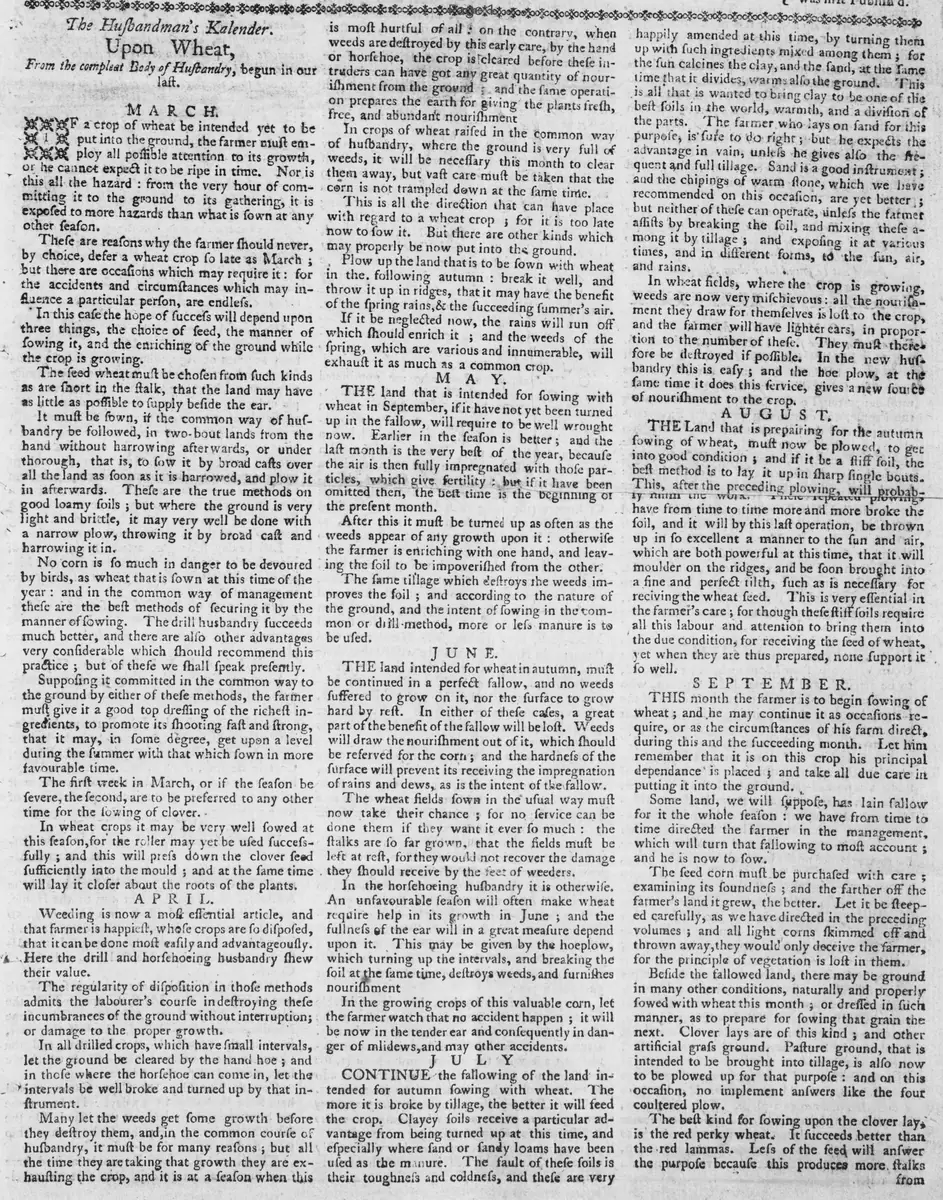
Upon Wheat,
From the compleat Body of Husbandry, begun in our last.
MARCH
If a crop of wheat be intended yet to be put into the ground, the farmer must employ all possible attention to its growth, or he cannot expect it to be ripe in time. Nor is this all the hazard: from the very hour of committing it to the ground to its gathering, it is exposed to more hazards than what is known at any other season.
There are reasons why the farmer should never, by choice, defer a wheat crop so late as March; but there are occasions which may require it: for the accidents and circumstances which may influence a particular person, are endless.
In this case the hope of success will depend upon three things, the choice of seed, the manner of sowing it, and the enriching of the ground while the crop is growing.
The seed wheat must be chosen from such kinds as are short in the stalk, that the land may have as little as possible to supply beside the ear.
It must be sown, if the common way of husbandry be followed, in two-bout lands from the hand without harrowing afterwards, or under thorough, that is, to sow it by broad cast over all the land as soon as it is harrowed, and plow it in afterwards. These are the true methods on good loamy soils; but where the ground is very light and brittle, it may very well be done with a narrow plow, throwing it by broad cast and harrowing it in.
No corn is so much in danger to be devoured by birds, as wheat that is sown at this time of the year: and in the common way of management these are the best methods of securing it by the manner of sowing. The drill husbandry succeeds much better, and there are also other advantages very considerable which should recommend this practice; but of these we shall speak presently.
Supposing it committed in the common way to the ground by either of these methods, the farmer must give it a good top dressing of the richest ingredients, to promote its shooting fast and strong, that it may, in some degree, get upon a level during the summer with that which sown in more favourable time.
The first week in March, or if the season be severe, the second, are to be preferred to any other time for the sowing of clover.
In wheat crops it may be very well sowed at this season, for the roller may yet be used successfully; and this will press down the clover seed sufficiently into the mould; and at the same time will lay it closer about the roots of the plants.
APRIL.
Weeding is now a most essential article, and that farmer is happiest, whose crops are so disposed, that it can be done most easily and advantageously.
Here the drill and horsehoeing husbandry show their value.
The regularity of disposition in those methods admits the labourer's course in destroying these incumbrances of the ground without interruption; or damage to the proper growth.
In all drilled crops, which have small intervals, let the ground be cleared by the hand hoe; and in those where the horsehoe can come in, let the intervals be well broke and turned up by that instrument.
Many let the weeds get some growth before they destroy them, and in the common course of husbandry, it must be for many reasons; but all the time they are taking that growth they are exhausting the crop, and it is at a season when this is most hurtful of all: on the contrary, when weeds are destroyed by this early care, by the hand or horsehoe, the crop is cleared before these intruders can have got any great quantity of nourishment from the ground; and the same operation prepares the earth for giving the plants fresh, free, and abundant nourishment.
In crops of wheat raised in the common way of husbandry, where the ground is very full of weeds, it will be necessary this month to clear them away, but vast care must be taken that the corn is not trampled down at the same time.
This is all the direction that can have place with regard to a wheat crop; for it is too late now to sow it. But there are other kinds which may properly be now put into the ground.
Plow up the land that is to be sown with wheat in the following autumn: break it well, and throw it up in ridges, that it may have the benefit of the spring rains, & the succeeding summer's air.
If it be neglected now, the rains will run off which should enrich it; and the weeds of the spring, which are various and innumerable, will exhaust it as much as a common crop.
MAY.
THE land that is intended for sowing with wheat in September, if it have not yet been turned up in the fallow, will require to be well wrought now. Earlier in the season is better: and the last month is the very best of the year, because the air is then fully impregnated with those particles, which give fertility: but if it have been omitted then, the best time is the beginning of the present month.
After this it must be turned up as often as the weeds appear of any growth upon it: otherwise the farmer is enriching with one hand, and leaving the soil to be impoverished from the other.
The same tillage which destroys the weeds improves the soil; and according to the nature of the ground, and the intent of sowing in the common or drill-method, more or less manure is to be used.
JUNE.
THE land intended for wheat in autumn, must be continued in a perfect fallow, and no weeds suffered to grow on it, nor the surface to grow hard by rest. In either of these cases, a great part of the benefit of the fallow will be lost. Weeds will draw the nourishment out of it, which should be reserved for the corn: and the hardness of the surface will prevent its receiving the impregnation of rains and dews, as is the intent of the fallow.
The wheat fields sown in the usual way must now take their chance; for no service can be done them if they want it ever so much: the stalks are so far grown. that the fields must be left at rest, for they would not recover the damage they should receive by the feet of weeders.
In the horsehoeing husbandry it is otherwise.
An unfavourable season will often make wheat require help in its growth in June; and the fullness of the ear will in a great measure depend upon it. This may be given by the hoeplow, which turning up the intervals, and breaking the soil at the same time, destroys weeds, and furnishes nourishment.
In the growing crops of this valuable corn, let the farmer watch that no accident happen; it will be now in the tender ear and consequently in danger of mildews, and many other accidents.
JULY
CONTINUE the fallowing of the land intended for autumn sowing with wheat. The more it is broke by tillage, the better it will feed the crop. Clayey soils receive a particular advantage from being turned up at this time, and especially where sand or sandy loams have been used as the manure. The fault of these soils is their toughness and coldness, and these are very happily amended at this time, by turning them up with such ingredients mixed among them; for the sun calcines the clay, and the sand, at the same time that it divides, warms also the ground. This is all that is wanted to bring clay to be one of the best soils in the world, warmth, and a division of the parts. The farmer who lays on sand for this purpose, is sure to do right; but he expects the advantage in vain, unless he gives also the frequent and full tillage. Sand is a good instrument; and the chippings of warm ones, which we have recommended on this occasion, are yet better; but neither of these can operate, unless the farmer assists by breaking the soil, and mixing these among it by tillage; and exposing it at various times, and in different forms, to the sun, air, and rains.
In wheat fields, where the crop is growing, weeds are now very mischievous: all the nourishment they draw for themselves is lost to the crop- and the farmer will have lighter ears, in proportion to the number of these. They must therefore be destroyed if possible. In the new husbandry this is easy; and the hoe plow, at the same time it does this service, gives a new source of nourishment to the crop.
AUGUST
THE Land that is preparing for the autumn sowing of wheat, must now be plowed, to get into good condition; and if it be a stiff soil. the best method is to lay it up in sharp single bouts. This, after the preceding plowing, will probably have from time to time more and more broke the soil, and it will by this last operation, be thrown up in so excellent a manner to the sun and air. which are both powerful at this time, that it will moulder on the ridges, and be soon brought into a fine and perfect tilth, such as is necessary for receiving the wheat seed. This is very essential in the farmer's care; for though these stiff soils require all this labour and attention to bring them into the due condition. for receiving the seed of wheat, yet when they are thus prepared, none support it so well.
SEPTEMBER.
THIS month the farmer is to begin sowing of wheat : and he may continue it as occasions require, or as the circumstances of his farm direct. during this and the succeeding month. Let him remember that it is on this crop his principal dependance is placed ; and take all due care in putting it into the ground.
Some land, we will suppose, has lain fallow for it the whole season : we have from time to time directed the farmer in the management, which will turn that fallowing to most account ; and he is now to sow.
The seed corn must be purchased with care ; examining its soundness ; and the farther off the farmer's land it grew, the better. Let it be steeped carefully, as we have directed in the preceding volumes ; and all light corns skimmed off and thrown away,they would only deceive the farmer, for the principle of vegetation is lost in them.
Beside the fallowed land, there may be ground in many other conditions, naturally and properly sowed with wheat this month ; or dressed in such manner, as to prepare for sowing that grain the next. Clover lays are of this kind ; and other artificial grass ground. Pasture ground, that is intended to be brought into tillage, is also now to be plowed up for that purpose : and on this occasion, no implement answers like the four coultered plow.
The best kind for sowing upon the clover lay is the red perky wheat. It succeeds better than the red lammas. Less of the seed will answer the purpose because this produces more. stalks
From each root; and the price it brings to market is nearly the same.
When the seed is harrowed in, the farmer ought to have a watchful eye over the business: for the purpose is to cover seed without raising up any of the roots of grass or weeds, which had grown among the clover. The more harrowing is used, the more danger there is of this; but so much be allowed as will cover the seed. Let the ground be harrowed twice or three times lengthwise, and let him observe whether this raises enough of the mould for the proper covering of the seed corn: if it does, let there be nothing more done in this matter. If this do not raise enough of the mould, it must be harrowed crosswise. This must be done with great art and care, for it is in this the danger lies, of pulling forth the roots of weeds, which will by that means be set to growing.
The sowing wheat upon a plowed stubble, is not a practice for this season of the year, but it is so hazardous, that we can scarce recommend it to the farmer. If he will venture upon it, let him take the proper caution.
This season sow wheat also on the pea stubble; there is nothing wheat fallows better than pease, but care must be taken to refresh the ground in spring by a top dressing, while the wheat is growing:
N.B. As the frosts come on sooner in this country than in England, so the clover-lays and pasture ground ought to be plowed up a month or two earlier than is before directed: Also Wheat should not be sowed later than August or the beginning of September.
What sub-type of article is it?
What themes does it cover?
What keywords are associated?
What entities or persons were involved?
Literary Details
Title
The Husbandman's Kalender. Upon Wheat
Author
From The Compleat Body Of Husbandry
Subject
Monthly Instructions For Wheat Cultivation
Form / Style
Prose Agricultural Guide With Seasonal Sections
Key Lines