Thank you for visiting SNEWPapers!
Sign up free
Story
December 28, 1825
Phenix Gazette
Alexandria, Virginia
What is this article about?
Biographical account of Sir Andrew Wood, Scottish naval commander under James IV, who defeated English ships in the Firth of Forth in the late 15th century, capturing vessels and earning royal rewards for his bravery and skill.
Clipping
OCR Quality
98%
Excellent
Full Text
Sir Andrew Wood.
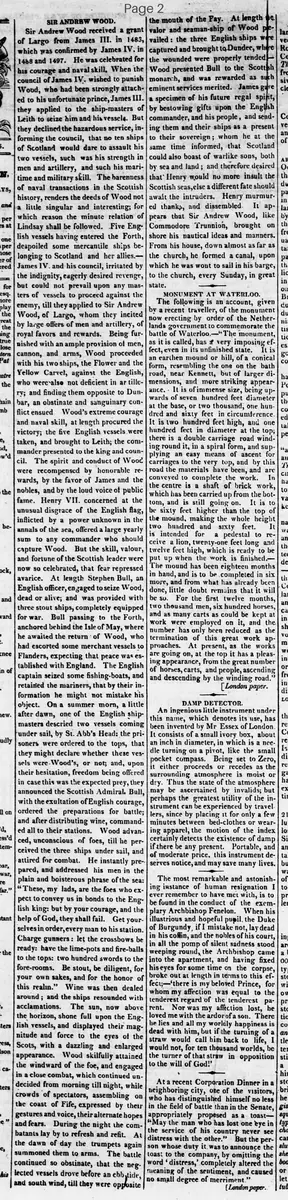
Sir Andrew Wood received a grant of Largo from James III. in 1483, which was confirmed by James IV. in 1488 and 1497. He was celebrated for his courage and naval skill. When the council of James IV. wished to punish Wood, who had been strongly attached to his unfortunate prince, James III., they applied to the ship-masters of Leith to seize him and his vessels. But they declined the hazardous service, informing the council, that no ten ships of Scotland would dare to assault his two vessels, such was his strength in men and artillery, and such his maritime and military skill. The barrenness of naval transactions in the Scottish history, renders the deeds of Wood not a little singular and interesting; for which reason the minute relation of Lindsay shall be followed. Five English vessels having entered the Forth, despoiled some mercantile ships belonging to Scotland and her allies.— James IV. and his council, irritated by the indignity, eagerly desired revenge, but could not prevail upon any masters of vessels to proceed against the enemy, till they applied to Sir Andrew Wood, of Largo, whom they incited by large offers of men and artillery, of royal favors and rewards. Being furnished with an ample provision of men, cannon, and arms, Wood proceeded with his two ships, the Flower and the Yellow Carvel, against the English, who were also not deficient in artillery; and finding them opposite to Dunbar, an obstinate and sanguinary conflict ensued. Wood's extreme courage and naval skill, at length procured the victory; the five English vessels were taken, and brought to Leith; the commander presented to the king and council. The spirit and conduct of Wood were recompensed by honorable rewards, by the favor of James and the nobles, and by the loud voice of public fame. Henry VII. concerned at the unusual disgrace of the English flag, inflicted by a power unknown in the annals of the sea, offered a large yearly sum to any commander who should capture Wood. But the skill, valour, and fortune of the Scottish leader were now so celebrated, that fear repressed avarice. At length Stephen Bull, an English officer, engaged to seize Wood, dead or alive; and was provided with three stout ships, completely equipped for war. Bull passing to the Forth, anchored behind the Isle of May, where he awaited the return of Wood, who had escorted some merchant vessels to Flanders, expecting that peace was established with England. The English captain seized some fishing-boats, and retained the mariners, that by their information he might not mistake his object. On a summer morn, a little after dawn, one of the English ship-masters descried two vessels coming under sail, by St. Abb's Head: the prisoners were ordered to the tops, that they might declare whether these vessels were Wood's, or not; and, upon their hesitation, freedom being offered in case this was the expected prey, they announced the Scottish Admiral. Bull, with the exultation of English courage, ordered the preparations for battle; and after distributing wine, commanded all to their stations. Wood advanced, unconscious of foes, till he perceived the three ships under sail, and attired for combat. He instantly prepared, and addressed his men in the plain and boisterous phrase of the sea: "These, my lads, are the foes who expect to convey us in bonds to the English king: but by your courage, and the help of God, they shall fail. Get yourselves in order, every man to his station. Charge gunners: let the crossbows be ready: have the lime-pots and fire-balls to the tops: two hundred swords to the fore-rooms. Be stout, be diligent, for your own sakes, and for the honor of this realm." Wine was then dealt around; and the ships resounded with acclamations. The sun, now above the horizon, shone full upon the English vessels, and displayed their magnitude and force to the eyes of the Scots, with a dazzling and enlarged appearance. Wood skilfully attained the windward of the foe, and engaged in a close combat, which continued undecided from morning till night, while crowds of spectators, assembling on the coast of Fife, expressed by their gestures and voice, their alternate hopes and fears. During the night the combatants lay by to refresh and refit. At the dawn of day the trumpets again summoned them to arms. The battle continued so obstinate, that the neglected vessels drove before an ebb tide and south wind, till they were opposite the mouth of the Tay. At length the valor and seamanship of Wood prevailed: the three English ships were captured and brought to Dundee, where the wounded were properly tended. Wood presented Bull to the Scottish monarch, and was rewarded as such eminent services merited. James gave a specimen of his future regal spirit, by bestowing gifts upon the English commander, and his people, and sending them and their ships as a present to their sovereign; whom he at the same time informed, that Scotland could also boast of warlike sons, both by sea and land; and therefore desired that Henry would no more insult the Scottish seas, else a different fate should await the intruders. Henry murmured thanks, and dissembled. It appears that Sir Andrew Wood, like Commodore Trunnion, brought on shore his nautical ideas and manners. From his house, down almost as far as the church, he formed a canal, upon which he was wont to sail in his barge, to the church, every Sunday, in great state.
Sir Andrew Wood received a grant of Largo from James III. in 1483, which was confirmed by James IV. in 1488 and 1497. He was celebrated for his courage and naval skill. When the council of James IV. wished to punish Wood, who had been strongly attached to his unfortunate prince, James III., they applied to the ship-masters of Leith to seize him and his vessels. But they declined the hazardous service, informing the council, that no ten ships of Scotland would dare to assault his two vessels, such was his strength in men and artillery, and such his maritime and military skill. The barrenness of naval transactions in the Scottish history, renders the deeds of Wood not a little singular and interesting; for which reason the minute relation of Lindsay shall be followed. Five English vessels having entered the Forth, despoiled some mercantile ships belonging to Scotland and her allies.— James IV. and his council, irritated by the indignity, eagerly desired revenge, but could not prevail upon any masters of vessels to proceed against the enemy, till they applied to Sir Andrew Wood, of Largo, whom they incited by large offers of men and artillery, of royal favors and rewards. Being furnished with an ample provision of men, cannon, and arms, Wood proceeded with his two ships, the Flower and the Yellow Carvel, against the English, who were also not deficient in artillery; and finding them opposite to Dunbar, an obstinate and sanguinary conflict ensued. Wood's extreme courage and naval skill, at length procured the victory; the five English vessels were taken, and brought to Leith; the commander presented to the king and council. The spirit and conduct of Wood were recompensed by honorable rewards, by the favor of James and the nobles, and by the loud voice of public fame. Henry VII. concerned at the unusual disgrace of the English flag, inflicted by a power unknown in the annals of the sea, offered a large yearly sum to any commander who should capture Wood. But the skill, valour, and fortune of the Scottish leader were now so celebrated, that fear repressed avarice. At length Stephen Bull, an English officer, engaged to seize Wood, dead or alive; and was provided with three stout ships, completely equipped for war. Bull passing to the Forth, anchored behind the Isle of May, where he awaited the return of Wood, who had escorted some merchant vessels to Flanders, expecting that peace was established with England. The English captain seized some fishing-boats, and retained the mariners, that by their information he might not mistake his object. On a summer morn, a little after dawn, one of the English ship-masters descried two vessels coming under sail, by St. Abb's Head: the prisoners were ordered to the tops, that they might declare whether these vessels were Wood's, or not; and, upon their hesitation, freedom being offered in case this was the expected prey, they announced the Scottish Admiral. Bull, with the exultation of English courage, ordered the preparations for battle; and after distributing wine, commanded all to their stations. Wood advanced, unconscious of foes, till he perceived the three ships under sail, and attired for combat. He instantly prepared, and addressed his men in the plain and boisterous phrase of the sea: "These, my lads, are the foes who expect to convey us in bonds to the English king: but by your courage, and the help of God, they shall fail. Get yourselves in order, every man to his station. Charge gunners: let the crossbows be ready: have the lime-pots and fire-balls to the tops: two hundred swords to the fore-rooms. Be stout, be diligent, for your own sakes, and for the honor of this realm." Wine was then dealt around; and the ships resounded with acclamations. The sun, now above the horizon, shone full upon the English vessels, and displayed their magnitude and force to the eyes of the Scots, with a dazzling and enlarged appearance. Wood skilfully attained the windward of the foe, and engaged in a close combat, which continued undecided from morning till night, while crowds of spectators, assembling on the coast of Fife, expressed by their gestures and voice, their alternate hopes and fears. During the night the combatants lay by to refresh and refit. At the dawn of day the trumpets again summoned them to arms. The battle continued so obstinate, that the neglected vessels drove before an ebb tide and south wind, till they were opposite the mouth of the Tay. At length the valor and seamanship of Wood prevailed: the three English ships were captured and brought to Dundee, where the wounded were properly tended. Wood presented Bull to the Scottish monarch, and was rewarded as such eminent services merited. James gave a specimen of his future regal spirit, by bestowing gifts upon the English commander, and his people, and sending them and their ships as a present to their sovereign; whom he at the same time informed, that Scotland could also boast of warlike sons, both by sea and land; and therefore desired that Henry would no more insult the Scottish seas, else a different fate should await the intruders. Henry murmured thanks, and dissembled. It appears that Sir Andrew Wood, like Commodore Trunnion, brought on shore his nautical ideas and manners. From his house, down almost as far as the church, he formed a canal, upon which he was wont to sail in his barge, to the church, every Sunday, in great state.
What sub-type of article is it?
Biography
Naval Engagement
Heroic Act
What themes does it cover?
Bravery Heroism
Triumph
Justice
What keywords are associated?
Sir Andrew Wood
Naval Battle
Scottish Victory
English Ships
James Iv
Firth Of Forth
Heroic Seamanship
What entities or persons were involved?
Sir Andrew Wood
James Iii
James Iv
Henry Vii
Stephen Bull
Where did it happen?
Firth Of Forth, Largo, Leith, Dunbar, Isle Of May, St. Abb's Head, Fife, Tay, Dundee
Story Details
Key Persons
Sir Andrew Wood
James Iii
James Iv
Henry Vii
Stephen Bull
Location
Firth Of Forth, Largo, Leith, Dunbar, Isle Of May, St. Abb's Head, Fife, Tay, Dundee
Event Date
1483, 1488, 1497
Story Details
Sir Andrew Wood, loyal to James III and granted lands by James IV, leads two ships to victory against five English vessels near Dunbar, capturing them. Later, he defeats three English ships under Stephen Bull in the Forth, bringing them to Dundee and earning royal honors.