Thank you for visiting SNEWPapers!
Sign up free
The Mississippi Creole
Canton, Madison County, Mississippi
What is this article about?
Gen. Taylor's Sept. 1, 1846, letter from Camp Near Camargo proposes shipping coarse muslins to Mexico for profitable exchange with locals for army provisions, saving $700,000 and addressing clothing shortages amid scarce money.
Clipping
OCR Quality
Full Text
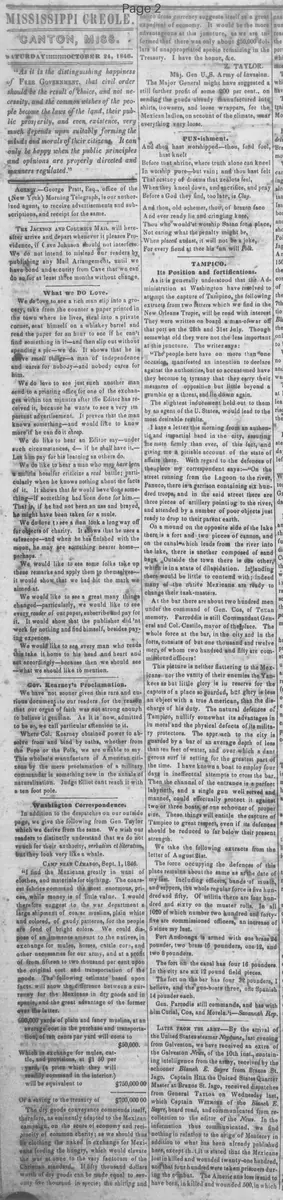
In addition to the despatches on our outside page, we give the following from Gen. Taylor which we derive from the same. We wish our readers to distinctly understand that we do not vouch for their authority, verbatim et literatim, but they look very like a whale.
Camp Near Camargo, Sept. 1, 1846.
"I find the Mexicans greatly in want of clothes, and materials for clothing. The coarsest fabrics command the most enormous prices, while money is of little value. I would therefore suggest to the war department a large shipment of coarse muslins, plain white and colored, of gaudy patterns, for the people are fond of bright colors. We could dispose of an immense amount to the natives, in exchange for mules, horses, cattle, corn, and other necessaries for our army, and at a profit of from fifteen to two thousand per cent upon the original cost and transportation of the goods. The following estimate based upon facts, will show the difference between a currency for the Mexicans in dry goods and in specie, and the great advantage of the former over the latter.
500,000 yards of plain and fancy muslins, at an average cost in the purchase and transportation, of ten cents per yard will come to $50,000.
Which in exchange for mules, cattle, and provisions, at $1.50 per yard, (a price which they will readily command in the interior.) will be equivalent to $750,000.00
Of a saving to the treasury of $700,000.00
The dry goods conveyance commends itself, therefore, as eminently adapted to the Mexican campaign, on the score of economy and reciprocity of common charity; as we should thus be clothing the naked in exchange or Mexican feeding the hungry, which would elevate the war at once to the very acme of the Christian standard. If fifty thousand dollars worth of dry goods can be made equal to seventy five thousand in specie; the shirting and calico coarse currency suggests itself as a great expedient of economy. It would be the more advantageous at this juncture, as we are informed that there was only about $50,000 dollars of unappropriated specie remaining in the Treasury, I have the honor, &c.
Z. TAYLOR,
Maj. Gen U. S. Army of Invasion.
The Major General might have suggested a still further profit of some 200 per cent., on sending the goods already manufactured into shirts, trousers, and loose wrappers, for the Mexican ladies, on account of the climate, wear everything very loose."
What sub-type of article is it?
What keywords are associated?
What entities or persons were involved?
Where did it happen?
Foreign News Details
Primary Location
Camp Near Camargo
Event Date
Sept. 1, 1846
Key Persons
Outcome
saving to the treasury of $700,000.00; profit of from fifteen to two thousand per cent upon the original cost and transportation of the goods
Event Details
Gen. Taylor reports Mexicans in want of clothes and materials, with money of little value. Suggests large shipment of coarse muslins, plain white and colored, of gaudy patterns, to exchange for mules, horses, cattle, corn, and other necessaries for the army. Estimate: 500,000 yards at 10 cents per yard cost $50,000; sold at $1.50 per yard yields $750,000, saving $700,000. Commends dry goods as economical and charitable, clothing the naked while feeding the hungry. Notes low unappropriated specie in Treasury. Additional suggestion for manufacturing into shirts, trousers, and loose wrappers for profit.