Thank you for visiting SNEWPapers!
Sign up free
Literary
June 8, 1894
The Red Cloud Chief
Red Cloud, Webster County, Nebraska
What is this article about?
Chapter II details George Washington's role from 1774-1776: as Congress member, Commander-in-Chief, recruitment challenges, maintaining Boston blockade, fortifying Dorchester Heights, leading to British evacuation of Boston in March 1776, and his reception as deliverer.
Clipping
OCR Quality
95%
Excellent
Full Text
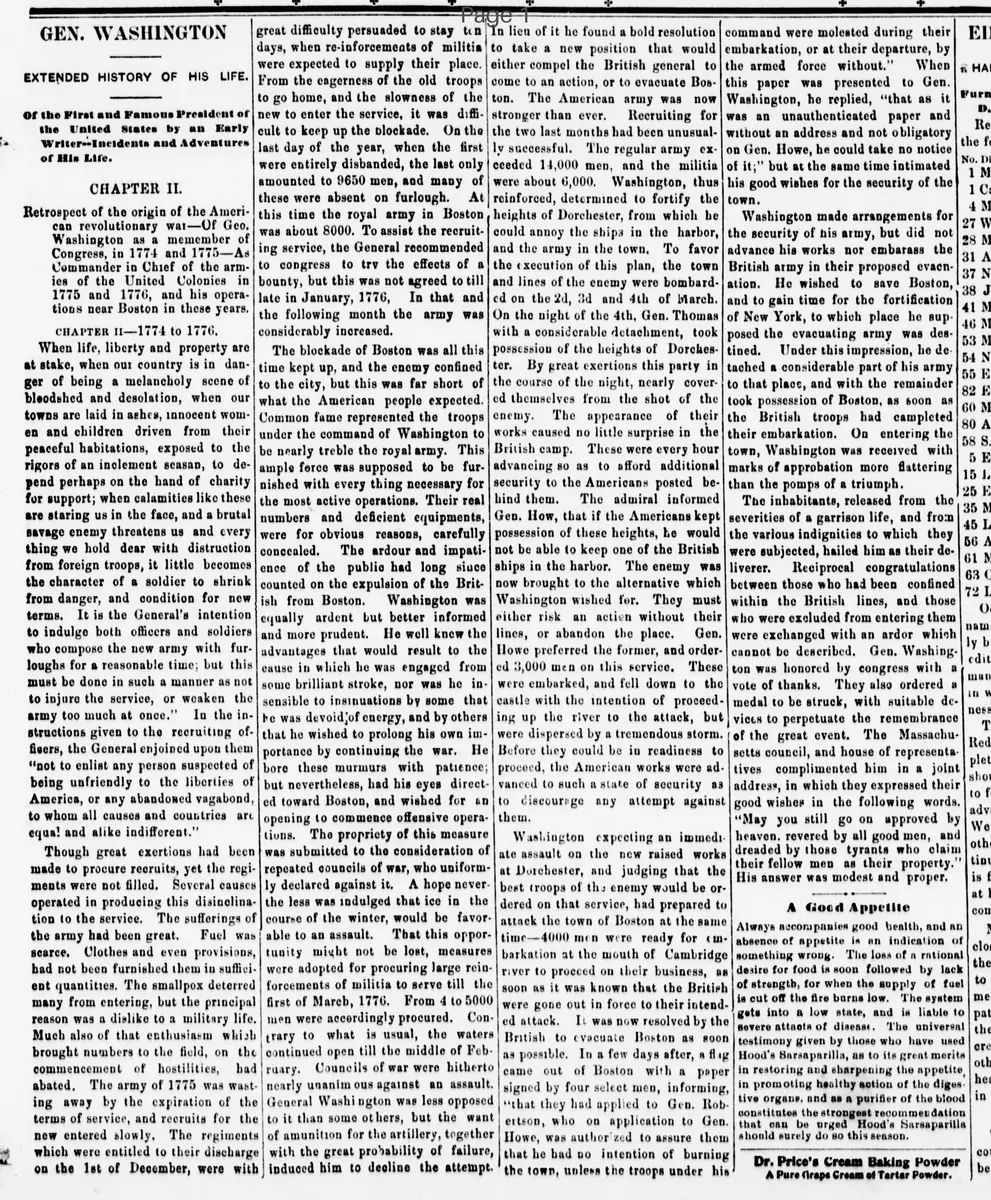
GEN. WASHINGTON
EXTENDED HISTORY OF HIS LIFE.
Of the First and Famous President of the United States by an Early Writer--Incidents and Adventures of His Life.
CHAPTER II.
Retrospect of the origin of the American revolutionary war--Of Geo. Washington as a member of Congress, in 1774 and 1775--As Commander in Chief of the armies of the United Colonies in 1775 and 1776, and his operations near Boston in these years.
CHAPTER II--1774 to 1776.
When life, liberty and property are at stake, when our country is in danger of being a melancholy scene of bloodshed and desolation, when our towns are laid in ashes, innocent women and children driven from their peaceful habitations, exposed to the rigors of an inclement season, to depend perhaps on the hand of charity for support; when calamities like these are staring us in the face, and a brutal savage enemy threatens us and every thing we hold dear with destruction from foreign troops, it little becomes the character of a soldier to shrink from danger, and condition for new terms. It is the General's intention to indulge both officers and soldiers who compose the new army with furloughs for a reasonable time; but this must be done in such a manner as not to injure the service, or weaken the army too much at once.
In the instructions given to the recruiting officers, the General enjoined upon them "not to enlist any person suspected of being unfriendly to the liberties of America, or any abandoned vagabond to whom all causes and countries are equal and alike indifferent."
Though great exertions had been made to procure recruits, yet the regiments were not filled. Several causes operated in producing this disinclination to the service. The sufferings of the army had been great. Fuel was scarce. Clothes and even provisions, had not been furnished them in sufficient quantities. The smallpox deterred many from entering, but the principal reason was a dislike to a military life. Much also of that enthusiasm which brought numbers to the field, on the commencement of hostilities, had abated. The army of 1775 was wasting away by the expiration of the terms of service, and recruits for the new entered slowly. The regiments which were entitled to their discharge on the 1st of December, were with great difficulty persuaded to stay ten days, when re-inforcements of militia were expected to supply their place. From the eagerness of the old troops to go home, and the slowness of the new to enter the service, it was difficult to keep up the blockade. On the last day of the year, when the first were entirely disbanded, the last only amounted to 9650 men, and many of these were absent on furlough. At this time the royal army in Boston was about 8000. To assist the recruiting service, the General recommended to congress to try the effects of a bounty, but this was not agreed to till late in January, 1776. In that and the following month the army was considerably increased. The blockade of Boston was all this time kept up, and the enemy confined to the city, but this was far short of what the American people expected. Common fame represented the troops under the command of Washington to be nearly treble the royal army. This ample force was supposed to be furnished with every thing necessary for the most active operations. Their real numbers and deficient equipments, were for obvious reasons, carefully concealed. The ardour and impatience of the public had long since counted on the expulsion of the British from Boston. Washington was equally ardent but better informed and more prudent. He well knew the advantages that would result to the cause in which he was engaged from some brilliant stroke, nor was he insensible to insinuations by some that he was devoid of energy, and by others that he wished to prolong his own importance by continuing the war. He bore these murmurs with patience; but nevertheless, had his eyes directed toward Boston, and wished for an opening to commence offensive operations. The propriety of this measure was submitted to the consideration of repeated councils of war, who uniformly declared against it. A hope nevertheless was indulged that ice in the course of the winter, would be favorable to an assault. That this opportunity might not be lost, measures were adopted for procuring large reinforcements of militia to serve till the first of March, 1776. From 4 to 5000 men were accordingly procured. Contrary to what is usual, the waters continued open till the middle of February. Councils of war were hitherto nearly unanimous against an assault. General Washington was less opposed to it than some others, but the want of ammunition for the artillery, together with the great probability of failure, induced him to decline the attempt.
In lieu of it he found a bold resolution to take a new position that would either compel the British general to come to an action, or to evacuate Boston. The American army was now stronger than ever. Recruiting for the two last months had been unusually successful. The regular army exceeded 14,000 men, and the militia were about 6000. Washington, thus reinforced, determined to fortify the heights of Dorchester, from which he could annoy the ships in the harbor, and the army in the town. To favor the execution of this plan, the town and lines of the enemy were bombarded on the 2d, 3d and 4th of March. On the night of the 4th. Gen. Thomas with a considerable detachment, took possession of the heights of Dorchester. By great exertions this party in the course of the night, nearly covered themselves from the shot of the enemy. The appearance of their works caused no little surprise in the British camp. These were every hour advancing so as to afford additional security to the Americans posted behind them. The admiral informed Gen. Howe, that if the Americans kept possession of these heights, he would not be able to keep one of the British ships in the harbor. The enemy was now brought to the alternative which Washington wished for. They must either risk an action without their lines, or abandon the place. Gen. Howe preferred the former, and ordered 3,000 men on this service. These were embarked, and fell down to the castle with the intention of proceeding up the river to the attack, but were dispersed by a tremendous storm. Before they could be in readiness to proceed, the American works were advanced to such a state of security as to discourage any attempt against them.
Washington expecting an immediate assault on the new raised works at Dorchester, and judging that the best troops of the enemy would be ordered on that service, had prepared to attack the town of Boston at the same time--4000 men were ready for embarkation at the mouth of Cambridge river to proceed on their business, as soon as it was known that the British were gone out in force to their intended attack. It was now resolved by the British to evacuate Boston as soon as possible. In a few days after, a flag came out of Boston with a paper signed by four select men, informing, "that they had applied to Gen. Robertson, who on application to Gen. Howe, was authorized to assure them that he had no intention of burning the town, unless the troops under his command were molested during their embarkation, or at their departure, by the armed force without."
When this paper was presented to Gen. Washington, he replied, "that as it was an unauthenticated paper and without an address and not obligatory on Gen. Howe, he could take no notice of it;" but at the same time intimated his good wishes for the security of the town. Washington made arrangements for the security of his army, but did not advance his works nor embarrass the British army in their proposed evacuation. He wished to save Boston, and to gain time for the fortification of New York, to which place he supposed the evacuating army was destined. Under this impression, he detached a considerable part of his army to that place, and with the remainder took possession of Boston, as soon as the British troops had completed their embarkation. On entering the town, Washington was received with marks of approbation more flattering than the pomps of a triumph. The inhabitants, released from the severities of a garrison life, and from the various indignities to which they were subjected, hailed him as their deliverer. Reciprocal congratulations between those who had been confined within the British lines, and those who were excluded from entering them were exchanged with an ardor which cannot be described. Gen. Washington was honored by congress with a vote of thanks. They also ordered a medal to be struck, with suitable devices to perpetuate the remembrance of the great event. The Massachusetts council, and house of representatives complimented him in a joint address, in which they expressed their good wishes in the following words. "May you still go on approved by heaven, revered by all good men, and dreaded by those tyrants who claim their fellow men as their property." His answer was modest and proper.
EXTENDED HISTORY OF HIS LIFE.
Of the First and Famous President of the United States by an Early Writer--Incidents and Adventures of His Life.
CHAPTER II.
Retrospect of the origin of the American revolutionary war--Of Geo. Washington as a member of Congress, in 1774 and 1775--As Commander in Chief of the armies of the United Colonies in 1775 and 1776, and his operations near Boston in these years.
CHAPTER II--1774 to 1776.
When life, liberty and property are at stake, when our country is in danger of being a melancholy scene of bloodshed and desolation, when our towns are laid in ashes, innocent women and children driven from their peaceful habitations, exposed to the rigors of an inclement season, to depend perhaps on the hand of charity for support; when calamities like these are staring us in the face, and a brutal savage enemy threatens us and every thing we hold dear with destruction from foreign troops, it little becomes the character of a soldier to shrink from danger, and condition for new terms. It is the General's intention to indulge both officers and soldiers who compose the new army with furloughs for a reasonable time; but this must be done in such a manner as not to injure the service, or weaken the army too much at once.
In the instructions given to the recruiting officers, the General enjoined upon them "not to enlist any person suspected of being unfriendly to the liberties of America, or any abandoned vagabond to whom all causes and countries are equal and alike indifferent."
Though great exertions had been made to procure recruits, yet the regiments were not filled. Several causes operated in producing this disinclination to the service. The sufferings of the army had been great. Fuel was scarce. Clothes and even provisions, had not been furnished them in sufficient quantities. The smallpox deterred many from entering, but the principal reason was a dislike to a military life. Much also of that enthusiasm which brought numbers to the field, on the commencement of hostilities, had abated. The army of 1775 was wasting away by the expiration of the terms of service, and recruits for the new entered slowly. The regiments which were entitled to their discharge on the 1st of December, were with great difficulty persuaded to stay ten days, when re-inforcements of militia were expected to supply their place. From the eagerness of the old troops to go home, and the slowness of the new to enter the service, it was difficult to keep up the blockade. On the last day of the year, when the first were entirely disbanded, the last only amounted to 9650 men, and many of these were absent on furlough. At this time the royal army in Boston was about 8000. To assist the recruiting service, the General recommended to congress to try the effects of a bounty, but this was not agreed to till late in January, 1776. In that and the following month the army was considerably increased. The blockade of Boston was all this time kept up, and the enemy confined to the city, but this was far short of what the American people expected. Common fame represented the troops under the command of Washington to be nearly treble the royal army. This ample force was supposed to be furnished with every thing necessary for the most active operations. Their real numbers and deficient equipments, were for obvious reasons, carefully concealed. The ardour and impatience of the public had long since counted on the expulsion of the British from Boston. Washington was equally ardent but better informed and more prudent. He well knew the advantages that would result to the cause in which he was engaged from some brilliant stroke, nor was he insensible to insinuations by some that he was devoid of energy, and by others that he wished to prolong his own importance by continuing the war. He bore these murmurs with patience; but nevertheless, had his eyes directed toward Boston, and wished for an opening to commence offensive operations. The propriety of this measure was submitted to the consideration of repeated councils of war, who uniformly declared against it. A hope nevertheless was indulged that ice in the course of the winter, would be favorable to an assault. That this opportunity might not be lost, measures were adopted for procuring large reinforcements of militia to serve till the first of March, 1776. From 4 to 5000 men were accordingly procured. Contrary to what is usual, the waters continued open till the middle of February. Councils of war were hitherto nearly unanimous against an assault. General Washington was less opposed to it than some others, but the want of ammunition for the artillery, together with the great probability of failure, induced him to decline the attempt.
In lieu of it he found a bold resolution to take a new position that would either compel the British general to come to an action, or to evacuate Boston. The American army was now stronger than ever. Recruiting for the two last months had been unusually successful. The regular army exceeded 14,000 men, and the militia were about 6000. Washington, thus reinforced, determined to fortify the heights of Dorchester, from which he could annoy the ships in the harbor, and the army in the town. To favor the execution of this plan, the town and lines of the enemy were bombarded on the 2d, 3d and 4th of March. On the night of the 4th. Gen. Thomas with a considerable detachment, took possession of the heights of Dorchester. By great exertions this party in the course of the night, nearly covered themselves from the shot of the enemy. The appearance of their works caused no little surprise in the British camp. These were every hour advancing so as to afford additional security to the Americans posted behind them. The admiral informed Gen. Howe, that if the Americans kept possession of these heights, he would not be able to keep one of the British ships in the harbor. The enemy was now brought to the alternative which Washington wished for. They must either risk an action without their lines, or abandon the place. Gen. Howe preferred the former, and ordered 3,000 men on this service. These were embarked, and fell down to the castle with the intention of proceeding up the river to the attack, but were dispersed by a tremendous storm. Before they could be in readiness to proceed, the American works were advanced to such a state of security as to discourage any attempt against them.
Washington expecting an immediate assault on the new raised works at Dorchester, and judging that the best troops of the enemy would be ordered on that service, had prepared to attack the town of Boston at the same time--4000 men were ready for embarkation at the mouth of Cambridge river to proceed on their business, as soon as it was known that the British were gone out in force to their intended attack. It was now resolved by the British to evacuate Boston as soon as possible. In a few days after, a flag came out of Boston with a paper signed by four select men, informing, "that they had applied to Gen. Robertson, who on application to Gen. Howe, was authorized to assure them that he had no intention of burning the town, unless the troops under his command were molested during their embarkation, or at their departure, by the armed force without."
When this paper was presented to Gen. Washington, he replied, "that as it was an unauthenticated paper and without an address and not obligatory on Gen. Howe, he could take no notice of it;" but at the same time intimated his good wishes for the security of the town. Washington made arrangements for the security of his army, but did not advance his works nor embarrass the British army in their proposed evacuation. He wished to save Boston, and to gain time for the fortification of New York, to which place he supposed the evacuating army was destined. Under this impression, he detached a considerable part of his army to that place, and with the remainder took possession of Boston, as soon as the British troops had completed their embarkation. On entering the town, Washington was received with marks of approbation more flattering than the pomps of a triumph. The inhabitants, released from the severities of a garrison life, and from the various indignities to which they were subjected, hailed him as their deliverer. Reciprocal congratulations between those who had been confined within the British lines, and those who were excluded from entering them were exchanged with an ardor which cannot be described. Gen. Washington was honored by congress with a vote of thanks. They also ordered a medal to be struck, with suitable devices to perpetuate the remembrance of the great event. The Massachusetts council, and house of representatives complimented him in a joint address, in which they expressed their good wishes in the following words. "May you still go on approved by heaven, revered by all good men, and dreaded by those tyrants who claim their fellow men as their property." His answer was modest and proper.
What sub-type of article is it?
Biography
Historical Narrative
What themes does it cover?
Liberty Freedom
Political
War Peace
What keywords are associated?
George Washington
Revolutionary War
Boston Siege
Dorchester Heights
British Evacuation
What entities or persons were involved?
By An Early Writer
Literary Details
Title
Chapter Ii 1774 To 1776.
Author
By An Early Writer
Subject
Retrospect Of The Origin Of The American Revolutionary War Of Geo. Washington As A Member Of Congress, In 1774 And 1775 As Commander In Chief Of The Armies Of The United Colonies In 1775 And 1776, And His Operations Near Boston In These Years.
Form / Style
Prose Historical Account
Key Lines
When Life, Liberty And Property Are At Stake, When Our Country Is In Danger Of Being A Melancholy Scene Of Bloodshed And Desolation...
In The Instructions Given To The Recruiting Officers, The General Enjoined Upon Them "Not To Enlist Any Person Suspected Of Being Unfriendly To The Liberties Of America..."
The Admiral Informed Gen. Howe, That If The Americans Kept Possession Of These Heights, He Would Not Be Able To Keep One Of The British Ships In The Harbor.
On Entering The Town, Washington Was Received With Marks Of Approbation More Flattering Than The Pomps Of A Triumph.
May You Still Go On Approved By Heaven, Revered By All Good Men, And Dreaded By Those Tyrants Who Claim Their Fellow Men As Their Property.