Thank you for visiting SNEWPapers!
Sign up free
Literary
February 1, 1800
Gazette Of The United States, & Philadelphia Daily Advertiser
Philadelphia, Philadelphia County, Pennsylvania
What is this article about?
Moral essay in 'The Lay Preacher' series retells the biblical Parable of the Prodigal Son, highlighting the younger son's repentance and return, the father's joyful forgiveness, and the elder son's jealous resentment. It reflects on themes of vice, reformation, and parental love.
Merged-components note: Text flows continuously from one component to the next across columns in the Lay Preacher essay.
Clipping
OCR Quality
95%
Excellent
Full Text
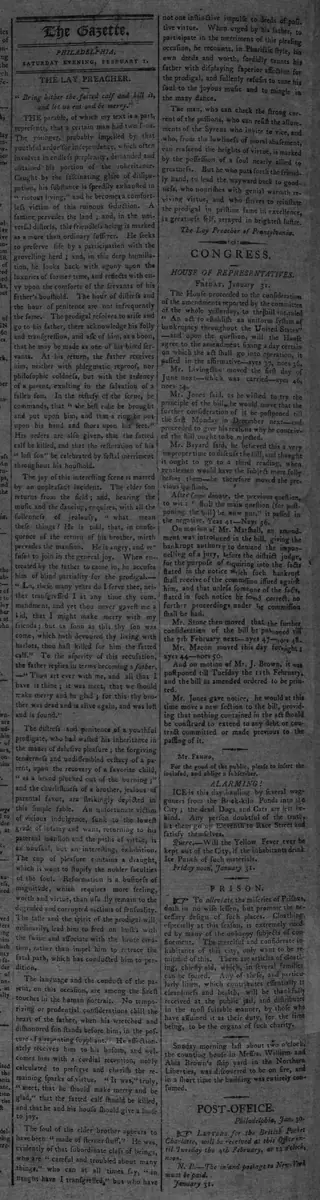
The Gazette.
PHILADELPHIA,
SATURDAY EVENING, FEBRUARY 1.
THE LAY PREACHER.
"Bring hither the fatted calf and kill it,
and let us eat and be merry."
THE parable, of which my text is a part,
represents, that a certain man had two sons.
The younger, probably impelled by that
youthful ardor for independence, which often
involves in endless perplexity, demanded and
obtained his portion of the inheritance.
Caught by the fascinating glare of dissipation,
his substance is speedily exhausted in
"riotous living," and he becomes a comfortless
victim of this ruinous seduction. A
famine pervades the land; and, in the universal
distress, this friendless being is marked
as a more than ordinary sufferer. He seeks
to preserve life by a participation with the
grovelling herd; and, in this deep humiliation,
he looks back with agony upon the
luxuries of former time, and reflects with envy
upon the comforts of the servants of his
father's household. The hour of distress and
the hour of penitence are not infrequently
the same. The prodigal resolves to arise and
go to his father, there acknowledge his folly
and transgression, and ask of him, as a boon,
that he may be made as one of his hired servants.
At his return, the father receives
him, neither with phlegmatic reproof, nor
philosophic coldness, but with the ardency
of a parent, exulting in the salvation of a
fallen son. In the ecstasy of the scene, he
commands, that "the best robe be brought
and put upon him, and that a ring be put
upon his hand and shoes upon his feet."
His orders are also given, that the fatted
calf be killed, and that the restoration of his
"lost son" be celebrated by festal merriment
throughout his household.
The joy of this interesting scene is marred
by an unpleasant incident. The elder son
returns from the field; and, hearing the
music and the dancing, enquires, with all the
sullenness of jealousy, "what mean
these things? He is told, that, in consequence
of the return of his brother, mirth
pervades the mansion. He is angry, and refuses
to join in the general joy. When entreated
by the father to come in, he accuses
him of blind partiality for the prodigal.—
"Lo, these many years do I serve thee, neither
transgressed I at any time thy commandment,
and yet thou never gavest me a
kid, that I might make merry with my
friends; but as soon as this thy son was
come, which hath devoured thy living with
harlots, thou hast killed for him the fatted
calf." To the asperity of this accusation,
the father replies in terms becoming a father,
—"Thou art ever with me, and all that I
have is thine; it was meet, that we should
make merry and be glad; for this thy brother
was dead and is alive again, and was lost
and is found."
The distress and penitence of a youthful
profligate, who had wasted his inheritance in
the mazes of delusive pleasure; the forgiving
tenderness and undisguised ecstasy of a parent,
upon the recovery of a favorite child,
"as a brand plucked out of the burning;"
and the churlishness of a brother, jealous of
parental favor, are strikingly depicted in
this simple fable. An unfortunate victim
of vicious indulgence, sunk to the lowest
grade of infamy and want, returning to his
paternal mansion and the paths of virtue, is
an unusual, but an interesting, exhibition.
The cup of pleasure contains a draught,
which is wont to stupify the nobler faculties
of the soul. Reformation is a business of
magnitude, which requires more feeling,
worth and virtue, than usually remain to the
degraded and corrupted victims of sensuality.
The taste and the spirit of the prodigal will
ordinarily, lead him to feed on husks; with
the swine and associate with the brute creation,
rather than impel him to retrace the
fatal path, which has conducted him to perdition.
The language and the conduct of the parent,
on this occasion, are among the finest
touches in the human portrait. No temporizing
or prudential considerations chill the
heart of the father, when his wretched and
dishonored son stands before him, in the posture
of a repenting supplicant. He affectionately
receives him to his bosom, and welcomes
him with a cordial reception, nobly
calculated to preserve and cherish the remaining
sparks of virtue. "It was," truly,
"meet, that he should make merry and be
glad," that the fatted calf should be killed,
and that he and his house should give a loose
to joy.
The soul of the elder brother appears to
have been "made of sterner stuff." He was,
evidently of that subordinate class of beings,
who are "careful and troubled about many
things," who can at all times say, "in
aught have I transgressed." but who have
not one instinctive impulse to deeds of positive
virtue. When urged by his father, to
participate in the merriment of this pleasing
occasion, he recounts, in Pharisaic style, his
own deeds and worth, sordidly taunts his
father with displaying superior affection for
the prodigal, and sullenly refuses to tune his
soul to the joyous music and to mingle in
the mazy dance.
The man, who can check the strong current
of the passions, who can resist the allurements
of the Syrens who invite to vice, and
who, from the lowliness of moral abasement,
can reascend the heights of virtue, is marked
by the portion of a soul nearly allied to
greatness. But he who puts forth the friendly
hand, to lead the wayward back to goodness,
who nourishes with genial warmth reviving
virtue, and who strives to reinstate
the prodigal in pristine fame in excellence,
is greatness itself, arrayed in brightest lustre.
The Lay Preacher of Pennsylvania.
PHILADELPHIA,
SATURDAY EVENING, FEBRUARY 1.
THE LAY PREACHER.
"Bring hither the fatted calf and kill it,
and let us eat and be merry."
THE parable, of which my text is a part,
represents, that a certain man had two sons.
The younger, probably impelled by that
youthful ardor for independence, which often
involves in endless perplexity, demanded and
obtained his portion of the inheritance.
Caught by the fascinating glare of dissipation,
his substance is speedily exhausted in
"riotous living," and he becomes a comfortless
victim of this ruinous seduction. A
famine pervades the land; and, in the universal
distress, this friendless being is marked
as a more than ordinary sufferer. He seeks
to preserve life by a participation with the
grovelling herd; and, in this deep humiliation,
he looks back with agony upon the
luxuries of former time, and reflects with envy
upon the comforts of the servants of his
father's household. The hour of distress and
the hour of penitence are not infrequently
the same. The prodigal resolves to arise and
go to his father, there acknowledge his folly
and transgression, and ask of him, as a boon,
that he may be made as one of his hired servants.
At his return, the father receives
him, neither with phlegmatic reproof, nor
philosophic coldness, but with the ardency
of a parent, exulting in the salvation of a
fallen son. In the ecstasy of the scene, he
commands, that "the best robe be brought
and put upon him, and that a ring be put
upon his hand and shoes upon his feet."
His orders are also given, that the fatted
calf be killed, and that the restoration of his
"lost son" be celebrated by festal merriment
throughout his household.
The joy of this interesting scene is marred
by an unpleasant incident. The elder son
returns from the field; and, hearing the
music and the dancing, enquires, with all the
sullenness of jealousy, "what mean
these things? He is told, that, in consequence
of the return of his brother, mirth
pervades the mansion. He is angry, and refuses
to join in the general joy. When entreated
by the father to come in, he accuses
him of blind partiality for the prodigal.—
"Lo, these many years do I serve thee, neither
transgressed I at any time thy commandment,
and yet thou never gavest me a
kid, that I might make merry with my
friends; but as soon as this thy son was
come, which hath devoured thy living with
harlots, thou hast killed for him the fatted
calf." To the asperity of this accusation,
the father replies in terms becoming a father,
—"Thou art ever with me, and all that I
have is thine; it was meet, that we should
make merry and be glad; for this thy brother
was dead and is alive again, and was lost
and is found."
The distress and penitence of a youthful
profligate, who had wasted his inheritance in
the mazes of delusive pleasure; the forgiving
tenderness and undisguised ecstasy of a parent,
upon the recovery of a favorite child,
"as a brand plucked out of the burning;"
and the churlishness of a brother, jealous of
parental favor, are strikingly depicted in
this simple fable. An unfortunate victim
of vicious indulgence, sunk to the lowest
grade of infamy and want, returning to his
paternal mansion and the paths of virtue, is
an unusual, but an interesting, exhibition.
The cup of pleasure contains a draught,
which is wont to stupify the nobler faculties
of the soul. Reformation is a business of
magnitude, which requires more feeling,
worth and virtue, than usually remain to the
degraded and corrupted victims of sensuality.
The taste and the spirit of the prodigal will
ordinarily, lead him to feed on husks; with
the swine and associate with the brute creation,
rather than impel him to retrace the
fatal path, which has conducted him to perdition.
The language and the conduct of the parent,
on this occasion, are among the finest
touches in the human portrait. No temporizing
or prudential considerations chill the
heart of the father, when his wretched and
dishonored son stands before him, in the posture
of a repenting supplicant. He affectionately
receives him to his bosom, and welcomes
him with a cordial reception, nobly
calculated to preserve and cherish the remaining
sparks of virtue. "It was," truly,
"meet, that he should make merry and be
glad," that the fatted calf should be killed,
and that he and his house should give a loose
to joy.
The soul of the elder brother appears to
have been "made of sterner stuff." He was,
evidently of that subordinate class of beings,
who are "careful and troubled about many
things," who can at all times say, "in
aught have I transgressed." but who have
not one instinctive impulse to deeds of positive
virtue. When urged by his father, to
participate in the merriment of this pleasing
occasion, he recounts, in Pharisaic style, his
own deeds and worth, sordidly taunts his
father with displaying superior affection for
the prodigal, and sullenly refuses to tune his
soul to the joyous music and to mingle in
the mazy dance.
The man, who can check the strong current
of the passions, who can resist the allurements
of the Syrens who invite to vice, and
who, from the lowliness of moral abasement,
can reascend the heights of virtue, is marked
by the portion of a soul nearly allied to
greatness. But he who puts forth the friendly
hand, to lead the wayward back to goodness,
who nourishes with genial warmth reviving
virtue, and who strives to reinstate
the prodigal in pristine fame in excellence,
is greatness itself, arrayed in brightest lustre.
The Lay Preacher of Pennsylvania.
What sub-type of article is it?
Essay
What themes does it cover?
Moral Virtue
Religious
What keywords are associated?
Prodigal Son
Parable
Repentance
Forgiveness
Moral Reformation
Parental Love
Jealousy
What entities or persons were involved?
The Lay Preacher Of Pennsylvania
Literary Details
Title
The Lay Preacher.
Author
The Lay Preacher Of Pennsylvania
Subject
On The Parable Of The Prodigal Son
Form / Style
Moral Essay Retelling A Biblical Parable
Key Lines
"Bring Hither The Fatted Calf And Kill It, And Let Us Eat And Be Merry."
"Lo, These Many Years Do I Serve Thee, Neither Transgressed I At Any Time Thy Commandment, And Yet Thou Never Gavest Me A Kid, That I Might Make Merry With My Friends; But As Soon As This Thy Son Was Come, Which Hath Devoured Thy Living With Harlots, Thou Hast Killed For Him The Fatted Calf."
"Thou Art Ever With Me, And All That I Have Is Thine; It Was Meet, That We Should Make Merry And Be Glad; For This Thy Brother Was Dead And Is Alive Again, And Was Lost And Is Found."