Thank you for visiting SNEWPapers!
Sign up free
The Daily Independent
Elizabeth City, Pasquotank County, North Carolina
What is this article about?
In May 193, President Roosevelt ended a year-long diplomatic feud between R. Walton Moore and Sumner Welles by appointing Welles under-secretary of state and creating an equal counselor role for Moore, both at $10,000 salary, amid tensions between career and political diplomats in Washington.
Clipping
OCR Quality
Full Text
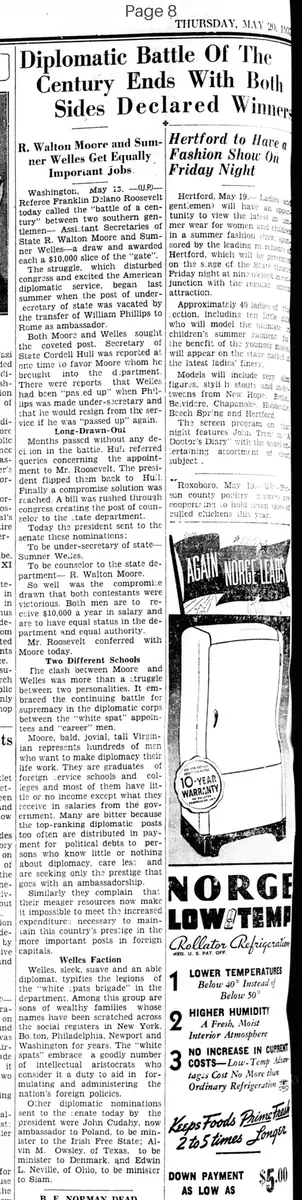
Diplomatic Battle Of The Century Ends With Both Sides Declared Winner
R. Walton Moore and Sumner Welles Get Equally Important jobs.
Referee Franklin Delano Roosevelt
Washington, May 19.—(U.P.) today called the "battle of a century" between two southern gentlemen—Assistant Secretaries of State R. Walton Moore and Sumner Welles—a draw and awarded each a $10,000 slice of the "gate".
The struggle, which disturbed congress and excited the American diplomatic service, began last summer when the post of under-secretary of state was vacated by the transfer of William Phillips to Rome as ambassador.
Both Moore and Welles sought the coveted post. Secretary of State Cordell Hull was reported at one time to favor Moore whom he brought into the department.
There were reports that Welles had been "passed up" when Phillips was made under-secretary and that he would resign from the service if he was "passed up" again.
Long-Drawn-Out
Months passed without any decision in the battle. Hull, referred queries concerning the appointment to Mr. Roosevelt. The president flipped them back to Hull.
Finally a compromise solution was reached. A bill was rushed through congress creating the post of counselor to the state department.
Today the president sent to the senate these nominations:
To be under-secretary of state— Sumner Welles.
To be counselor to the state department— R. Walton Moore.
So well was the compromise drawn that both contestants were victorious. Both men are to receive $10,000 a year in salary and are to have equal status in the department and equal authority.
Mr. Roosevelt conferred with Moore today.
Two Different Schools
The clash between Moore and Welles was more than a struggle between two personalities. It embraced the continuing battle for supremacy in the diplomatic corps between the "white spat" appointees and "career" men.
Moore, bald, jovial, tall Virginian represents hundreds of men who want to make diplomacy their life work. They are graduates of foreign service schools and colleges and most of them have little or no income except what they receive in salaries from the government. Many are bitter because the top-ranking diplomatic posts too often are distributed in payment for political debts to persons who know little or nothing about diplomacy, careless and are seeking only the prestige that goes with an ambassadorship.
Similarly they complain that their meager resources now make it impossible to meet the increased expenditures necessary to maintain this country's prestige in the more important posts in foreign capitals.
Welles Faction
Welles, sleek, suave and an able diplomat, typifies the legions of the "white spats brigade" in the department. Among this group are sons of wealthy families whose names have been scratched across the social registers in New York, Boston, Philadelphia, Newport and Washington for years. The "white spats" embrace a goodly number of intellectual aristocrats who consider it a duty to aid in formulating and administering the nation's foreign policies.
Other diplomatic nominations sent to the senate today by the president were John Cudahy, now ambassador to Poland, to be minister to the Irish Free State; Alvin M. Owsley, of Texas, to be minister to Denmark, and Edwin L. Neville, of Ohio, to be minister to Siam.
What sub-type of article is it?
What themes does it cover?
What keywords are associated?
What entities or persons were involved?
Where did it happen?
Story Details
Key Persons
Location
Washington
Event Date
May 19, 193
Story Details
Rivalry between Assistant Secretaries R. Walton Moore and Sumner Welles for the under-secretary of state position, vacated by William Phillips, ends in compromise: President Roosevelt nominates Welles as under-secretary and creates counselor post for Moore, both with equal $10,000 salaries and authority. The conflict highlights tensions between career diplomats and political appointees.