Thank you for visiting SNEWPapers!
Sign up free
The Virginian
Lynchburg, Virginia
What is this article about?
An observer advises Lynchburg and Salem Turnpike Company stockholders to accept the state's $30,000 stock subscription per recent Virginia legislative act, countering objections on terms, forfeiture risks, toll uses for extensions, and state directors, emphasizing benefits for project completion and broader internal improvements.
Clipping
OCR Quality
Full Text
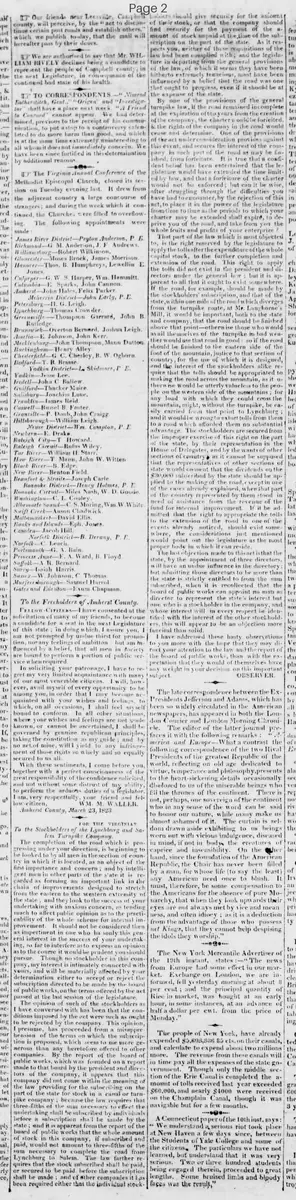
To the Stockholders of the Lynchburg and Salem Turnpike Company.
The completion of the road which is progressing under your direction, is beginning to be looked to by all men in the section of country in which it is located, as an object of the first importance and concern; and by intelligent men in other parts of the state it is regarded as forming an important link in the chain of improvements designed to stretch from the eastern to the western extremity of the state; and they look to the success of your undertaking with anxious concern, as tending much to affect public opinion as to the practicability of the whole scheme for internal improvement. It should not be considered then as impertinent in one who has only this general interest in the success of your undertaking, so far to interfere as to express an opinion as to the course it would be prudent you should pursue. Though no stockholder in this company, my interest is intimately connected with yours, and will be materially affected by your determination either to accept or reject the subscription directed to be made by the board of public works, on the terms offered by the act passed at the last session of the legislature. The opinion of such of the stockholders as I have conversed with has been that the conditions imposed by the act were such as ought to be rejected by the company. This opinion, I presume, has proceeded from a misapprehension of the terms on which the subscription is proposed, which seem to me more generous than any heretofore offered to other companies. By the report of the board of public works, which was founded on a report made to that board by the president and directors of the company, it appears that this company did not come within the meaning of the law providing for the subscribing on the part of the state for stock in a canal or turnpike company; because the law requires that three-fifths of the sum necessary to effect the undertaking shall be subscribed by individuals before a subscription shall be made by the state; and it is apparent from the report of the board of public works that the whole amount of stock in this company, if subscribed and paid, would not amount to three-fifths of the sum necessary to complete the road from Lynchburg to Salem. The law farther requires that the stock subscribed shall be paid, or secured to be paid, before the subscription shall be made; and of other companies it has been required either that the individual stockholders should give security for the amount of their stock, or that the company should find security for the payment of the amount of stock unpaid at the time of the subscription on the part of the state. As it respects you, neither of these requisitions of the law had been complied with; and the legislature in departing from the general provisions of the law, of which it seems they have been hitherto extremely tenacious, must have been influenced by a belief that the road was one that ought to progress, even if it should be at the expense of the state. By one of the provisions of the general turnpike law, if the road remained incomplete at the expiration of ten years from the creation of the company, the charter would be forfeited, & the rights of the company in the road would cease and determine. One of the provisions of the act under consideration provides against this event, and secures the interest of the company in such part of the road as may be finished, from forfeiture. It is true that a confident belief has been entertained that the legislature would have extended the time limited by law, and that a forfeiture of the charter would not be enforced; but can it be wise, after struggling through the difficulties you have had to encounter, by the rejection of this act, to place it in the power of the legislature from time to time as the periods to which your charter may be extended shall expire, to deprive you of the road, and take from you the whole fruits and profits of your enterprize? That part of the law which is most objected to, is the right reserved by the legislature to apply the tolls after the expenditure of the whole capital stock, to the further completion and extension of the road. This right to apply the tolls did not exist in the president and directors under the general law; but it is apparent to all that it ought to exist somewhere. If the road, for example, should be made by the stockholders' subscription, and that of the state, within one mile of the road which diverges from the turnpike route, at M. Langhorne's Mill, it would be important, both to the state and company, that the road should be finished above that point—otherwise those who would avail themselves of the turnpike in bad weather would use that road in good: so if the road should be finished to the eastern side of the foot of the mountain, justice to that section of country, for the use of which it is designed, and the interest of the stockholders alike require that the tolls should be appropriated to making the road across the mountain, as it otherwise would be utterly valueless to the people on the western side of the mountains; for any load with which they could cross the mountain, might, without the turnpike, be easily carried from that point to Lynchburg; and it would be wrong to extort tolls from them to a road which afforded them no substantial advantage. The stockholders are secured from the improper exercise of this right on the part of the state, by their representation in the House of Delegates, and by the wants of other sections of country as it cannot be supposed that the representatives of other sections of state would consent that the dividends on the $30,000 subscribed by the state should be applied to the making of the road, except in one of the cases already explained, when that part of the country represented by them stood in need of assistance from the revenue of the fund for internal improvement. If it be admitted that the right to appropriate the tolls to the extension of the road in one of the events already noticed, should exist somewhere, the considerations just mentioned would point out the legislature as the most proper body in which it can reside. The last objection made to this act is that the state, by the appointment of three directors, will have an undue influence in the directory; but admitting those directors to be more than the state is strictly entitled to from the sum subscribed, when it is recollected that the board of public works can appoint no man as director to represent the state's interest but one who is a stockholder in the company, and whose interest will in every respect be identified with the interest of the other stockholders, this will appear to be an objection more fanciful than solid. I have addressed these hasty observations to you more with the hope that they may direct your attention to the law and the report of the board of public works, than with the expectation that they would of themselves have any weight in your decision on this important subject.
OBSERVER
What sub-type of article is it?
What themes does it cover?
What keywords are associated?
What entities or persons were involved?
Letter to Editor Details
Author
Observer
Recipient
To The Stockholders Of The Lynchburg And Salem Turnpike Company
Main Argument
the writer urges the stockholders to accept the state's subscription offer under the recent legislative act, arguing that the terms are generous, prevent charter forfeiture, and address objections regarding toll applications and state-appointed directors, as rejection risks the project's success and public opinion on internal improvements.
Notable Details