Thank you for visiting SNEWPapers!
Sign up free
Editorial
October 10, 1789
Gazette Of The United States
New York, New York County, New York
What is this article about?
An editorial republishes and defends against a House of Representatives motion by Mr. Burke accusing printers like Francis Childs, John Fenno, and Thomas Lloyd of misrepresenting debates in publications such as the Congressional Register and newspapers, arguing the accusations are unfounded and the reporting impartial.
Clipping
OCR Quality
98%
Excellent
Full Text
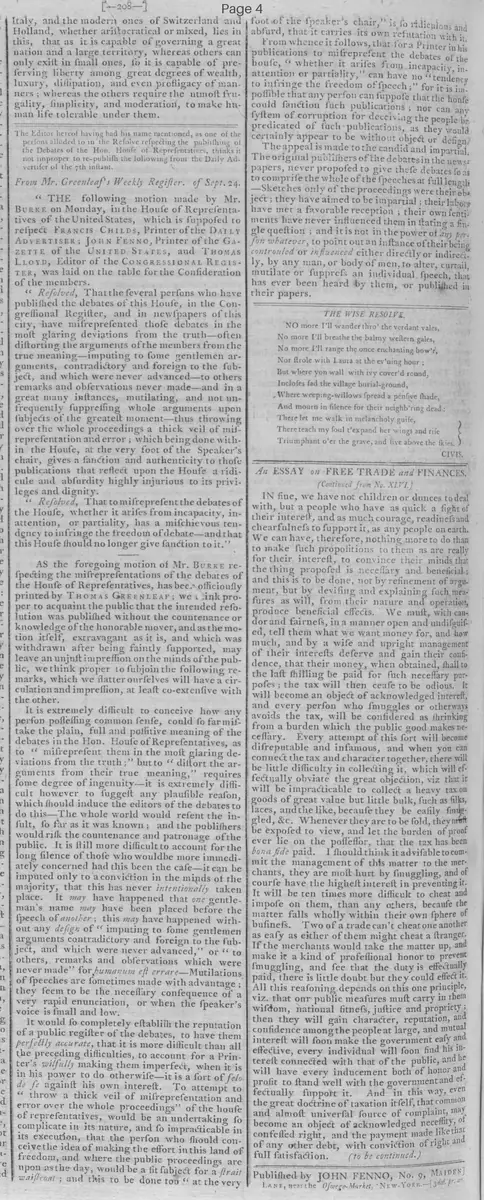
The Editor hereof having had his name mentioned, as one of the persons alluded to in the Resolve respecting the publishing of the Debates of the Hon. House of Representatives, thinks it not improper to re-publish the following from the Daily Advertiser of the 7th instant.
From Mr. Greenleaf's Weekly Register. of Sept. 24.
"THE following motion made by Mr. Burke on Monday, in the House of Representatives of the United States, which is supposed to respect Francis Childs, Printer of the Daily Advertiser; John Fenno, Printer of the GAZETTE of the UNITED STATES, and THOMAS Lloyd, Editor of the Congressional REGISTER, was laid on the table for the Consideration of the members.
"Resolved, That the several persons who have published the debates of this House, in the Congressional Register, and in newspapers of this city, have misrepresented those debates in the most glaring deviations from the truth—often distorting the arguments of the members from the true meaning—imputing to some gentlemen arguments, contradictory and foreign to the subject, and which were never advanced to others remarks and observations never made and in a great many instances, mutilating, and not unfrequently suppressing whole arguments upon subjects of the greatest moment—thus throwing over the whole proceedings a thick veil of misrepresentation and error; which being done within the House, at the very foot of the Speaker's chair, gives a sanction and authenticity to those publications that reflect upon the House a ridicule and absurdity highly injurious to its privileges and dignity.
"Resolved, That to misrepresent the debates of the House, whether it arises from incapacity, inattention, or partiality, has a mischievous tendency to infringe the freedom of debate—and that this House should no longer give sanction to it."
AS the foregoing motion of Mr. BURKE respecting the misrepresentations of the debates of the House of Representatives, has been officiously printed by THOMAS GREENLEAF; we think proper to acquaint the public that the intended resolution was published without the countenance or knowledge of the honorable mover, and as the motion itself, extravagant as it is, and which was withdrawn after being faintly supported, may leave an unjust impression on the minds of the public, we think proper to subjoin the following remarks, which we flatter ourselves will have a circulation and impression, at least co-extensive with the other.
It is extremely difficult to conceive how any person possessing common sense, could so far mistake the plain, full and positive meaning of the debates in the Hon. House of Representatives, as to "misrepresent them in the most glaring deviations from the truth;" but to "distort the arguments from their true meaning," requires some degree of ingenuity—it is extremely difficult however to suggest any plausible reason, which should induce the editors of the debates to do this—The whole world would resent the insult, so far as it was known; and the publishers would risk the countenance and patronage of the public. It is still more difficult to account for the long silence of those who would be more immediately concerned had this been the case—it can be imputed only to a conviction in the minds of the majority, that this has never intentionally taken place. It may have happened that one gentleman's name may have been placed before the speech of another; this may have happened without any design of "imputing to some gentlemen arguments contradictory and foreign to the subject, and which were never advanced," or "to others, remarks and observations which were never made" for humanum est errare—Mutilations of speeches are sometimes made with advantage; they seem to be the necessary consequence of a very rapid enunciation, or when the speaker's voice is small and low.
It would so completely establish the reputation of a public register of the debates, to have them perfectly accurate, that it is more difficult than all the preceding difficulties, to account for a Printer's wilfully making them imperfect, when it is in his power to do otherwise—it is a sort of felo de se against his own interest. To attempt to "throw a thick veil of misrepresentation and error over the whole proceedings" of the house of representatives, would be an undertaking so complicate in its nature, and so impracticable in its execution, that the person who should conceive the idea of making the effort in this land of freedom, and where the public proceedings are upon as the day, would be a fit subject for a strait waistcoat; and this to be done too "at the very foot of the Speaker's chair," is so ridiculous and absurd, that it carries its own refutation with it.
From whence it follows, that for a Printer in his publications to misrepresent the debates of the house, "whether it arises from incapacity, inattention or partiality," can have no "tendency to infringe the freedom of speech;" for it is impossible that any person can suppose that the house could sanction such publications; nor can any system of corruption for deceiving the people be predicated of such publications, as they would certainly appear to be without object or design.
The appeal is made to the candid and impartial.
The original publishers of the debates in the newspapers, never proposed to give these debates so as to comprise the whole of the speeches at full length—Sketches only of the proceedings were their object; they have aimed to be impartial; their labors have met a favorable reception; their own sentiments have never influenced them in stating a single question; and it is not in the power of any person whatever, to point out an instance of their being controlled or influenced either directly or indirectly, by any man, or body of men, to alter, curtail, mutilate or suppress an individual speech, that has ever been heard by them, or published in their papers.
From Mr. Greenleaf's Weekly Register. of Sept. 24.
"THE following motion made by Mr. Burke on Monday, in the House of Representatives of the United States, which is supposed to respect Francis Childs, Printer of the Daily Advertiser; John Fenno, Printer of the GAZETTE of the UNITED STATES, and THOMAS Lloyd, Editor of the Congressional REGISTER, was laid on the table for the Consideration of the members.
"Resolved, That the several persons who have published the debates of this House, in the Congressional Register, and in newspapers of this city, have misrepresented those debates in the most glaring deviations from the truth—often distorting the arguments of the members from the true meaning—imputing to some gentlemen arguments, contradictory and foreign to the subject, and which were never advanced to others remarks and observations never made and in a great many instances, mutilating, and not unfrequently suppressing whole arguments upon subjects of the greatest moment—thus throwing over the whole proceedings a thick veil of misrepresentation and error; which being done within the House, at the very foot of the Speaker's chair, gives a sanction and authenticity to those publications that reflect upon the House a ridicule and absurdity highly injurious to its privileges and dignity.
"Resolved, That to misrepresent the debates of the House, whether it arises from incapacity, inattention, or partiality, has a mischievous tendency to infringe the freedom of debate—and that this House should no longer give sanction to it."
AS the foregoing motion of Mr. BURKE respecting the misrepresentations of the debates of the House of Representatives, has been officiously printed by THOMAS GREENLEAF; we think proper to acquaint the public that the intended resolution was published without the countenance or knowledge of the honorable mover, and as the motion itself, extravagant as it is, and which was withdrawn after being faintly supported, may leave an unjust impression on the minds of the public, we think proper to subjoin the following remarks, which we flatter ourselves will have a circulation and impression, at least co-extensive with the other.
It is extremely difficult to conceive how any person possessing common sense, could so far mistake the plain, full and positive meaning of the debates in the Hon. House of Representatives, as to "misrepresent them in the most glaring deviations from the truth;" but to "distort the arguments from their true meaning," requires some degree of ingenuity—it is extremely difficult however to suggest any plausible reason, which should induce the editors of the debates to do this—The whole world would resent the insult, so far as it was known; and the publishers would risk the countenance and patronage of the public. It is still more difficult to account for the long silence of those who would be more immediately concerned had this been the case—it can be imputed only to a conviction in the minds of the majority, that this has never intentionally taken place. It may have happened that one gentleman's name may have been placed before the speech of another; this may have happened without any design of "imputing to some gentlemen arguments contradictory and foreign to the subject, and which were never advanced," or "to others, remarks and observations which were never made" for humanum est errare—Mutilations of speeches are sometimes made with advantage; they seem to be the necessary consequence of a very rapid enunciation, or when the speaker's voice is small and low.
It would so completely establish the reputation of a public register of the debates, to have them perfectly accurate, that it is more difficult than all the preceding difficulties, to account for a Printer's wilfully making them imperfect, when it is in his power to do otherwise—it is a sort of felo de se against his own interest. To attempt to "throw a thick veil of misrepresentation and error over the whole proceedings" of the house of representatives, would be an undertaking so complicate in its nature, and so impracticable in its execution, that the person who should conceive the idea of making the effort in this land of freedom, and where the public proceedings are upon as the day, would be a fit subject for a strait waistcoat; and this to be done too "at the very foot of the Speaker's chair," is so ridiculous and absurd, that it carries its own refutation with it.
From whence it follows, that for a Printer in his publications to misrepresent the debates of the house, "whether it arises from incapacity, inattention or partiality," can have no "tendency to infringe the freedom of speech;" for it is impossible that any person can suppose that the house could sanction such publications; nor can any system of corruption for deceiving the people be predicated of such publications, as they would certainly appear to be without object or design.
The appeal is made to the candid and impartial.
The original publishers of the debates in the newspapers, never proposed to give these debates so as to comprise the whole of the speeches at full length—Sketches only of the proceedings were their object; they have aimed to be impartial; their labors have met a favorable reception; their own sentiments have never influenced them in stating a single question; and it is not in the power of any person whatever, to point out an instance of their being controlled or influenced either directly or indirectly, by any man, or body of men, to alter, curtail, mutilate or suppress an individual speech, that has ever been heard by them, or published in their papers.
What sub-type of article is it?
Press Freedom
Partisan Politics
What keywords are associated?
Congressional Debates
Press Misrepresentation
House Motion
Printer Defense
Debate Accuracy
Impartial Reporting
What entities or persons were involved?
Mr. Burke
Francis Childs
John Fenno
Thomas Lloyd
Thomas Greenleaf
House Of Representatives
Editorial Details
Primary Topic
Defense Against Accusations Of Misrepresenting Congressional Debates
Stance / Tone
Defensive Of Press Impartiality And Accuracy
Key Figures
Mr. Burke
Francis Childs
John Fenno
Thomas Lloyd
Thomas Greenleaf
House Of Representatives
Key Arguments
Misrepresentations Would Harm Publishers' Reputation And Patronage
Silence Of Members Indicates No Intentional Distortion Occurred
Errors Like Misattribution Are Human And Unintentional
Accurate Reporting Benefits Publishers, Making Willful Inaccuracy Unlikely
Motion Is Extravagant And Was Withdrawn With Faint Support
Publishers Aimed For Impartial Sketches, Not Full Speeches
No Evidence Of Influence Or Suppression In Reporting