Thank you for visiting SNEWPapers!
Sign up free
Literary
January 16, 1787
The New York Packet
New York, New York County, New York
What is this article about?
Historical account from the Middlesex Gazette of Roman Consul Paullus Aemilius's triumph over King Perseus in the Macedonian War, capturing the king's family and treasures. The narrative describes the procession evoking pity for the captives and highlights Aemilius's speech reflecting on public success contrasted with his personal loss of two sons around the triumph.
Clipping
OCR Quality
95%
Excellent
Full Text
From the MIDDLESEX GAZETTE.
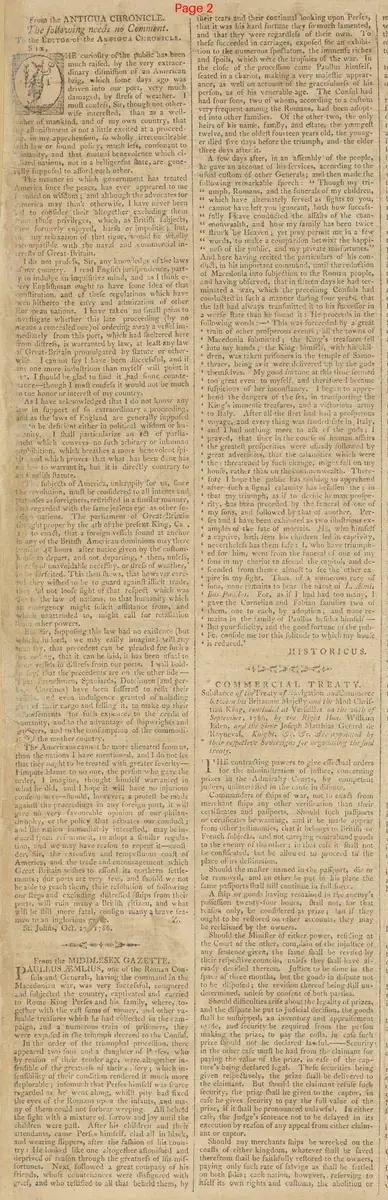
PAULLUS AEMILIUS, one of the Roman Consuls and Generals, having the command in the Macedonian war, was very successful, conquered and subjected the country, captivated and carried to Rome King Perseus and his family. where, together with the vast sums of money, and other valuable treasures which he had collected in the campaign, and a numerous train of prisoners, they were exposed in the triumph decreed to the Consul.
In the order of the triumphal procession, there appeared two sons and a daughter of Perseus. who by reason of their tender age, were altogether insensible of the greatness of their misery ; which insensibility of their condition rendered it much more deplorable; insomuch that Perseus himself was scarce regarded as he went along whilst pity had fixed the eyes of the Romans upon the infants, and many of them could not forbear weeping. All beheld the sight with a mixture of sorrow and joy until the children were past. After his children and their attendants, came Perseus himself, clad all in black, and wearing slippers, after the fashion of his country: He looked like one altogether astonished and deprived of reason through the greatness of his misfortunes. Next followed a great company of his friends, whose countenances were disfigured with grief, and who testified to all that beheld them, by their tears and their continual looking upon Perseus, that it was his hard fortune they so much lamented, and that they were regardless of their own. To these succeeded in carriages, exposed for an exhibition to the numerous spectators, the immense riches and spoils, which were the trophies of the war. In the close of the procession came Paullus himself, seated in a chariot, making a very majestic appearance, as well on account of the gracefulness of his person, as of his venerable age. The Consul had had four sons, two of whom, according to a custom very frequent among the Romans, had been adopted into other families. Of the other two, the only heirs of his name, family, and estate, the youngest twelve, and the oldest fourteen years old, the younger died five days before the triumph, and the elder three days after it.
A few days after, in an assembly of the people, he gave an account of his services, according to the usual custom of other Generals; and then made the following remarkable speech: "Though my triumph, Romans, and the funerals of my children, which have alternately served as sights to you, cannot have left you ignorant, both how successfully I have conducted the affairs of the commonwealth, and how my family has been twice struck by Heaven; yet pray permit me in a few words, to make a comparison betwixt the happiness of the public, and my private misfortunes."
And here having recited the particulars of his conduct, in his important command, until the reduction of Macedonia into subjection to the Roman people, and having observed, that in fifteen days he had terminated a war, which the preceding Consuls had conducted in such a manner during four years, that the last had always transmitted it to his successor in a worse state than he found it: He proceeds in the following words :-- "This was succeeded by a great train of other prosperous events ; all the towns of Macedonia submitted ; the King's treasures fell into my hands ; the King himself, with his children, was taken prisoners in the temple of Samothrace, being as it were delivered up by the gods themselves. My good fortune at this time seemed too great even to myself, and therefore I became suspicious of her inconstancy. I began to apprehend the dangers of the sea, in transporting the King's immense treasures, and a victorious army to Italy. After all the fleet had had a prosperous voyage, and every thing was landed safe in Italy, and I had nothing more to ask of the gods; I prayed, that since in the course of human affairs the greatest prosperities were usually followed by great adversities, that the calamities which were then threatened by such change, might fall on my house, rather than on the commonwealth. Therefore I hope the public has nothing to apprehend after such a signal calamity has befallen me ; in that my triumph, as if to deride human prosperity, has been preceded by the funeral of one of my sons, and followed by that of another. Perseus and I have been exhibited as two illustrious examples of the fate of mortals. He, who himself a captive, hath seen his children led in captivity, nevertheless has them safe : I, who have triumphed for him, went from the funeral of one of my sons in my chariot to ascend the capitol, and descended from thence almost to see the other expire in my sight. Thus, of a numerous race of sons, none remains to bear the name of L. Aemilius Paullus. For, as if I had had too many, I gave the Cornelian and Fabian families two of them, one to each, by adoption; and none remains in the family of Paullus besides himself - But your felicity, and the good fortune of the public, console me for this solitude to which my house is reduced."
HISTORICUS.
PAULLUS AEMILIUS, one of the Roman Consuls and Generals, having the command in the Macedonian war, was very successful, conquered and subjected the country, captivated and carried to Rome King Perseus and his family. where, together with the vast sums of money, and other valuable treasures which he had collected in the campaign, and a numerous train of prisoners, they were exposed in the triumph decreed to the Consul.
In the order of the triumphal procession, there appeared two sons and a daughter of Perseus. who by reason of their tender age, were altogether insensible of the greatness of their misery ; which insensibility of their condition rendered it much more deplorable; insomuch that Perseus himself was scarce regarded as he went along whilst pity had fixed the eyes of the Romans upon the infants, and many of them could not forbear weeping. All beheld the sight with a mixture of sorrow and joy until the children were past. After his children and their attendants, came Perseus himself, clad all in black, and wearing slippers, after the fashion of his country: He looked like one altogether astonished and deprived of reason through the greatness of his misfortunes. Next followed a great company of his friends, whose countenances were disfigured with grief, and who testified to all that beheld them, by their tears and their continual looking upon Perseus, that it was his hard fortune they so much lamented, and that they were regardless of their own. To these succeeded in carriages, exposed for an exhibition to the numerous spectators, the immense riches and spoils, which were the trophies of the war. In the close of the procession came Paullus himself, seated in a chariot, making a very majestic appearance, as well on account of the gracefulness of his person, as of his venerable age. The Consul had had four sons, two of whom, according to a custom very frequent among the Romans, had been adopted into other families. Of the other two, the only heirs of his name, family, and estate, the youngest twelve, and the oldest fourteen years old, the younger died five days before the triumph, and the elder three days after it.
A few days after, in an assembly of the people, he gave an account of his services, according to the usual custom of other Generals; and then made the following remarkable speech: "Though my triumph, Romans, and the funerals of my children, which have alternately served as sights to you, cannot have left you ignorant, both how successfully I have conducted the affairs of the commonwealth, and how my family has been twice struck by Heaven; yet pray permit me in a few words, to make a comparison betwixt the happiness of the public, and my private misfortunes."
And here having recited the particulars of his conduct, in his important command, until the reduction of Macedonia into subjection to the Roman people, and having observed, that in fifteen days he had terminated a war, which the preceding Consuls had conducted in such a manner during four years, that the last had always transmitted it to his successor in a worse state than he found it: He proceeds in the following words :-- "This was succeeded by a great train of other prosperous events ; all the towns of Macedonia submitted ; the King's treasures fell into my hands ; the King himself, with his children, was taken prisoners in the temple of Samothrace, being as it were delivered up by the gods themselves. My good fortune at this time seemed too great even to myself, and therefore I became suspicious of her inconstancy. I began to apprehend the dangers of the sea, in transporting the King's immense treasures, and a victorious army to Italy. After all the fleet had had a prosperous voyage, and every thing was landed safe in Italy, and I had nothing more to ask of the gods; I prayed, that since in the course of human affairs the greatest prosperities were usually followed by great adversities, that the calamities which were then threatened by such change, might fall on my house, rather than on the commonwealth. Therefore I hope the public has nothing to apprehend after such a signal calamity has befallen me ; in that my triumph, as if to deride human prosperity, has been preceded by the funeral of one of my sons, and followed by that of another. Perseus and I have been exhibited as two illustrious examples of the fate of mortals. He, who himself a captive, hath seen his children led in captivity, nevertheless has them safe : I, who have triumphed for him, went from the funeral of one of my sons in my chariot to ascend the capitol, and descended from thence almost to see the other expire in my sight. Thus, of a numerous race of sons, none remains to bear the name of L. Aemilius Paullus. For, as if I had had too many, I gave the Cornelian and Fabian families two of them, one to each, by adoption; and none remains in the family of Paullus besides himself - But your felicity, and the good fortune of the public, console me for this solitude to which my house is reduced."
HISTORICUS.
What sub-type of article is it?
Essay
Soliloquy
What themes does it cover?
War Peace
Death Mortality
Political
What keywords are associated?
Macedonian War
Roman Triumph
Paullus Aemilius
King Perseus
Family Loss
Public Fortune
What entities or persons were involved?
Historicus
Literary Details
Author
Historicus
Subject
Triumph Of Paullus Aemilius Over Perseus In The Macedonian War
Form / Style
Historical Narrative Incorporating A Consular Speech
Key Lines
Though My Triumph, Romans, And The Funerals Of My Children, Which Have Alternately Served As Sights To You, Cannot Have Left You Ignorant, Both How Successfully I Have Conducted The Affairs Of The Commonwealth, And How My Family Has Been Twice Struck By Heaven; Yet Pray Permit Me In A Few Words, To Make A Comparison Betwixt The Happiness Of The Public, And My Private Misfortunes.
Perseus And I Have Been Exhibited As Two Illustrious Examples Of The Fate Of Mortals. He, Who Himself A Captive, Hath Seen His Children Led In Captivity, Nevertheless Has Them Safe : I, Who Have Triumphed For Him, Went From The Funeral Of One Of My Sons In My Chariot To Ascend The Capitol, And Descended From Thence Almost To See The Other Expire In My Sight.
But Your Felicity, And The Good Fortune Of The Public, Console Me For This Solitude To Which My House Is Reduced.