Thank you for visiting SNEWPapers!
Sign up free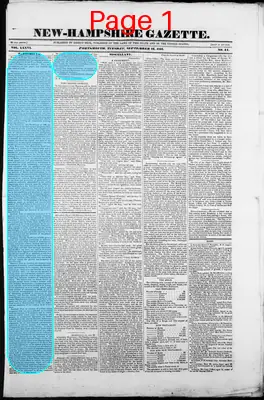
The New Hampshire Gazette
Portsmouth, Rockingham County, New Hampshire
What is this article about?
At a Free Trade meeting in Portland, Maine, on the 24th ult., resolutions were unanimously adopted criticizing the Tariff Law of 1828 for favoring manufacturers over agriculture and commerce, supporting revenue-only duties, and praising the National Administration's pro-commerce actions. Delegates were appointed to a Philadelphia convention, and a committee was formed to draft an address.
Clipping
OCR Quality
Full Text
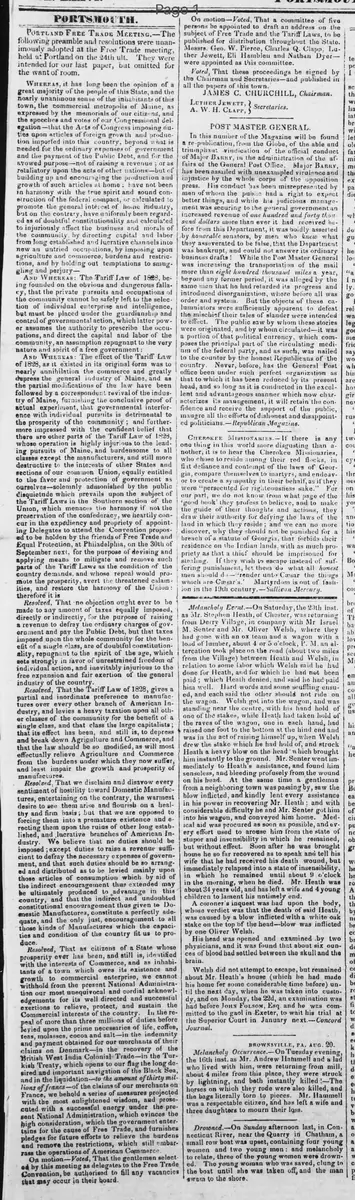
Portland Free Trade Meeting.—The following preamble and resolutions were unanimously adopted at the Free Trade meeting, held at Portland on the 24th ult. They were intended for our last paper, but omitted for the want of room.
Whereas, it has long been the opinion of a great majority of the people of this State, and the nearly unanimous sense of the inhabitants of this town, the commercial metropolis of Maine, as expressed by the memorials of our citizens, and the speeches and votes of our Congressional delegation—that the Acts of Congress imposing duties upon articles of foreign growth and production imported into this country, beyond what is needed for the ordinary expenses of government and the payment of the Public Debt, and for the avowed purpose—not of raising a revenue; or as retaliatory upon the acts of other nations—but of building up and encouraging the production and growth of such articles at home: have not been in harmony with the true spirit and sound construction of the federal compact, or calculated to promote the general interest of home industry, but on the contrary, have uniformly been regarded as of doubtful constitutionality and calculated to injuriously affect the business and morals of the community, by directing capital and labor from long established and lucrative channels into new and untried occupations, by imposing upon agriculture and commerce, burdens and restrictions, and by holding out temptations to smuggling and perjury—
And Whereas: The Tariff Law of 1828, being founded on the obvious and dangerous fallacy, that the private pursuits and occupations of the community cannot be safely left to the selection of individual enterprise and intelligence, but must be placed under the guardianship and control of governmental action, which latter power assumes the authority to prescribe the occupations, and direct the capital and labor of the community, an assumption repugnant to the very nature and spirit of a free government:
And Whereas: The effect of the Tariff Law of 1828, as it existed in its original form was to nearly annihilate the commerce and greatly depress the general industry of Maine, and as the partial modifications of the law have been followed by a correspondent revival of the industry of Maine, furnishing the conclusive proof of actual experiment, that governmental interference with individual pursuits is detrimental to the prosperity of the community; and furthermore impressed with the confident belief that there are other parts of the Tariff Law of 1828, whose operation is highly injurious to the leading pursuits of Maine, and burdensome to all classes except the manufacturers, and still more destructive to the interests of other States and sections of our common Union, equally entitled to the favor and protection of government as ourselves—solemnly admonished by the public disquietude which prevails upon the subject of the Tariff Laws in the Southern section of the Union, which menaces the harmony if not the preservation of the confederacy, we heartily concur in the expediency and propriety of appointing Delegates to attend the Convention proposed to be holden by the friends of Free Trade and Equal Protection, at Philadelphia, on the 30th of September next, for the purpose of devising and applying means to mitigate and remove such parts of the Tariff Laws as the condition of the country demands, and whose repeal would promote the prosperity, avert the threatened calamities, and restore the harmony of the Union:
Therefore it is
Resolved, That no objection ought ever to be made to any amount of taxes equally imposed, directly or indirectly, for the purpose of raising a revenue to defray the ordinary charges of government and pay the Public Debt, but that taxes imposed upon the whole community for the benefit of a single class, are of doubtful constitutionality, repugnant to the spirit of the age, which sets strongly in favor of unrestrained freedom of individual action, and inevitably injurious to the free expansion and fair exertion of the general industry of the country.
Resolved, That the Tariff Law of 1828, gives a partial and inordinate preference to manufactures over every other branch of American Industry, and levies a heavy taxation upon all other classes of the community for the benefit of a single class, and that class the large capitalists; that its effect has been, and still is, to depress and break down Agriculture and Commerce, and that the law should be so modified, as will most effectually relieve Agriculture and Commerce from the burdens under which they now suffer, and least impair the growth and prosperity of manufactures.
Resolved, That we disclaim and disavow every sentiment of hostility toward Domestic Manufactures, entertaining on the contrary, the warmest desire to see them arise and flourish on a healthy and firm basis; but that we are opposed to forcing them into a premature existence and erecting them upon the ruins of other long established, and lucrative branches of American Industry. We believe that no duties should be imposed; except duties to raise a revenue sufficient to defray the necessary expenses of government, and that such duties should be so arranged and distributed as to be levied mainly upon those articles of consumption which by aid of the indirect encouragement thus extended may be ultimately produced to advantage in this country, and that the indirect and undoubted constitutional encouragement thus given to Domestic Manufactures, constitute a perfectly adequate, and the only just, encouragement to all those kinds of Manufactures which the capacities and condition of the country fit us to produce.
Resolved, That as citizens of a State whose prosperity ever has been, and still is, identified with the interests of Commerce, and as inhabitants of a town which owes its existence and growth to commercial enterprise, we cannot withhold from the present National Administration our most unequivocal and cordial acknowledgements for its well directed and successful exertions to relieve, protect, and sustain the Commercial interests of the country. In the repeal of more than three millions of duties before levied upon the prime necessaries of life, coffee, teas, molasses, cocoa and salt—in the indemnity and payment obtained for our merchants of their claims on Denmark—in the recovery of the British West India Colonial Trade—in the Turkish Treaty, which opens to our flag the long desired and important navigation of the Black Sea, and in the liquidation—to the amount of thirty millions of francs—of the claims of our merchants on France, we behold a series of measures projected with the most enlightened wisdom, and prosecuted with a successful energy under the present National Administration, which evinces the high consideration, which the government entertains for the cause of Free Trade, and furnishes pledges for future efforts to relieve the burdens and remove the restrictions, which still embarrass the operations of American Commerce.
On motion—Voted, That the gentlemen selected by this meeting as delegates to the Free Trade Convention, be authorised to fill any vacancies that may occur in their board.
On motion—Voted, That a committee of five persons be appointed to draft an address on the subject of Free Trade and the Tariff Laws, to be published for distribution throughout the State. Messrs. Geo. W. Pierce, Charles Q. Clapp, Luther Jewett, Eli Hamblen and Nathan Dyer—were appointed as this committee.
Voted, That these proceedings be signed by the Chairman and Secretaries—and published in all the papers of this town.
JAMES C. CHURCHILL, Chairman.
Luther Jewett,
A. W. H. CLAPP,
Secretaries.
What sub-type of article is it?
What keywords are associated?
What entities or persons were involved?
Where did it happen?
Domestic News Details
Primary Location
Portland
Event Date
24th Ult.
Key Persons
Outcome
resolutions unanimously adopted criticizing the tariff law of 1828; delegates appointed to philadelphia free trade convention on september 30; committee of five appointed to draft address on free trade and tariff laws.
Event Details
Free Trade meeting held in Portland where a preamble and resolutions were adopted opposing protective tariffs beyond revenue needs, criticizing the 1828 Tariff Law for harming Maine's commerce and agriculture, supporting modifications to relieve burdens on non-manufacturing sectors, and praising the National Administration's pro-commerce measures. Motions passed to authorize delegates and appoint a publication committee.