Thank you for visiting SNEWPapers!
Sign up free
Daily State Sentinel
Indianapolis, Marion County, Indiana
What is this article about?
Congressional proceedings in Washington on May 13: Senate debates Pacific bill (rejected as special order), passes Indian protection and medal resolutions, considers revenue and appropriation bills; House concurs on Agriculture Department bill and passes pension bill with fraud detection amendment.
Clipping
OCR Quality
Full Text
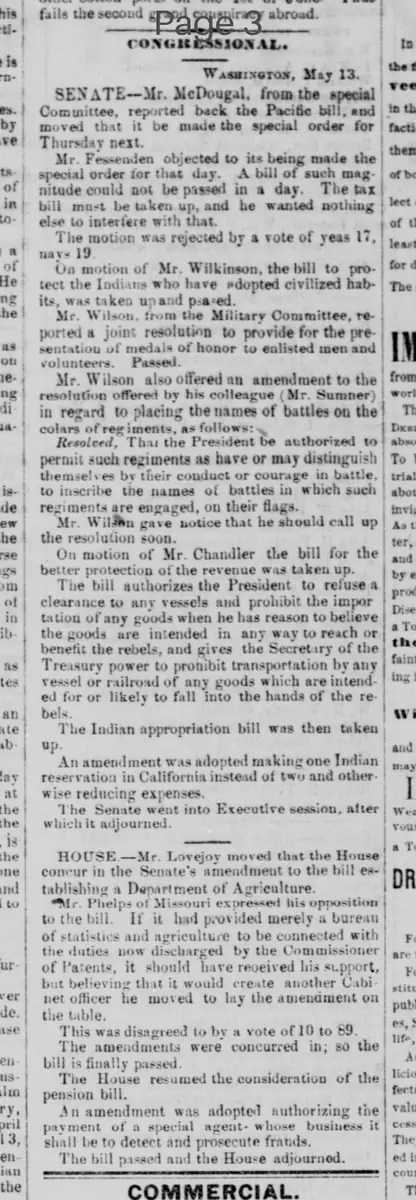
WASHINGTON, May 13.
SENATE.—Mr. McDougal, from the special Committee, reported back the Pacific bill, and moved that it be made the special order for Thursday next.
Mr. Fessenden objected to its being made the special order for that day. A bill of such magnitude could not be passed in a day. The tax bill must be taken up, and he wanted nothing else to interfere with that.
The motion was rejected by a vote of yeas 17, nays 19.
On motion of Mr. Wilkinson, the bill to protect the Indians who have adopted civilized habits, was taken up and passed.
Mr. Wilson, from the Military Committee, reported a joint resolution to provide for the presentation of medals of honor to enlisted men and volunteers. Passed.
Mr. Wilson also offered an amendment to the resolution offered by his colleague (Mr. Sumner) in regard to placing the names of battles on the colors of regiments, as follows:
Resolved, That the President be authorized to permit such regiments as have or may distinguish themselves by their conduct or courage in battle, to inscribe the names of battles in which such regiments are engaged, on their flags.
Mr. Wilson gave notice that he should call up the resolution soon.
On motion of Mr. Chandler the bill for the better protection of the revenue was taken up.
The bill authorizes the President to refuse a clearance to any vessels and prohibit the importation of any goods when he has reason to believe the goods are intended in any way to reach or benefit the rebels, and gives the Secretary of the Treasury power to prohibit transportation by any vessel or railroad of any goods which are intended for or likely to fall into the hands of the rebels.
The Indian appropriation bill was then taken up.
An amendment was adopted making one Indian reservation in California instead of two and otherwise reducing expenses.
The Senate went into Executive session, after which it adjourned.
HOUSE.—Mr. Lovejoy moved that the House concur in the Senate's amendment to the bill establishing a Department of Agriculture.
Mr. Phelps of Missouri expressed his opposition to the bill. "If it had provided merely a bureau of statistics and agriculture to be connected with the duties now discharged by the Commissioner of Patents, it should have received his support; but believing that it would create another Cabinet officer he moved to lay the amendment on the table."
This was disagreed to by a vote of 10 to 89.
The amendments were concurred in; so the bill is finally passed.
The House resumed the consideration of the pension bill.
An amendment was adopted authorizing the payment of a special agent—whose business it shall be to detect and prosecute frauds.
The bill passed and the House adjourned.
What sub-type of article is it?
What keywords are associated?
What entities or persons were involved?
Where did it happen?
Domestic News Details
Primary Location
Washington
Event Date
May 13
Key Persons
Outcome
pacific bill special order rejected (17-19); indian protection bill passed; medals resolution passed; revenue bill considered; indian appropriation amended and considered; agriculture department bill passed; pension bill passed with fraud detection amendment.
Event Details
Senate: Reported Pacific bill, motion for special order rejected; passed bill protecting civilized Indians; passed medals for enlisted men; Wilson offered amendment on battle names on flags; considered revenue protection bill against rebels; took up amended Indian appropriation bill. House: Concurred in Senate amendments to Agriculture Department bill despite opposition, passed it; resumed and passed pension bill with special agent for frauds.