Thank you for visiting SNEWPapers!
Sign up free
Literary
July 22, 1789
Gazette Of The United States
New York, New York County, New York
What is this article about?
This continued essay critiques proposals for unchecked popular assemblies in a commonwealth, using Roman history (Marius, Appius, Pompey, Caesar) to argue that without a senate, majorities would perpetuate power, corruption, and oppression. It praises laws as eternal and advocates balanced government with checks to curb self-interest, warning of annual elections' risks.
Clipping
OCR Quality
98%
Excellent
Full Text
The RIGHT CONSTITUTION of a COMMON.
WEALTH EXAMINED.
[Continued from our last.]
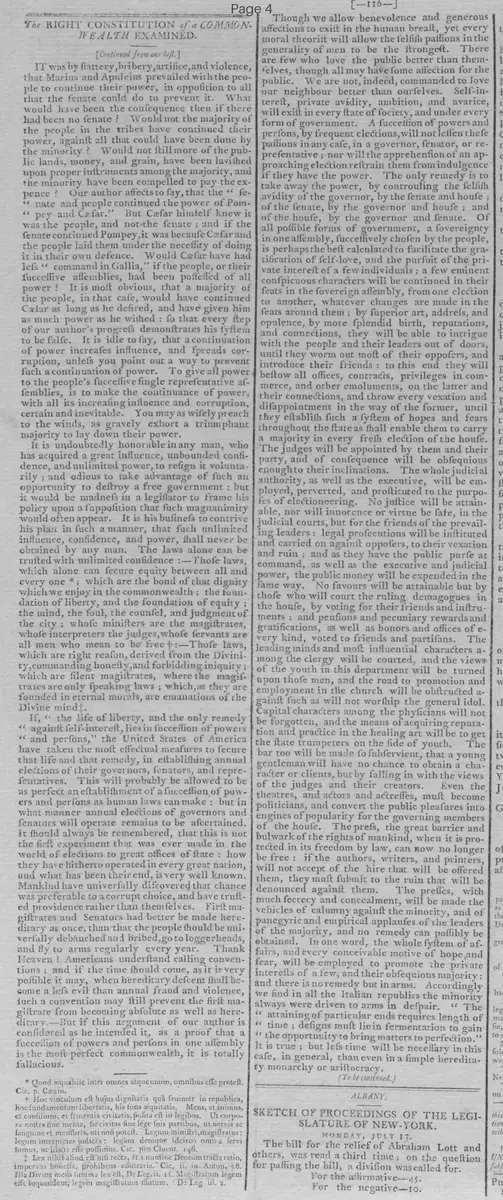
IT was by flattery, bribery, artifice, and violence, that Marius and Appuleius prevailed with the people to continue their power, in opposition to all that the senate could do to prevent it. What would have been the consequence then if there had been no senate? Would not the majority of the people in the tribes have continued their power, against all that could have been done by the minority? Would not still more of the public lands, money, and grain, have been lavished upon proper instruments among the majority, and the minority have been compelled to pay the expense? Our author affects to say, that the "senate and people continued the power of Pompey and Cæsar." But Cæsar himself knew it was the people, and not the senate; and if the senate continued Pompey, it was because Cæsar and the people laid them under the necessity of doing it in their own defence. Would Cæsar have had less "command in Gallia," if the people, or their successive assemblies, had been possessed of all power? It is most obvious, that a majority of the people, in that case, would have continued Cæsar as long as he desired, and have given him as much power as he wished: so that every step of our author's progress demonstrates his system to be false. It is idle to say, that a continuation of power increases influence, and spreads corruption, unless you point out a way to prevent such a continuation of power. To give all power to the people's successive single representative assemblies, is to make the continuance of power, with all its increasing influence and corruption, certain and inevitable. You may as wisely preach to the winds, as gravely exhort a triumphant majority to lay down their power.
It is undoubtedly honorable in any man, who has acquired a great influence, unbounded confidence, and unlimited power, to resign it voluntarily; and odious to take advantage of such an opportunity to destroy a free government: but it would be madness in a legislator to frame his policy upon a supposition that such magnanimity would often appear. It is his business to contrive his plan in such a manner, that such unlimited influence, confidence, and power, shall never be obtained by any man. The laws alone can be trusted with unlimited confidence:—Those laws, which alone can secure equity between all and every one*; which are the bond of that dignity which we enjoy in the commonwealth; the foundation of liberty, and the foundation of equity; the mind, the soul, the counsel, and judgment of the city; whose ministers are the magistrates, whose interpreters the judges, whose servants are all men who mean to be free**:—Those laws, which are right reason, derived from the Divinity, commanding honesty, and forbidding iniquity***; which are silent magistrates, where the magistrates are only speaking laws****; which, as they are founded in eternal morals, are emanations of the Divine mind.*****
If, "the life of liberty, and the only remedy against self-interest, lies in succession of powers and persons," the United States of America have taken the most effectual measures to secure that life and that remedy, in establishing annual elections of their governors, senators, and representatives. This will probably be allowed to be as perfect an establishment of a succession of powers and persons as human laws can make: but in what manner annual elections of governors and senators will operate remains to be ascertained. It should always be remembered, that this is not the first experiment that was ever made in the world of elections to great offices of state: how they have hitherto operated in every great nation, and what has been their end, is very well known. Mankind have universally discovered that chance was preferable to a corrupt choice, and have trusted providence rather than themselves. First magistrates and Senators had better be made hereditary at once, than that the people should be universally debauched and bribed, go to loggerheads, and fly to arms regularly every year. Thank Heaven! Americans understand calling conventions; and if the time should come, as it is very possible it may, when hereditary descent shall become a less evil than annual fraud and violence, such a convention may still prevent the first magistrate from becoming absolute as well as hereditary.—But if this argument of our author is considered as he intended it, as a proof that a succession of powers and persons in one assembly is the most perfect commonwealth, it is totally fallacious.
* Quod æquabile inter omnes atque unum, omnibus esse protest.
Cic. pro Cæcin.
+ Hoc vinculum et hujus dignitatis quâ fruimur in republicâ.
hoc fundamentum libertatis, hujus fons æquitatis. Mens, et animus,
et consilium, et sententia civitatis, posita est in legibus. Ut corpo-
ra nostra sine mente, sic civitas sine lege suis partibus, ut nervis ac
sanguine et membris, uti non potest. Legum ministri, magistratus:
legum interpretes, judices: legum denique idcirco omnes servi
sumus, ut liberi esse possimus. Cic. pro Cluent. 146.
Lex nihil aliud est nisi recta, et a numine Deorum tracta ratio,
imperans honesta, prohibens contraria. Cic. ii. in Anton, 28.
Illa Divina mens summa lex est, De Leg. ii. 11. Magistratûm legem
esse loquendam, legem magistratûm mutam. De Leg. ii. 2.
Though we allow benevolence and generous affections to exist in the human breast, yet every moral theorist will allow the selfish passions in the generality of men to be the strongest. There are few who love the public better than themselves, though all may have some affection for the public. We are not, indeed, commanded to love our neighbour better than ourselves. Self-interest, private avidity, ambition, and avarice, will exist in every state of society, and under every form of government. A succession of powers and persons, by frequent elections, will not lessen these passions in any case, in a governor, senator, or representative; nor will the apprehension of an approaching election restrain them from indulgence if they have the power. The only remedy is to take away the power, by controuling the selfish avidity of the governor, by the senate and house; of the senate, by the governor and house; and of the house, by the governor and senate. Of all possible forms of government, a sovereignty in one assembly, successively chosen by the people, is perhaps the best calculated to facilitate the gratification of self-love, and the pursuit of the private interest of a few individuals; a few eminent conspicuous characters will be continued in their seats in the sovereign assembly, from one election to another, whatever changes are made in the seats around them; by superior art, address, and opulence, by more splendid birth, reputations, and connections, they will be able to intrigue with the people and their leaders out of doors, until they worm out most of their opposers, and introduce their friends: to this end they will bestow all offices, contracts, privileges in commerce, and other emoluments, on the latter and their connections, and throw every vexation and disappointment in the way of the former, until they establish such a system of hopes and fears throughout the state as shall enable them to carry a majority in every fresh election of the house. The judges will be appointed by them and their party, and of consequence will be obsequious enough to their inclinations. The whole judicial authority, as well as the executive, will be employed, perverted, and prostituted to the purposes of electioneering. No justice will be attainable, nor will innocence or virtue be safe, in the judicial courts, but for the friends of the prevailing leaders: legal prosecutions will be instituted and carried on against opposers, to their vexation and ruin; and as they have the public purse at command, as well as the executive and judicial power, the public money will be expended in the same way. No favours will be attainable but by those who will court the ruling demagogues in the house, by voting for their friends and instruments; and pensions and pecuniary rewards and gratifications, as well as honors and offices of every kind, voted to friends and partisans. The leading minds and most influential characters among the clergy will be courted, and the views of the youth in this department will be turned upon those men, and the road to promotion and employment in the church will be obstructed against such as will not worship the general idol. Capital characters among the physicians will not be forgotten, and the means of acquiring reputation and practice in the healing art will be to get the state trumpeters on the side of youth. The bar too will be made so subservient, that a young gentleman will have no chance to obtain a character or clients, but by falling in with the views of the judges and their creators. Even the theatres, and actors and actresses, must become politicians, and convert the public pleasures into engines of popularity for the governing members of the house. The press, the great barrier and bulwark of the rights of mankind, when it is protected in its freedom by law, can now no longer be free: if the authors, writers, and printers, will not accept of the hire that will be offered them, they must submit to the ruin that will be denounced against them. The presses, with much secrecy and concealment, will be made the vehicles of calumny against the minority, and of panegyric and empirical applauses of the leaders of the majority, and no remedy can possibly be obtained. In one word, the whole system of affairs, and every conceivable motive of hope and fear, will be employed to promote the private interests of a few, and their obsequious majority: and there is no remedy but in arms. Accordingly we find in all the Italian republics the minority always were driven to arms in despair. "The attaining of particular ends requires length of time; designs must lie in fermentation to gain the opportunity to bring matters to perfection." It is true; but less time will be necessary in this case, in general, than even in a simple hereditary monarchy or aristocracy.
(To be continued.)
WEALTH EXAMINED.
[Continued from our last.]
IT was by flattery, bribery, artifice, and violence, that Marius and Appuleius prevailed with the people to continue their power, in opposition to all that the senate could do to prevent it. What would have been the consequence then if there had been no senate? Would not the majority of the people in the tribes have continued their power, against all that could have been done by the minority? Would not still more of the public lands, money, and grain, have been lavished upon proper instruments among the majority, and the minority have been compelled to pay the expense? Our author affects to say, that the "senate and people continued the power of Pompey and Cæsar." But Cæsar himself knew it was the people, and not the senate; and if the senate continued Pompey, it was because Cæsar and the people laid them under the necessity of doing it in their own defence. Would Cæsar have had less "command in Gallia," if the people, or their successive assemblies, had been possessed of all power? It is most obvious, that a majority of the people, in that case, would have continued Cæsar as long as he desired, and have given him as much power as he wished: so that every step of our author's progress demonstrates his system to be false. It is idle to say, that a continuation of power increases influence, and spreads corruption, unless you point out a way to prevent such a continuation of power. To give all power to the people's successive single representative assemblies, is to make the continuance of power, with all its increasing influence and corruption, certain and inevitable. You may as wisely preach to the winds, as gravely exhort a triumphant majority to lay down their power.
It is undoubtedly honorable in any man, who has acquired a great influence, unbounded confidence, and unlimited power, to resign it voluntarily; and odious to take advantage of such an opportunity to destroy a free government: but it would be madness in a legislator to frame his policy upon a supposition that such magnanimity would often appear. It is his business to contrive his plan in such a manner, that such unlimited influence, confidence, and power, shall never be obtained by any man. The laws alone can be trusted with unlimited confidence:—Those laws, which alone can secure equity between all and every one*; which are the bond of that dignity which we enjoy in the commonwealth; the foundation of liberty, and the foundation of equity; the mind, the soul, the counsel, and judgment of the city; whose ministers are the magistrates, whose interpreters the judges, whose servants are all men who mean to be free**:—Those laws, which are right reason, derived from the Divinity, commanding honesty, and forbidding iniquity***; which are silent magistrates, where the magistrates are only speaking laws****; which, as they are founded in eternal morals, are emanations of the Divine mind.*****
If, "the life of liberty, and the only remedy against self-interest, lies in succession of powers and persons," the United States of America have taken the most effectual measures to secure that life and that remedy, in establishing annual elections of their governors, senators, and representatives. This will probably be allowed to be as perfect an establishment of a succession of powers and persons as human laws can make: but in what manner annual elections of governors and senators will operate remains to be ascertained. It should always be remembered, that this is not the first experiment that was ever made in the world of elections to great offices of state: how they have hitherto operated in every great nation, and what has been their end, is very well known. Mankind have universally discovered that chance was preferable to a corrupt choice, and have trusted providence rather than themselves. First magistrates and Senators had better be made hereditary at once, than that the people should be universally debauched and bribed, go to loggerheads, and fly to arms regularly every year. Thank Heaven! Americans understand calling conventions; and if the time should come, as it is very possible it may, when hereditary descent shall become a less evil than annual fraud and violence, such a convention may still prevent the first magistrate from becoming absolute as well as hereditary.—But if this argument of our author is considered as he intended it, as a proof that a succession of powers and persons in one assembly is the most perfect commonwealth, it is totally fallacious.
* Quod æquabile inter omnes atque unum, omnibus esse protest.
Cic. pro Cæcin.
+ Hoc vinculum et hujus dignitatis quâ fruimur in republicâ.
hoc fundamentum libertatis, hujus fons æquitatis. Mens, et animus,
et consilium, et sententia civitatis, posita est in legibus. Ut corpo-
ra nostra sine mente, sic civitas sine lege suis partibus, ut nervis ac
sanguine et membris, uti non potest. Legum ministri, magistratus:
legum interpretes, judices: legum denique idcirco omnes servi
sumus, ut liberi esse possimus. Cic. pro Cluent. 146.
Lex nihil aliud est nisi recta, et a numine Deorum tracta ratio,
imperans honesta, prohibens contraria. Cic. ii. in Anton, 28.
Illa Divina mens summa lex est, De Leg. ii. 11. Magistratûm legem
esse loquendam, legem magistratûm mutam. De Leg. ii. 2.
Though we allow benevolence and generous affections to exist in the human breast, yet every moral theorist will allow the selfish passions in the generality of men to be the strongest. There are few who love the public better than themselves, though all may have some affection for the public. We are not, indeed, commanded to love our neighbour better than ourselves. Self-interest, private avidity, ambition, and avarice, will exist in every state of society, and under every form of government. A succession of powers and persons, by frequent elections, will not lessen these passions in any case, in a governor, senator, or representative; nor will the apprehension of an approaching election restrain them from indulgence if they have the power. The only remedy is to take away the power, by controuling the selfish avidity of the governor, by the senate and house; of the senate, by the governor and house; and of the house, by the governor and senate. Of all possible forms of government, a sovereignty in one assembly, successively chosen by the people, is perhaps the best calculated to facilitate the gratification of self-love, and the pursuit of the private interest of a few individuals; a few eminent conspicuous characters will be continued in their seats in the sovereign assembly, from one election to another, whatever changes are made in the seats around them; by superior art, address, and opulence, by more splendid birth, reputations, and connections, they will be able to intrigue with the people and their leaders out of doors, until they worm out most of their opposers, and introduce their friends: to this end they will bestow all offices, contracts, privileges in commerce, and other emoluments, on the latter and their connections, and throw every vexation and disappointment in the way of the former, until they establish such a system of hopes and fears throughout the state as shall enable them to carry a majority in every fresh election of the house. The judges will be appointed by them and their party, and of consequence will be obsequious enough to their inclinations. The whole judicial authority, as well as the executive, will be employed, perverted, and prostituted to the purposes of electioneering. No justice will be attainable, nor will innocence or virtue be safe, in the judicial courts, but for the friends of the prevailing leaders: legal prosecutions will be instituted and carried on against opposers, to their vexation and ruin; and as they have the public purse at command, as well as the executive and judicial power, the public money will be expended in the same way. No favours will be attainable but by those who will court the ruling demagogues in the house, by voting for their friends and instruments; and pensions and pecuniary rewards and gratifications, as well as honors and offices of every kind, voted to friends and partisans. The leading minds and most influential characters among the clergy will be courted, and the views of the youth in this department will be turned upon those men, and the road to promotion and employment in the church will be obstructed against such as will not worship the general idol. Capital characters among the physicians will not be forgotten, and the means of acquiring reputation and practice in the healing art will be to get the state trumpeters on the side of youth. The bar too will be made so subservient, that a young gentleman will have no chance to obtain a character or clients, but by falling in with the views of the judges and their creators. Even the theatres, and actors and actresses, must become politicians, and convert the public pleasures into engines of popularity for the governing members of the house. The press, the great barrier and bulwark of the rights of mankind, when it is protected in its freedom by law, can now no longer be free: if the authors, writers, and printers, will not accept of the hire that will be offered them, they must submit to the ruin that will be denounced against them. The presses, with much secrecy and concealment, will be made the vehicles of calumny against the minority, and of panegyric and empirical applauses of the leaders of the majority, and no remedy can possibly be obtained. In one word, the whole system of affairs, and every conceivable motive of hope and fear, will be employed to promote the private interests of a few, and their obsequious majority: and there is no remedy but in arms. Accordingly we find in all the Italian republics the minority always were driven to arms in despair. "The attaining of particular ends requires length of time; designs must lie in fermentation to gain the opportunity to bring matters to perfection." It is true; but less time will be necessary in this case, in general, than even in a simple hereditary monarchy or aristocracy.
(To be continued.)
What sub-type of article is it?
Essay
What themes does it cover?
Political
Liberty Freedom
What keywords are associated?
Commonwealth
Senate
Elections
Corruption
Liberty
Self Interest
Roman History
Cicero
Balanced Government
American Republic
Literary Details
Title
The Right Constitution Of A Commonwealth Examined.
Key Lines
The Laws Alone Can Be Trusted With Unlimited Confidence:—Those Laws, Which Alone Can Secure Equity Between All And Every One*
If, "The Life Of Liberty, And The Only Remedy Against Self Interest, Lies In Succession Of Powers And Persons," The United States Of America Have Taken The Most Effectual Measures To Secure That Life And That Remedy, In Establishing Annual Elections Of Their Governors, Senators, And Representatives.
The Only Remedy Is To Take Away The Power, By Controuling The Selfish Avidity Of The Governor, By The Senate And House; Of The Senate, By The Governor And House; And Of The House, By The Governor And Senate.
Of All Possible Forms Of Government, A Sovereignty In One Assembly, Successively Chosen By The People, Is Perhaps The Best Calculated To Facilitate The Gratification Of Self Love, And The Pursuit Of The Private Interest Of A Few Individuals;
In One Word, The Whole System Of Affairs, And Every Conceivable Motive Of Hope And Fear, Will Be Employed To Promote The Private Interests Of A Few, And Their Obsequious Majority: And There Is No Remedy But In Arms.