Thank you for visiting SNEWPapers!
Sign up free
Richmond Enquirer
Richmond, Richmond County, Virginia
What is this article about?
A letter criticizes the Southern anti-abolition panic as politically motivated by opponents of Van Buren, arguing it weakens the South by invoking freedom of speech and press issues. It urges internal vigilance against abolitionist materials rather than demanding Northern legislation, trusting Northern majorities to resist abolitionists while preserving the Union.
Clipping
OCR Quality
Full Text
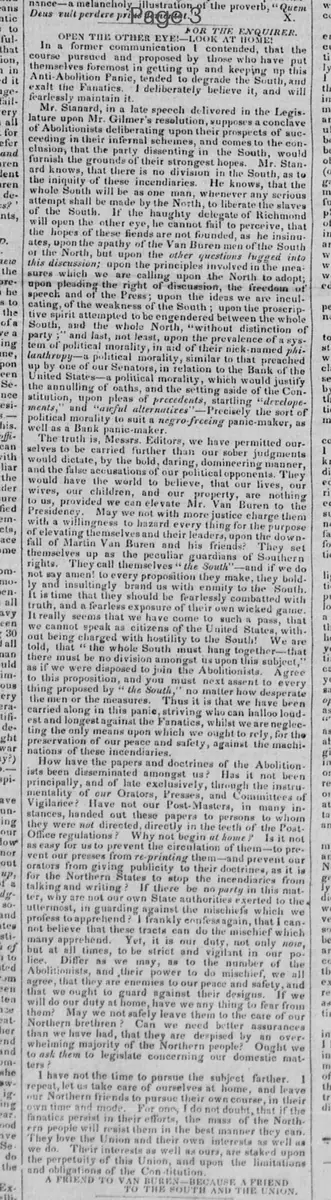
OPEN THE OTHER EYE!—LOOK AT HOME!
In a former communication I contended, that the course pursued and proposed by those who have put themselves foremost in getting up and keeping up this Anti-Abolition Panic, tended to degrade the South, and exalt the Fanatics. I deliberately believe it, and will fearlessly maintain it.
Mr. Stanard, in a late speech delivered in the Legislature upon Mr. Gilmer's resolution, supposes a conclave of Abolitionists deliberating upon their prospects of succeeding in their infernal schemes, and comes to the conclusion, that the party dissenting in the South, would furnish the grounds of their strongest hopes. Mr. Stanard knows, that there is no division in the South, as to the iniquity of these incendiaries. He knows, that the whole South will be as one man, whenever any serious attempt shall be made by the North, to liberate the slaves of the South. If the haughty delegate of Richmond will open the other eye, he cannot fail to perceive, that the hopes of these fiends are not founded, as he insinuates, upon the apathy of the Van Buren men of the South or the North, but upon the other questions lugged into this discussion; upon the principles involved in the measures which we are calling upon the North to adopt; upon pleading the right of discussion, the freedom of speech and of the Press; upon the ideas we are inculcating, of the weakness of the South; upon the proscriptive spirit attempted to be engendered between the whole South, and the whole North, "without distinction of party ;" and last, not least, upon the prevalence of a system of political morality, in aid of their nick-named philanthropy—a political morality, similar to that preached up by one of our Senators, in relation to the Bank of the United States—a political morality, which would justify the annulling of oaths, and the setting aside of the Constitution, upon pleas of precedents, startling "developments," and "awful alternatives"—Precisely the sort of political morality to suit a negro-freeing panic-maker, as well as a Bank panic-maker.
The truth is, Messrs. Editors, we have permitted ourselves to be carried further than our sober judgments would dictate, by the bold, daring, domineering manner, and the false accusations of our political opponents. They would have the world to believe, that our lives, our wives, our children, and our property, are nothing to us, provided we can elevate Mr. Van Buren to the Presidency. May we not with more justice charge them with a willingness to hazard every thing for the purpose of elevating themselves and their leaders, upon the downfall of Martin Van Buren and his friends? They set themselves up as the peculiar guardians of Southern rights. They call themselves "the South"—and if we do not say amen! to every proposition they make, they boldly and insultingly brand us with enmity to the South. It is time that they should be fearlessly combatted with truth, and a fearless exposure of their own wicked game. It really seems that we have come to such a pass, that we cannot speak as citizens of the United States, without being charged with hostility to the South! We are told, that "the whole South must hang together—that there must be no division amongst us upon this subject," as if we were disposed to join the Abolitionists. Agree to this proposition, and you must next assent to every thing proposed by "the South," no matter how desperate the men or the measures. Thus it is that we have been carried along in this panic, striving who can halloo loudest and longest against the Fanatics, whilst we are neglecting the only means upon which we ought to rely, for the preservation of our peace and safety, against the machinations of these incendiaries.
How have the papers and doctrines of the Abolitionists been disseminated amongst us? Has it not been principally, and of late exclusively, through the instrumentality of our Orators, Presses, and Committees of Vigilance? Have not our Post-Masters, in many instances, handed out these papers to persons to whom they were not directed, directly in the teeth of the Post-Office regulations? Why not begin at home? Is it not as easy for us to prevent the circulation of them—to prevent our presses from re-printing them—and prevent our orators from giving publicity to their doctrines, as it is for the Northern States to stop the incendiaries from talking and writing? If there be no party in this matter, why are not our own State authorities exerted to the utmost, in guarding against the mischiefs which we profess to apprehend? "I frankly confess again, that I cannot believe that these tracts can do the mischief which many apprehend. Yet, it is our duty, not only now, but at all times, to be strict and vigilant in our police. Differ as we may, as to the number of the Abolitionists, and their power to do mischief, we all agree, that they are enemies to our peace and safety, and that we ought to guard against their designs. If we will do our duty at home, have we any thing to fear from them? May we not safely leave them to the care of our Northern brethren? Can we need better assurances than we have had, that they are despised by an overwhelming majority of the Northern people?" Ought we to ask them to legislate concerning our domestic matters?
I have not the time to pursue the subject farther. I repeat, let us take care of ourselves at home, and leave our Northern friends to pursue their own course, in their own time and mode. For one, I do not doubt, that if the fanatics persist in their efforts, the mass of the Northern people will resist them in the best manner they can. They love the Union and their own interests as well as we do. Their interests as well as ours, are staked upon the perpetuity of this Union, and upon the limitations and obligations of the Constitution.
A FRIEND TO VAN BUREN—BECAUSE A FRIEND TO THE SOUTH AND THE UNION.
What sub-type of article is it?
What themes does it cover?
What keywords are associated?
What entities or persons were involved?
Letter to Editor Details
Author
A Friend To Van Buren—Because A Friend To The South And The Union.
Recipient
For The Enquirer.
Main Argument
the anti-abolition panic in the south is politically driven by van buren opponents to degrade southern unity and exalt abolitionists; instead, the south should focus on internal measures to curb abolitionist materials and trust northern resistance, avoiding demands that infringe on freedoms of speech and press.
Notable Details