Thank you for visiting SNEWPapers!
Sign up free
Editorial
November 10, 1853
South Carolina Temperance Advocate
Charleston, Camden, Kershaw County, South Carolina
What is this article about?
Editorial defends the legislature's right to prohibit alcohol sales under the Maine Law, arguing society must prevent vices like drunkenness to avoid pauperism and crime, supported by science, economics, and theology showing alcohol's destructive effects.
Clipping
OCR Quality
98%
Excellent
Full Text
The Right to Prohibit.
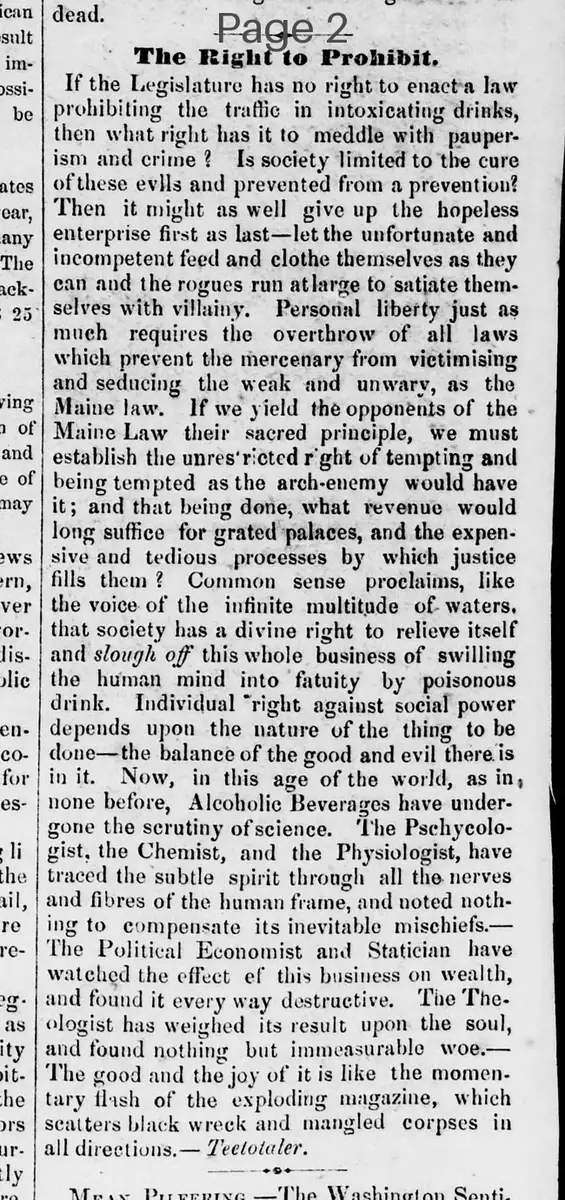
If the Legislature has no right to enact a law prohibiting the traffic in intoxicating drinks, then what right has it to meddle with pauperism and crime? Is society limited to the cure of these evils and prevented from a prevention? Then it might as well give up the hopeless enterprise first as last-let the unfortunate and incompetent feed and clothe themselves as they can and the rogues run at large to satiate themselves with villainy. Personal liberty just as much requires the overthrow of all laws which prevent the mercenary from victimising and seducing the weak and unwary, as the Maine law. "If we yield the opponents of the Maine Law their sacred principle, we must establish the unrestricted right of tempting and being tempted as the arch-enemy would have it; and that being done, what revenue would long suffice for gilded palaces, and the expensive and tedious processes by which justice fills them? Common sense proclaims, like the voice of the infinite multitude of waters, that society has a divine right to relieve itself and slough off this whole business of swilling the human mind into fatuity by poisonous drink. Individual right against social power depends upon the nature of the thing to be done--the balance of the good and evil there is in it. Now, in this age of the world, as in none before, Alcoholic Beverages have undergone the scrutiny of science. The Psychologist, the Chemist, and the Physiologist, have traced the subtle spirit through all the nerves and fibres of the human frame, and noted nothing to compensate its inevitable mischiefs. The Political Economist and Statistician have watched the effect of this business on wealth, and found it every way destructive. The Theologian has weighed its result upon the soul, and found nothing but immeasurable woe. The good and the joy of it is like the momentary flash of the exploding magazine, which scatters black wreck and mangled corpses in all directions.
If the Legislature has no right to enact a law prohibiting the traffic in intoxicating drinks, then what right has it to meddle with pauperism and crime? Is society limited to the cure of these evils and prevented from a prevention? Then it might as well give up the hopeless enterprise first as last-let the unfortunate and incompetent feed and clothe themselves as they can and the rogues run at large to satiate themselves with villainy. Personal liberty just as much requires the overthrow of all laws which prevent the mercenary from victimising and seducing the weak and unwary, as the Maine law. "If we yield the opponents of the Maine Law their sacred principle, we must establish the unrestricted right of tempting and being tempted as the arch-enemy would have it; and that being done, what revenue would long suffice for gilded palaces, and the expensive and tedious processes by which justice fills them? Common sense proclaims, like the voice of the infinite multitude of waters, that society has a divine right to relieve itself and slough off this whole business of swilling the human mind into fatuity by poisonous drink. Individual right against social power depends upon the nature of the thing to be done--the balance of the good and evil there is in it. Now, in this age of the world, as in none before, Alcoholic Beverages have undergone the scrutiny of science. The Psychologist, the Chemist, and the Physiologist, have traced the subtle spirit through all the nerves and fibres of the human frame, and noted nothing to compensate its inevitable mischiefs. The Political Economist and Statistician have watched the effect of this business on wealth, and found it every way destructive. The Theologian has weighed its result upon the soul, and found nothing but immeasurable woe. The good and the joy of it is like the momentary flash of the exploding magazine, which scatters black wreck and mangled corpses in all directions.
What sub-type of article is it?
Temperance
Moral Or Religious
Social Reform
What keywords are associated?
Prohibition
Maine Law
Temperance
Intoxicating Drinks
Social Evil
Personal Liberty
Scientific Scrutiny
Moral Reform
What entities or persons were involved?
Legislature
Maine Law
Opponents Of The Maine Law
Psychologist
Chemist
Physiologist
Political Economist
Statistician
Theologian
Editorial Details
Primary Topic
Defense Of The Right To Prohibit Traffic In Intoxicating Drinks
Stance / Tone
Strongly Pro Prohibition And Moral Exhortation
Key Figures
Legislature
Maine Law
Opponents Of The Maine Law
Psychologist
Chemist
Physiologist
Political Economist
Statistician
Theologian
Key Arguments
Legislature Has Right To Prohibit Alcohol Traffic To Prevent Evils Like Pauperism And Crime
Society Must Prevent Rather Than Just Cure Social Ills
Personal Liberty Does Not Extend To Allowing Victimization Through Alcohol
Yielding To Opponents Establishes Unrestricted Temptation
Society Has Divine Right To Eliminate Alcohol Consumption
Individual Rights Balance Against Social Good Based On Alcohol's Harms
Science Shows Alcohol's Inevitable Mischiefs With No Compensating Benefits
Alcohol Destroys Wealth And Causes Woe To The Soul