Thank you for visiting SNEWPapers!
Sign up free
The New Hampshire Gazette And General Advertiser
Portsmouth, Exeter, Rockingham County, New Hampshire
What is this article about?
American ministers declare cessation of hostilities with Britain following preliminary peace articles signed in Paris on November 30, 1782, recognizing US independence, defining boundaries, and outlining terms like fishing rights and debt recovery. Includes London parliamentary debate on the treaties.
Merged-components note: Merged the news report from Salem on the Declaration of Cessation of Arms, the continuation with London Public Ledger excerpts on parliamentary discussion of the peace articles, and the full text of the Preliminary Articles of the Treaty of Paris into a single coherent foreign news component focused on the international peace treaty.
Clippings
1 of 2
OCR Quality
Full Text
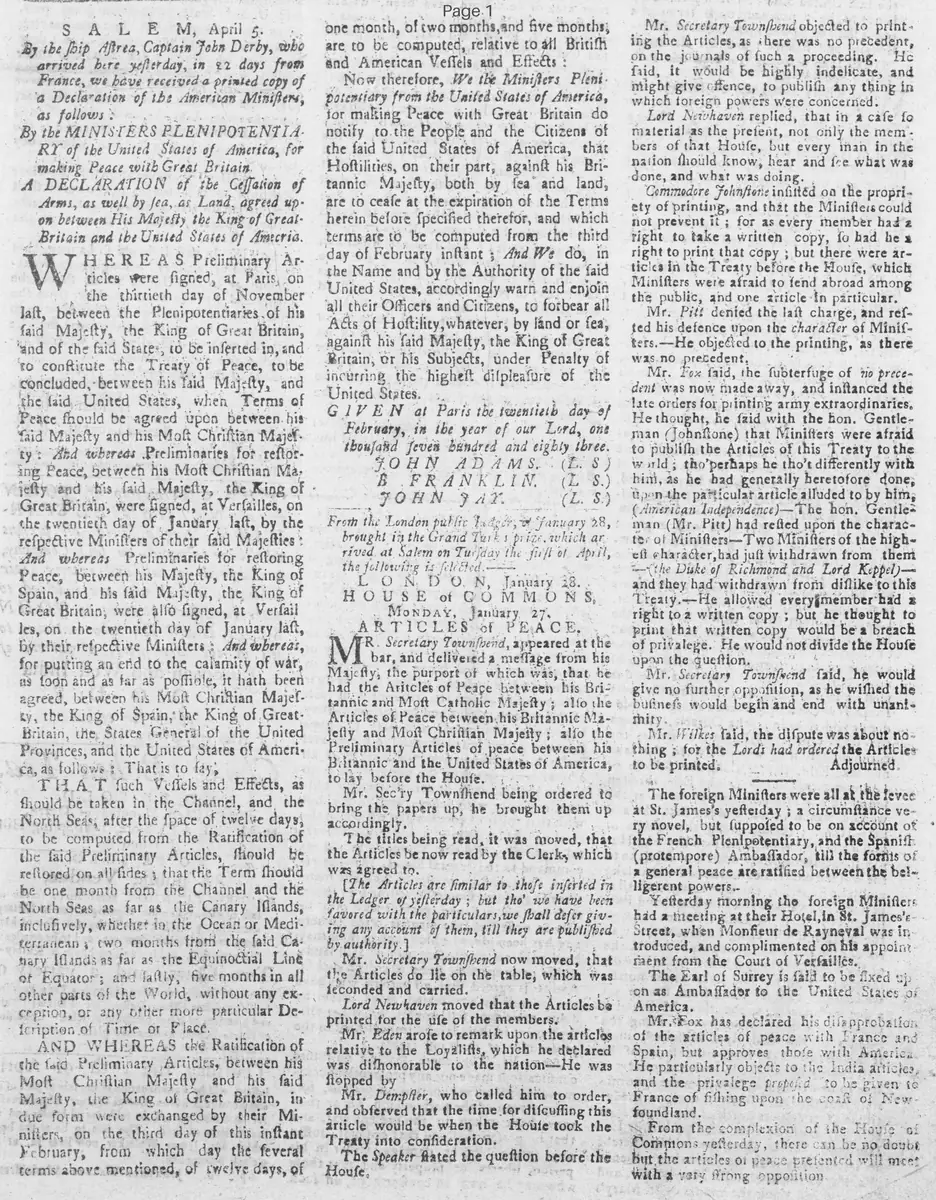
By the ship Atrea, Captain John Derby, who arrived here yesterday, in 22 days from France, we have received a printed copy of a Declaration of the American Ministers, as follows:
By the MINISTERS PLENIPOTENTIARY of the United States of America, for making Peace with Great Britain.
A DECLARATION of the Cessation of Arms, as well by sea, as Land, agreed upon between His Majesty the King of Great-Britain and the United States of America.
WHEREAS Preliminary Articles Were signed, at Paris on the thirtieth day of November last, between the Plenipotentiaries of his said Majesty, the King of Great Britain, and of the said States, to be inserted in, and to constitute the Treaty of Peace, to be concluded between his said Majesty, and the said United States, when Terms of Peace should be agreed upon between his said Majesty and his Most Christian Majesty: And whereas Preliminaries for restoring Peace, between his Most Christian Majesty and his said Majesty, the King of Great Britain, were signed at Versailles, on the twentieth day of January last, by the respective Ministers of their said Majesties: And whereas Preliminaries for restoring Peace, between his Majesty, the King of Spain, and his said Majesty, the King of Great Britain: were also signed at Versailles, on the twentieth day of January last, by their respective Ministers: And whereas, for putting an end to the calamity of war, as soon and as far as possible, it hath been agreed, between his Most Christian Majesty, the King of Spain, the King of Great-Britain, the States General of the United Provinces, and the United States of America, as follows: That is to say:
THAT such Vessels and Effects, as should be taken in the Channel and the North Seas, after the space of twelve days, to be computed from the Ratification of the said Preliminary Articles, should be restored on all sides: that the Term should be one month from the Channel and the North Seas as far as the Canary Islands, inclusively, whether in the Ocean or Mediterranean; two months from the said Canary Islands as far as the Equinoctial Line of Equator: and lastly, five months in all other parts of the World, without any exception, or any other more particular Description of Time or Place.
AND WHEREAS the Ratification of the said Preliminary Articles, between his Most Christian Majesty and his said Majesty, the King of Great Britain, in due form were exchanged by their Ministers, on the third day of this instant February, from which day the several terms above mentioned, of twelve days, of
one month, of two months, and five months, are to be computed: relative to all British and American Vessels and Effects:
Now therefore, We the Ministers Plenipotentiary from the United States of America, for making Peace with Great Britain do notify to the People and the Citizens of the said United States of America, that Hostilities, on their part, against his Britannic Majesty, both by sea and land, are to cease at the expiration of the Terms herein before specified therefor, and which terms are to be computed from the third day of February instant; And We do, in the Name and by the Authority of the said United States, accordingly warn and enjoin all their Officers and Citizens, to forbear all Acts of Hostility, whatever, by land or sea, against his said Majesty, the King of Great Britain, or his Subjects, under Penalty of incurring the highest displeasure of the United States.
GIVEN at Paris the twentieth day of February, in the year of our Lord, one thousand seven hundred and eighty three.
JOHN ADAMS. (L.S.)
B. FRANKLIN. (L.S.)
JOHN JAY (L.S.)
From the London Public Ledger, it January 28, brought in the Grand Turk's prize, which arrived at Salem on Tuesday the first of April, the following is selected in
LONDON, January 28.
HOUSE OF COMMONS.
MONDAY, January 27.
ARTICLES OF PEACE.
Mr. Secretary moved, the purport of which was: that he had the Articles of Peace between his Britannic and Most Catholic Majesty: also the Articles of Peace between his Britannic Majesty and Most Christian Majesty: also the Preliminary Articles of peace between his Britannic and the United States of America, to lay before the House.
Mr. Sec'ry Townshend being ordered to bring the papers up, he brought them up accordingly.
The titles being read, it was moved, that the Articles be now read by the Clerk- which was agreed to.
The Articles are similar to those inserted in the Ledger of yesterday: but tho' we have been favored with the particulars, we shall defer giving any account of them, till they are published by authority.
Mr. Secretary Townshend now moved, that the Articles do lie on the table, which was seconded and carried.
Lord Newhaven moved that the Articles be printed for the use of the members.
Mr. Eden arose to remark upon the articles relative to the Loyalists, which he declared was dishonorable to the nation- He was stopped by
Mr. Dempster, who called him to order, and observed that the time for discussing this article would be when the House took the Treaty into consideration.
The Speaker stated the question before the House.
Mr. Secretary Townshend objected to printing the Articles, as there was no precedent on the journals of such a proceeding. He said, it would be highly indelicate, and might give offence, to publish any thing in which foreign powers were concerned.
Lord Newhaven replied, that in a case so material as the present, not only the members of that House, but every man in the nation should know, hear and see what was done, and what was doing.
Commodore Johnstone insisted on the propriety of printing, and that the Ministers could not prevent it: for as every member had a right to take a written copy, so had he a right to print that copy: but there were articles in the Treaty before the House, which Ministers were afraid to send abroad among the public, and one article in particular.
Mr. Pitt denied the last charge, and rested his defence upon the character of Ministers.-- He objected to the printing, as there was no precedent.
Mr. Fox said, the subterfuge of no precedent was now made away, and instanced the late orders for printing army extraordinaries. He thought, he said with the hon. Gentleman (Johnstone) that Ministers were afraid to publish the Articles of this Treaty to the world: tho' perhaps he tho't differently with him, as he had generally heretofore done, upon the particular article alluded to by him, (American Independence)-- The hon. Gentleman (Mr. Pitt) had rested upon the character of Ministers-- Two Ministers of the highest character had just withdrawn from them (the Duke of Richmond and Lord Keppel)- and they had withdrawn from dislike to this Treaty.-- He allowed every member had a right to a written copy; but he thought to print that written copy would be a breach of privilege. He would not divide the House upon the question.
Mr. Secretary Townshend said, he would give no further opposition, as he wished the business would begin and end with unanimity.
Mr. Wilkes said, the dispute was about nothing: for the Lords had ordered the Articles to be printed.
Adjourned.
The foreign Ministers were all at the levee at St. James's yesterday: a circumstance very novel, but supposed to be on account of the French Plenipotentiary, and the Spanish (protempore) Ambassador, till the forms of a general peace are ratified between the belligerent powers.
2
Yesterday morning the foreign Ministers had a meeting at their Hotel, in St. James's-Street, when Monsieur de Rayneval was introduced, and complimented on his appointment from the Court of Versailles.
The Earl of Surrey is said to be fixed upon as Ambassador to the United States of America.
Mr. Fox has declared his disapprobation of the articles of peace with France and Spain, but approves those with America. He particularly objects to the India articles, and the privilege proposed to be given to France of fishing upon the coast of Newfoundland.
From the complexion of the House of Commons yesterday, there can be no doubt but the articles of peace presented will meet with a very strong opposition.
ARTICLES agreed upon by and between Richard Oswald, Esquire, the Commissioner of his Britannic Majesty, for treating of Peace with the Commissioners of the United States of America, in behalf of his said Majesty, on the one part : and John Adams, Benjamin Franklin, John Jay, and Henry Laurens, four of the Commissioners of the said States, for treating of Peace with the Commissioner of his said Majesty, on their behalf, on the other part ; to be inserted in, and constitute the Treaty of Peace proposed to be concluded between the Crown of Great-Britain and the said United States : but which treaty is not to be concluded, until terms of a peace shall be agreed upon between Great-Britain and France : and his Britannic Majesty shall be ready to conclude such Treaty accordingly.
WHEREAS reciprocal advantages and mutual conveniences are found, by experience, to form the only permanent foundation of peace and friendship between states, it is agreed to form the articles of the proposed treaty, on such principles of liberal equity and reciprocity, as that partial advantages, those seeds of discord, being excluded, such a beneficial and satisfactory intercourse between the two countries may be established, as to promise and secure to both, perpetual peace and harmony.
Article I. His Britannic Majesty acknowledges the said United States, viz. New-Hampshire, Massachusetts Bay, Rhode Island and Providence Plantations, Connecticut, New-York, New-Jersey, Pennsylvania, Delaware, Maryland, Virginia, North Carolina, South-Carolina, and Georgia, to be Free, Sovereign, and Independent States ; that he treats with them as such : and for himself, his heirs and successors, relinquishes all claims to the government, proprietary and territorial rights of the same, and every part thereof : and that all disputes which might arise in future on the subject of the boundaries of the said United States, might be prevented, It is hereby agreed and declared, that the following are and shall be their boundaries, viz.
Art. II. From the north-west angle of Nova-Scotia, viz. that angle which is formed by a line drawn due north, from the source of St. Croix river to the Highlands, along the said Highlands which divide those rivers that empty themselves into the river St. Lawrence, from those which fall into the Atlantic ocean, to the north-westernmost head of Connecticut river, thence down along the middle of that river to the 45th degree of north latitude, from thence by a line due west on said latitude, until it strikes the river Iroquois or Cataraquy, thence along the middle of said river into lake Ontario, through the middle of said lake until it strikes the communication by water between that lake and lake Erie, thence along the middle of said communication into lake Erie, through the middle of said lake until it arrives at the water communication between that lake and lake Huron : thence along the middle of said water communication into the lake Huron, thence through the middle of said lake to the water communication between that lake and lake Superior, thence through lake Superior northward of the Isles Royal and Philippeaux to the Long Lake: thence through the middle of said Long Lake and the water communication between it and the Lake of the Woods, to the said Lake of the Woods: thence through the said lake to the north-western point thereof, and from thence, on a due west course, to the river Mississippi : thence by a line to be drawn along the middle of the said river Mississippi, until it shall intersect the northernmost part of the 31st degree of north latitude; South by a line to be drawn due East from the determination of the line last mentioned, on the latitude of 31 degrees north of the Equator, to the middle of the river Apalachicola or Chattahoochee ; thence along the middle thereof to its junction with the Flint river; thence straight to the head of St. Mary's river, and thence down along the middle of St. Mary's river to the Atlantic ocean : east by a line to be drawn along the middle of the river St. Croix, from its mouth in the bay of Fundy to its source, and from its source directly north to the aforesaid Highlands which divide the rivers that fall into the Atlantic ocean, from those which fall into the river St. Lawrence, comprehending all islands within 20 leagues of any part of the shores of the United States, and lying between lines to be drawn due East from the points where the aforesaid boundaries between Nova-Scotia on the one part, and East-Florida on the other, shall respectively touch the bay of Fundy and the Atlantic ocean, excepting such islands as now are, or heretofore have been, within the limits of the said province of Nova-Scotia.
Art. III. It is agreed that the people of the United States, shall continue to enjoy, unmolested the right to take fish of every kind on the Grand Banks of Newfoundland, also in the gulf of St. Lawrence, and at all other places in the sea, where the inhabitants of both countries used at any time heretofore to fish : and also that the inhabitants of the United States shall have liberty to take fish of every kind on such part of the coast of Newfoundland, as British fishermen shall use (but not to dry or cure the same on that island) and also on the coasts, bays and creeks of all other of his Britannic Majesty's dominions in America ? and that the American fishermen shall have liberty to dry and cure fish in any of the unsettled bays, harbours and creeks of Nova-Scotia, Magdalene Island and Labrador, to long as the same shall remain unsettled : but so soon as the same, or either of them, shall be settled, it shall not be lawful for the said fishermen to dry or cure fish at such settlements, without a previous agreement for that purpose, with the inhabitants, proprietors or possessors of the ground.
Art. IV. It is agreed that the creditors on either side, shall meet with no lawful impediment to the recovery of the full value in sterling money, of all bona fide debts heretofore contracted.
Art. V. It is agreed that the Congress shall earnestly recommend it to the legislatures of the respective States to provide for the restitution of all estates, rights or properties, which have been confiscated, belonging to real British subjects : and also of persons resident in districts in the possession of his Majesty's arms, and who have not borne arms against the said United States, and that persons of any other description shall have free liberty to go to any part or parts of any of the thirteen United States, and therein to remain twelve months, unmolested in their endeavours to obtain the restitution of such of their estates, rights and properties, as may have been confiscated, and that Congress shall also earnestly recommend to the several States a re-consideration and revision of all acts or laws regarding the premises, so as to render the said laws or acts perfectly consistent, not only with justice and equity, but with that spirit of conciliation which on the return of the blessings of peace should universally prevail ; and that Congress should recommend to the several States, that the estates, rights and properties of such last mentioned persons, should be restored to them, they refunding to any persons who may be now in possession, the bona fide price (where any has been given) which such persons may have paid on purchasing any of said lands, rights or properties, since the confiscation. And it is agreed that all persons who have any interest in confiscated lands, either by debts, marriage, settlements or otherwise, shall meet with no lawful impediment in the prosecution of their just rights.
Art. VI. That there shall be no future confiscations made nor any prosecutions commenced against any person or persons, for, or by reason of the part which he or they may have taken in the present war, and that no person shall, on that account, suffer any future loss or damage, either in his person, liberty or property and that those who may be now in confinement, on such charges at the time of the ratification of the treaty in America, shall be immediately set at liberty and the prosecutions so commenced be discontinued.
Art. VII. There shall be a firm and perpetual peace between his Britannic Majesty and said States and between the subjects of one and the citizens of the other : wherefore all hostilities both by sea and land, shall then immediately cease : all prisoners on both sides shall be set at liberty, and his Britannic Majesty shall, with all convenient speed, and without causing any destruction, or carrying away any negroes, or other property of the American inhabitants, withdraw all his armies, garrisons and fleets, from the said United States, and from every post, place and harbour within the same, leaving in all fortifications the American artillery that may be therein; and shall also order and cause all archives, records, deeds and papers belonging to any of the said States or their citizens, which in the course of the war, may have fallen into the hands of his officers, to be forthwith restored and delivered to the proper States, and persons to whom they belong.
Art. VIII. The navigation of the river Mississippi, from its source to the ocean, shall forever remain free and open to the subjects of Great Britain, and the citizens of the United States.
Art. IX. In case it should so happen, that any place or territory, belonging to Great-Britain or to the United States, should be conquered by the arms of either from the other, before the arrival of these articles in America, it is agreed that the same shall be restored without difficulty, and without requiring any compensation.
Done at Paris, November 30, 1782.
RICHARD OSWALD, (L. S.)
JOHN ADAMS. (L.S.)
BENJ. FRANKLIN. (L. S.)
JOHN JAY, (L. S.)
HENRY LAURENS, (L. S:)
Witnesses,
CALEB WHITEFORD, Secretary to the British Commission.
W. T. FRANKLIN, Secretary to the American Commission.
What sub-type of article is it?
What keywords are associated?
What entities or persons were involved?
Where did it happen?
Foreign News Details
Primary Location
Paris
Event Date
November 30, 1782 To February 20, 1783
Key Persons
Outcome
cessation of hostilities by sea and land after specified terms from february 3, 1783; recognition of united states as free, sovereign, and independent states; defined boundaries; fishing rights on grand banks and newfoundland; no impediments to debt recovery; recommendation for restitution of confiscated properties; no future confiscations or prosecutions; perpetual peace; british withdrawal of forces; free navigation of mississippi.
Event Details
Preliminary articles of peace signed at Paris on November 30, 1782, between British commissioner Richard Oswald and American commissioners John Adams, Benjamin Franklin, John Jay, and Henry Laurens. Declaration by American ministers on February 20, 1783, notifying cessation of arms computed from February 3, 1783, following ratifications. Articles detail acknowledgment of US independence, boundaries from Nova Scotia to Mississippi, fishing liberties, debt recovery, property restitution recommendations, no future confiscations, perpetual peace with prisoner release and British evacuation, Mississippi navigation rights, and restoration of conquered places. London House of Commons on January 27, 1783, receives and debates the articles, with motions to print them opposed by ministers.