Thank you for visiting SNEWPapers!
Sign up free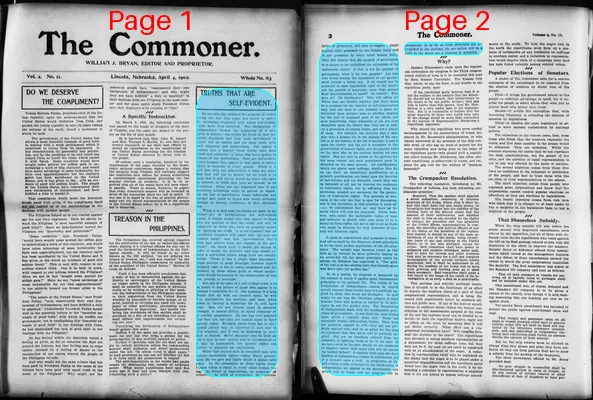
Editorial
April 4, 1902
The Commoner
Lincoln, Lancaster County, Nebraska
What is this article about?
This editorial defends the self-evident truths of the Declaration of Independence, emphasizing equality in natural rights, the purpose of government to secure these rights, and the ongoing need to apply these principles for national progress, despite opposition from monarchists and imperialists.
Merged-components note: Continuation of the editorial 'TRUTHS THAT ARE SELF-EVIDENT.' across pages 1 and 2.
Clippings
1 of 2
OCR Quality
95%
Excellent
Full Text
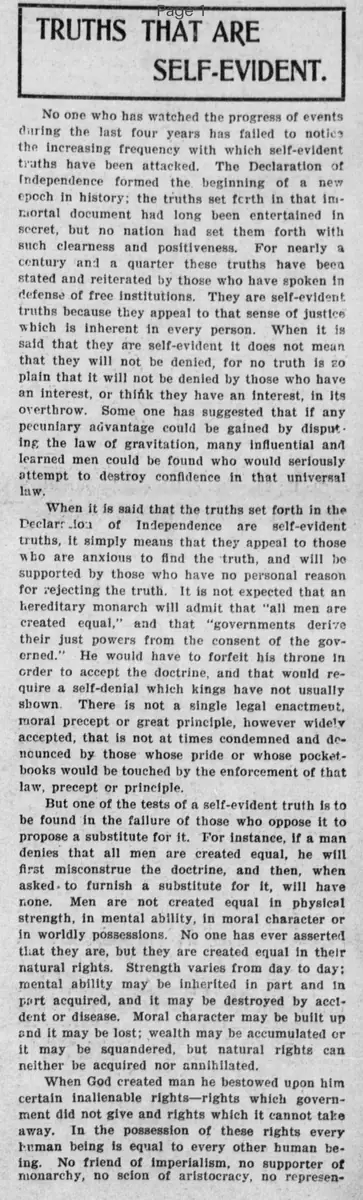
TRUTHS THAT ARE SELF-EVIDENT.
No one who has watched the progress of events during the last four years has failed to notice the increasing frequency with which self-evident truths have been attacked. The Declaration of Independence formed the beginning of a new epoch in history: the truths set forth in that immortal document had long been entertained in secret, but no nation had set them forth with such clearness and positiveness. For nearly a century and a quarter these truths have been stated and reiterated by those who have spoken in defense of free institutions. They are self-evident truths because they appeal to that sense of justice which is inherent in every person. When it is said that they are self-evident it does not mean that they will not be denied, for no truth is so plain that it will not be denied by those who have an interest, or think they have an interest, in its overthrow. Some one has suggested that if any pecuniary advantage could be gained by disputing the law of gravitation, many influential and learned men could be found who would seriously attempt to destroy confidence in that universal law.
When it is said that the truths set forth in the Declaration of Independence are self-evident truths, it simply means that they appeal to those who are anxious to find the truth, and will be supported by those who have no personal reason for rejecting the truth. It is not expected that an hereditary monarch will admit that "all men are created equal," and that "governments derive their just powers from the consent of the governed." He would have to forfeit his throne in order to accept the doctrine, and that would require a self-denial which kings have not usually shown. There is not a single legal enactment, moral precept or great principle, however widely accepted, that is not at times condemned and denounced by those whose pride or whose pocketbooks would be touched by the enforcement of that law, precept or principle.
But one of the tests of a self-evident truth is to be found in the failure of those who oppose it to propose a substitute for it. For instance, if a man denies that all men are created equal, he will first misconstrue the doctrine, and then, when asked to furnish a substitute for it, will have none. Men are not created equal in physical strength, in mental ability, in moral character or in worldly possessions. No one has ever asserted that they are, but they are created equal in their natural rights. Strength varies from day to day: mental ability may be inherited in part and in part acquired, and it may be destroyed by accident or disease. Moral character may be built up and it may be lost; wealth may be accumulated or it may be squandered, but natural rights can neither be acquired nor annihilated.
When God created man he bestowed upon him certain inalienable rights—rights which government did not give and rights which it cannot take away. In the possession of these rights every human being is equal to every other human being. No friend of imperialism, no supporter of monarchy, no scion of aristocracy, no representative of privilege, can propose any substitute for the equality of man in natural rights.
representative of plutocracy, will dare to suggest a single natural right possessed by one human being that is not possessed by every other human being.
Who will dispute that the purpose of government is to secure to the individual the enjoyment of his inalienable rights? If that is not the purpose of government, what is its true purpose? Let him who would destroy the foundation of our government furnish a better one. If all should not be protected in their inalienable right of life, liberty and the pursuit of happiness, upon what ground shall discrimination be based? On wealth? Who says so? On intelligence? Who will affirm it?
When men are thrown together and must share in a common lot the instinct of self-preservation may lead one man or one element to place restrictions upon another man or another element for the real or supposed good of the whole, but such restrictions, when defensible at all, are only defensible upon the theory that they are in reality a protection of human rights, and not a denial of them. For instance, the doctrine that a man may take a human life in the defense of his own life or in the defense of the life of another, is based upon the theory that the act is necessary to the preservation of human rights, and the penalty falls on the man who by his conduct forfeits his own rights. Men are sent to prison or the gallows for the same reason, and such punishment must be defended on the same ground. All qualifications which are placed upon suffrage, whether they fix an age limit, an educational qualification or a property qualification, are based upon the doctrine of self-defense and are defended, where they can be defended at all, not by denying the existence of inalienable rights, but by affirming that the provisions adopted are necessary for the protection of inalienable rights. The question of necessity is the only one that is open for discussion, and in the discussion of this question it must always be remembered that one may have an interest which will bias his judgment. Those, however, who admit the inalienable rights of man and endeavor to justify what may seem to be a denial of those rights, are not so apt to err as those who begin by denying the very existence of natural and inherent rights.
It must be remembered that progress is measured not so much by the discovery of new principles as by the more perfect application of the old principles. The upright man becomes better as the days go by because he more perfectly applies to his every-day life the moral principles which he adopts—as Solomon has expressed it, "The path of the just is as the shining light that shineth more and more unto the perfect day."
So in a nation, its progress is measured by the manner in which it applies great fundamental principles to its national life. The truths of the Declaration of Independence cannot be denied merely because those truths were not perfectly applied by those who wrote the document. As well might we say that the Christian religion is false because those who profess to believe in its principles do not live perfect lives. The Declaration of Independence deals with the fundamental principles of government. It sets forth the basic truths upon which a republic must rest.
These are axiomatic truths—self-evident truths. They were not perfectly applied in 1776—they are not perfectly applied now—and let us admit for the sake of argument that they never will be perfectly applied. But are we therefore relieved from the necessity of applying them as far as we can? If we have erred in the past, should we not endeavor to improve rather than make past sins an excuse for further failure? A republic built upon the Declaration of Independence cannot be overthrown, for it is founded upon a rock. In proportion as the self-evident truths contained in the Declaration of Independence are applied to our government, our people will be happy and our progress will be permanent; in so far as those principles are exemplified in our national life our nation will be a light to the world and a blessing to mankind.
No one who has watched the progress of events during the last four years has failed to notice the increasing frequency with which self-evident truths have been attacked. The Declaration of Independence formed the beginning of a new epoch in history: the truths set forth in that immortal document had long been entertained in secret, but no nation had set them forth with such clearness and positiveness. For nearly a century and a quarter these truths have been stated and reiterated by those who have spoken in defense of free institutions. They are self-evident truths because they appeal to that sense of justice which is inherent in every person. When it is said that they are self-evident it does not mean that they will not be denied, for no truth is so plain that it will not be denied by those who have an interest, or think they have an interest, in its overthrow. Some one has suggested that if any pecuniary advantage could be gained by disputing the law of gravitation, many influential and learned men could be found who would seriously attempt to destroy confidence in that universal law.
When it is said that the truths set forth in the Declaration of Independence are self-evident truths, it simply means that they appeal to those who are anxious to find the truth, and will be supported by those who have no personal reason for rejecting the truth. It is not expected that an hereditary monarch will admit that "all men are created equal," and that "governments derive their just powers from the consent of the governed." He would have to forfeit his throne in order to accept the doctrine, and that would require a self-denial which kings have not usually shown. There is not a single legal enactment, moral precept or great principle, however widely accepted, that is not at times condemned and denounced by those whose pride or whose pocketbooks would be touched by the enforcement of that law, precept or principle.
But one of the tests of a self-evident truth is to be found in the failure of those who oppose it to propose a substitute for it. For instance, if a man denies that all men are created equal, he will first misconstrue the doctrine, and then, when asked to furnish a substitute for it, will have none. Men are not created equal in physical strength, in mental ability, in moral character or in worldly possessions. No one has ever asserted that they are, but they are created equal in their natural rights. Strength varies from day to day: mental ability may be inherited in part and in part acquired, and it may be destroyed by accident or disease. Moral character may be built up and it may be lost; wealth may be accumulated or it may be squandered, but natural rights can neither be acquired nor annihilated.
When God created man he bestowed upon him certain inalienable rights—rights which government did not give and rights which it cannot take away. In the possession of these rights every human being is equal to every other human being. No friend of imperialism, no supporter of monarchy, no scion of aristocracy, no representative of privilege, can propose any substitute for the equality of man in natural rights.
representative of plutocracy, will dare to suggest a single natural right possessed by one human being that is not possessed by every other human being.
Who will dispute that the purpose of government is to secure to the individual the enjoyment of his inalienable rights? If that is not the purpose of government, what is its true purpose? Let him who would destroy the foundation of our government furnish a better one. If all should not be protected in their inalienable right of life, liberty and the pursuit of happiness, upon what ground shall discrimination be based? On wealth? Who says so? On intelligence? Who will affirm it?
When men are thrown together and must share in a common lot the instinct of self-preservation may lead one man or one element to place restrictions upon another man or another element for the real or supposed good of the whole, but such restrictions, when defensible at all, are only defensible upon the theory that they are in reality a protection of human rights, and not a denial of them. For instance, the doctrine that a man may take a human life in the defense of his own life or in the defense of the life of another, is based upon the theory that the act is necessary to the preservation of human rights, and the penalty falls on the man who by his conduct forfeits his own rights. Men are sent to prison or the gallows for the same reason, and such punishment must be defended on the same ground. All qualifications which are placed upon suffrage, whether they fix an age limit, an educational qualification or a property qualification, are based upon the doctrine of self-defense and are defended, where they can be defended at all, not by denying the existence of inalienable rights, but by affirming that the provisions adopted are necessary for the protection of inalienable rights. The question of necessity is the only one that is open for discussion, and in the discussion of this question it must always be remembered that one may have an interest which will bias his judgment. Those, however, who admit the inalienable rights of man and endeavor to justify what may seem to be a denial of those rights, are not so apt to err as those who begin by denying the very existence of natural and inherent rights.
It must be remembered that progress is measured not so much by the discovery of new principles as by the more perfect application of the old principles. The upright man becomes better as the days go by because he more perfectly applies to his every-day life the moral principles which he adopts—as Solomon has expressed it, "The path of the just is as the shining light that shineth more and more unto the perfect day."
So in a nation, its progress is measured by the manner in which it applies great fundamental principles to its national life. The truths of the Declaration of Independence cannot be denied merely because those truths were not perfectly applied by those who wrote the document. As well might we say that the Christian religion is false because those who profess to believe in its principles do not live perfect lives. The Declaration of Independence deals with the fundamental principles of government. It sets forth the basic truths upon which a republic must rest.
These are axiomatic truths—self-evident truths. They were not perfectly applied in 1776—they are not perfectly applied now—and let us admit for the sake of argument that they never will be perfectly applied. But are we therefore relieved from the necessity of applying them as far as we can? If we have erred in the past, should we not endeavor to improve rather than make past sins an excuse for further failure? A republic built upon the Declaration of Independence cannot be overthrown, for it is founded upon a rock. In proportion as the self-evident truths contained in the Declaration of Independence are applied to our government, our people will be happy and our progress will be permanent; in so far as those principles are exemplified in our national life our nation will be a light to the world and a blessing to mankind.
What sub-type of article is it?
Constitutional
Moral Or Religious
What keywords are associated?
Self Evident Truths
Declaration Of Independence
Natural Rights
Equality
Government Purpose
Inalienable Rights
Republican Principles
What entities or persons were involved?
Declaration Of Independence
Hereditary Monarchs
Friends Of Imperialism
Supporters Of Monarchy
Scions Of Aristocracy
Representatives Of Privilege
God
Editorial Details
Primary Topic
Defense Of Self Evident Truths In The Declaration Of Independence
Stance / Tone
Strongly Supportive Of Equality And Natural Rights
Key Figures
Declaration Of Independence
Hereditary Monarchs
Friends Of Imperialism
Supporters Of Monarchy
Scions Of Aristocracy
Representatives Of Privilege
God
Key Arguments
Self Evident Truths Appeal To Inherent Justice And Are Denied Only By Those With Interest In Their Overthrow
Opponents Of Equality In Natural Rights Fail To Propose Substitutes
All Men Are Created Equal In Inalienable Rights Bestowed By God
Purpose Of Government Is To Secure Enjoyment Of Inalienable Rights
Restrictions On Rights, Like Suffrage Qualifications, Must Protect Rather Than Deny Rights
Progress Comes From Better Application Of Fundamental Principles
Republic Founded On Declaration's Truths Is Unassailable