Thank you for visiting SNEWPapers!
Sign up free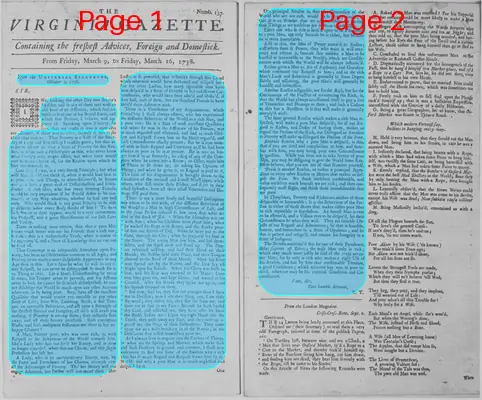
Literary
March 9, 1739
The Virginia Gazette
Richmond, Williamsburg, Richmond County, Virginia
What is this article about?
An essay from the Universal Spectator critiques Seneca's view that poverty reveals true friends, arguing it brings contempt and loss of respect. It contrasts societal treatment of rich vs. poor, references Job, shares an anecdote, and explores reasons for bias towards wealth, concluding true worth lies in virtue.
Merged-components note: This is a single philosophical essay from the Universal Spectator, continued across pages 1 and 2. The second component was mislabeled as letter_to_editor, but the content is an essay in letter form, best classified as literary.
Clippings
1 of 2
OCR Quality
95%
Excellent
Full Text
From the Universal Spectator,
October 7, 1738.
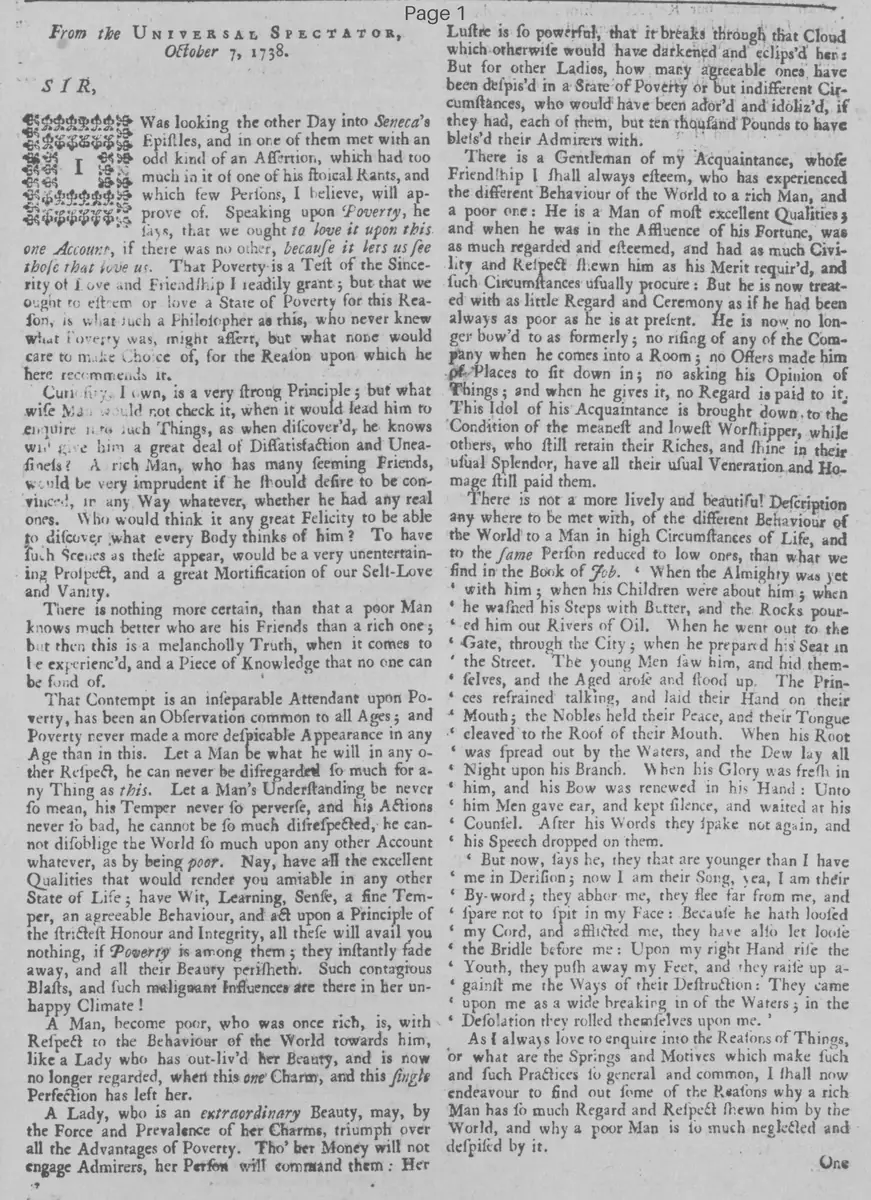
Was looking the other Day into Seneca's Epistles, and in one of them met with an odd kind of an Assertion, which had too much in it of one of his stoical Rants, and which few Persons, I believe, will approve of. Speaking upon Poverty, he says, that we ought to love it upon this one Account, if there was no other, because it lets us see those that love us. That Poverty is a Test of the Sincerity of Love and Friendship I readily grant; but that we ought to esteem or love a State of Poverty for this Reason, is what such a Philosopher as this, who never knew what Poverty was, might assert, but what none would care to make Choice of, for the Reason upon which he here recommends it.
Curiosity, I own, is a very strong Principle; but what wise Man should not check it, when it would lead him to enquire into such Things, as when discover'd, he knows will give him a great deal of Dissatisfaction and Uneasiness? A rich Man, who has many seeming Friends, would be very imprudent if he should dare to be convinced, in any Way whatever, whether he had any real ones. Who would think it any great Felicity to be able to discover what every Body thinks of him? To have such Scenes as these appear, would be a very unentertaining Prospect, and a great Mortification of our Self-Love and Vanity.
There is nothing more certain, than that a poor Man knows much better who are his Friends than a rich one; but then this is a melancholy Truth, when it comes to be experienced, and a Piece of Knowledge that no one can be fond of.
That Contempt is an inseparable Attendant upon Poverty, has been an Observation common to all Ages; and Poverty never made a more despicable Appearance in any Age than in this. Let a Man be what he will in any other Respect, he can never be disregarded so much for any Thing as this. Let a Man's Understanding be never so mean, his Temper never so perverse, and his Actions never so bad, he cannot be so much disrespected, he cannot disoblige the World so much upon any other Account whatever, as by being poor. Nay, have all the excellent Qualities that would render you amiable in any other State of Life; have Wit, Learning, Sense, a fine Temper, an agreeable Behaviour, and act upon a Principle of the strictest Honour and Integrity, all these will avail you nothing, if Poverty is among them; they instantly fade away, and all their Beauty perisheth. Such contagious Blasts, and such malign Influences are there in her unhappy Climate!
A Man, become poor, who was once rich, is, with Respect to the Behaviour of the World towards him, like a Lady who has out-lived her Beauty, and is now no longer regarded, when this one Charm, and this single Perfection has left her.
A Lady, who is an extraordinary Beauty, may, by the Force and Prevalence of her Charms, triumph over all the Disadvantages of Poverty. Though her Money will not engage Admirers, her Person will command them: Her Lustre is so powerful, that it breaks through that Cloud which otherwise would have darkened and eclipsed hers. But for other Ladies, how many agreeable ones have been despised in a State of Poverty or but indifferent Circumstances, who would have been adored and idolized, if they had, each of them, but ten thousand Pounds to have blessed their Admirers with.
There is a Gentleman of my Acquaintance, whose Friendship I shall always esteem, who has experienced the different Behaviour of the World to a rich Man, and a poor one: He is a Man of most excellent Qualities, and when he was in the Affluence of his Fortune, was as much regarded and esteemed, and had as much Civility and Respect shewn him as his Merit required, and such Circumstances usually procure: But he is now treated with as little Regard and Ceremony as if he had been always as poor as he is at present. He is now no longer bowed to as formerly; no rising of any of the Company when he comes into a Room; no Offers made him of Places to sit down in; no asking his Opinion of Things; and when he gives it, no Regard is paid to it. This Idol of his Acquaintance is brought down to the Condition of the meanest and lowest Worshipper, while others, who still retain their Riches, and shine in their usual Splendor, have all their usual Veneration and Homage still paid them.
There is not a more lively and beautiful Description any where to be met with, of the different Behaviour of the World to a Man in high Circumstances of Life, and to the same Person reduced to low ones, than what we find in the Book of Job. When the Almighty was yet with him; when his Children were about him; when he washed his Steps with Butter, and the Rocks poured him out Rivers of Oil. When he went out to the Gate, through the City; when he prepared his Seat in the Street. The young Men saw him, and hid themselves, and the Aged arose and stood up. The Princes refrained talking, and laid their Hand on their Mouth; the Nobles held their Peace, and their Tongue cleaved to the Roof of their Mouth. When his Root was spread out by the Waters, and the Dew lay all Night upon his Branch. When his Glory was fresh in him, and his Bow was renewed in his Hand: Unto him Men gave ear, and kept silence, and waited at his Counsel. After his Words they spake not again, and his Speech dropped on them.
But now, says he, they that are younger than I have me in Derision; now I am their Song, yea, I am their By-word; they abhor me, they flee far from me, and spare not to spit in my Face: Because he hath loosed my Cord, and afflicted me, they have also let loose the Bridle before me: Upon my right Hand rise the Youth, they push away my Feet, and they raise up against me the Ways of their Destruction: They came upon me as a wide breaking in of the Waters; in the Desolation they rolled themselves upon me.
As I always love to enquire into the Reasons of Things, or what are the Springs and Motives which make such and such Practices so general and common, I shall now endeavour to find out some of the Reasons why a rich Man has so much Regard and Respect Shewn him by the World, and why a poor Man is so much neglected and despised by it.
One principal Reason is, that the Generality of the World who are not rich, would be so if they could; for that it is no Wonder that we admire others for having such Things as we ourselves are desirous of possessing.
Every one who is rich is look'd upon to be a Superior to a poor Man, not only because he is richer, but because he is more honourable.
Add to this, the Idea of Power annex'd to Riches; and where there is Power, they who want it will reverence and esteem it, because this enables a Man to be hurtful or serviceable to the World; which are Considerations with which the World will be always influenc'd.
Riches gives a Man an Air of Authority and Grandeur which command our Respect to him; and as the rich Man's Look and Behaviour is generally in some Degree stately and assuming, the poor Man's will generally be humble and submissive.
Another Reason assignable, not for the Rise, but for the Continuance of the Practice of reverencing the Rich, is, that the World has always accustomed itself to pay a sort of Veneration and Homage to them; and such a Custom as this has a Sanction in it that will make it generally complied with.
The same general Reason which makes a rich Man respected, will make a poor Man despis'd; for if our Regard to Riches, and Desire of having them, makes us regard the Persons of the Rich, our Disregard or Aversion to Poverty will make us disregard the Persons of the Poor.
Another Reason why a poor Man is despis'd, is this, that if you are civil and complaisant to him, and familiar with him, you may bring your own Circumstances in question. While you seem not to take Notice of poor Men, you may be designing to give the World some Reason to believe, that you are not of that Number yourself.
Pride is another Reason, or rather a principal Ingredient in every other Reason or Motive that makes us despise the Poor. We think ourselves considerable, and value ourselves much because we are rich; and then consequently must slight, and think those inconsiderable that are poor.
In Themselves, Poverty and Riches are neither of them despicable or honourable: It is the Behaviour of the Persons in either of those States that makes either poor Men or rich reputable or scandalous. An honest Man is ever to be esteem'd, and a Villain ever to be despis'd, let their Circumstances be what they will. They are suitable Objects of our Regard and Admiration; he that is humble, humane, and benevolent in a State of Opulence; and he that is patient and resign'd, and retains his Integrity in a State of Indigence.
The Stoicks maintain'd this for one of their Paradoxes, Solus Sapiens et Dives; the wise Man only is rich; which may much more justly be said of the truly virtuous Man; for he only is rich who makes a right Use of his Reason, and has by him that inestimable Treasure, a good Conscience; which whoever has not, is poor indeed, whatever may be his external Condition and Circumstances.
I am, Sir,
Your humble Servant,
R. T.
October 7, 1738.
Was looking the other Day into Seneca's Epistles, and in one of them met with an odd kind of an Assertion, which had too much in it of one of his stoical Rants, and which few Persons, I believe, will approve of. Speaking upon Poverty, he says, that we ought to love it upon this one Account, if there was no other, because it lets us see those that love us. That Poverty is a Test of the Sincerity of Love and Friendship I readily grant; but that we ought to esteem or love a State of Poverty for this Reason, is what such a Philosopher as this, who never knew what Poverty was, might assert, but what none would care to make Choice of, for the Reason upon which he here recommends it.
Curiosity, I own, is a very strong Principle; but what wise Man should not check it, when it would lead him to enquire into such Things, as when discover'd, he knows will give him a great deal of Dissatisfaction and Uneasiness? A rich Man, who has many seeming Friends, would be very imprudent if he should dare to be convinced, in any Way whatever, whether he had any real ones. Who would think it any great Felicity to be able to discover what every Body thinks of him? To have such Scenes as these appear, would be a very unentertaining Prospect, and a great Mortification of our Self-Love and Vanity.
There is nothing more certain, than that a poor Man knows much better who are his Friends than a rich one; but then this is a melancholy Truth, when it comes to be experienced, and a Piece of Knowledge that no one can be fond of.
That Contempt is an inseparable Attendant upon Poverty, has been an Observation common to all Ages; and Poverty never made a more despicable Appearance in any Age than in this. Let a Man be what he will in any other Respect, he can never be disregarded so much for any Thing as this. Let a Man's Understanding be never so mean, his Temper never so perverse, and his Actions never so bad, he cannot be so much disrespected, he cannot disoblige the World so much upon any other Account whatever, as by being poor. Nay, have all the excellent Qualities that would render you amiable in any other State of Life; have Wit, Learning, Sense, a fine Temper, an agreeable Behaviour, and act upon a Principle of the strictest Honour and Integrity, all these will avail you nothing, if Poverty is among them; they instantly fade away, and all their Beauty perisheth. Such contagious Blasts, and such malign Influences are there in her unhappy Climate!
A Man, become poor, who was once rich, is, with Respect to the Behaviour of the World towards him, like a Lady who has out-lived her Beauty, and is now no longer regarded, when this one Charm, and this single Perfection has left her.
A Lady, who is an extraordinary Beauty, may, by the Force and Prevalence of her Charms, triumph over all the Disadvantages of Poverty. Though her Money will not engage Admirers, her Person will command them: Her Lustre is so powerful, that it breaks through that Cloud which otherwise would have darkened and eclipsed hers. But for other Ladies, how many agreeable ones have been despised in a State of Poverty or but indifferent Circumstances, who would have been adored and idolized, if they had, each of them, but ten thousand Pounds to have blessed their Admirers with.
There is a Gentleman of my Acquaintance, whose Friendship I shall always esteem, who has experienced the different Behaviour of the World to a rich Man, and a poor one: He is a Man of most excellent Qualities, and when he was in the Affluence of his Fortune, was as much regarded and esteemed, and had as much Civility and Respect shewn him as his Merit required, and such Circumstances usually procure: But he is now treated with as little Regard and Ceremony as if he had been always as poor as he is at present. He is now no longer bowed to as formerly; no rising of any of the Company when he comes into a Room; no Offers made him of Places to sit down in; no asking his Opinion of Things; and when he gives it, no Regard is paid to it. This Idol of his Acquaintance is brought down to the Condition of the meanest and lowest Worshipper, while others, who still retain their Riches, and shine in their usual Splendor, have all their usual Veneration and Homage still paid them.
There is not a more lively and beautiful Description any where to be met with, of the different Behaviour of the World to a Man in high Circumstances of Life, and to the same Person reduced to low ones, than what we find in the Book of Job. When the Almighty was yet with him; when his Children were about him; when he washed his Steps with Butter, and the Rocks poured him out Rivers of Oil. When he went out to the Gate, through the City; when he prepared his Seat in the Street. The young Men saw him, and hid themselves, and the Aged arose and stood up. The Princes refrained talking, and laid their Hand on their Mouth; the Nobles held their Peace, and their Tongue cleaved to the Roof of their Mouth. When his Root was spread out by the Waters, and the Dew lay all Night upon his Branch. When his Glory was fresh in him, and his Bow was renewed in his Hand: Unto him Men gave ear, and kept silence, and waited at his Counsel. After his Words they spake not again, and his Speech dropped on them.
But now, says he, they that are younger than I have me in Derision; now I am their Song, yea, I am their By-word; they abhor me, they flee far from me, and spare not to spit in my Face: Because he hath loosed my Cord, and afflicted me, they have also let loose the Bridle before me: Upon my right Hand rise the Youth, they push away my Feet, and they raise up against me the Ways of their Destruction: They came upon me as a wide breaking in of the Waters; in the Desolation they rolled themselves upon me.
As I always love to enquire into the Reasons of Things, or what are the Springs and Motives which make such and such Practices so general and common, I shall now endeavour to find out some of the Reasons why a rich Man has so much Regard and Respect Shewn him by the World, and why a poor Man is so much neglected and despised by it.
One principal Reason is, that the Generality of the World who are not rich, would be so if they could; for that it is no Wonder that we admire others for having such Things as we ourselves are desirous of possessing.
Every one who is rich is look'd upon to be a Superior to a poor Man, not only because he is richer, but because he is more honourable.
Add to this, the Idea of Power annex'd to Riches; and where there is Power, they who want it will reverence and esteem it, because this enables a Man to be hurtful or serviceable to the World; which are Considerations with which the World will be always influenc'd.
Riches gives a Man an Air of Authority and Grandeur which command our Respect to him; and as the rich Man's Look and Behaviour is generally in some Degree stately and assuming, the poor Man's will generally be humble and submissive.
Another Reason assignable, not for the Rise, but for the Continuance of the Practice of reverencing the Rich, is, that the World has always accustomed itself to pay a sort of Veneration and Homage to them; and such a Custom as this has a Sanction in it that will make it generally complied with.
The same general Reason which makes a rich Man respected, will make a poor Man despis'd; for if our Regard to Riches, and Desire of having them, makes us regard the Persons of the Rich, our Disregard or Aversion to Poverty will make us disregard the Persons of the Poor.
Another Reason why a poor Man is despis'd, is this, that if you are civil and complaisant to him, and familiar with him, you may bring your own Circumstances in question. While you seem not to take Notice of poor Men, you may be designing to give the World some Reason to believe, that you are not of that Number yourself.
Pride is another Reason, or rather a principal Ingredient in every other Reason or Motive that makes us despise the Poor. We think ourselves considerable, and value ourselves much because we are rich; and then consequently must slight, and think those inconsiderable that are poor.
In Themselves, Poverty and Riches are neither of them despicable or honourable: It is the Behaviour of the Persons in either of those States that makes either poor Men or rich reputable or scandalous. An honest Man is ever to be esteem'd, and a Villain ever to be despis'd, let their Circumstances be what they will. They are suitable Objects of our Regard and Admiration; he that is humble, humane, and benevolent in a State of Opulence; and he that is patient and resign'd, and retains his Integrity in a State of Indigence.
The Stoicks maintain'd this for one of their Paradoxes, Solus Sapiens et Dives; the wise Man only is rich; which may much more justly be said of the truly virtuous Man; for he only is rich who makes a right Use of his Reason, and has by him that inestimable Treasure, a good Conscience; which whoever has not, is poor indeed, whatever may be his external Condition and Circumstances.
I am, Sir,
Your humble Servant,
R. T.
What sub-type of article is it?
Essay
Satire
What themes does it cover?
Social Manners
Moral Virtue
Commerce Trade
What keywords are associated?
Poverty
Riches
Friendship
Society
Seneca
Job
Virtue
Contempt
What entities or persons were involved?
R. T.
Literary Details
Author
R. T.
Key Lines
Speaking Upon Poverty, He Says, That We Ought To Love It Upon This One Account, If There Was No Other, Because It Lets Us See Those That Love Us.
That Contempt Is An Inseparable Attendant Upon Poverty, Has Been An Observation Common To All Ages; And Poverty Never Made A More Despicable Appearance In Any Age Than In This.
There Is Not A More Lively And Beautiful Description Any Where To Be Met With, Of The Different Behaviour Of The World To A Man In High Circumstances Of Life, And To The Same Person Reduced To Low Ones, Than What We Find In The Book Of Job.
In Themselves, Poverty And Riches Are Neither Of Them Despicable Or Honourable: It Is The Behaviour Of The Persons In Either Of Those States That Makes Either Poor Men Or Rich Reputable Or Scandalous.
Solus Sapiens Et Dives; The Wise Man Only Is Rich; Which May Much More Justly Be Said Of The Truly Virtuous Man; For He Only Is Rich Who Makes A Right Use Of His Reason, And Has By Him That Inestimable Treasure, A Good Conscience;