Thank you for visiting SNEWPapers!
Sign up free
New Orleans Daily Crescent
New Orleans, Orleans County, Louisiana
What is this article about?
An English gentleman recounts his pilgrimage to Mecca, detailing the varied classes of pilgrims from paupers to grandees, their modes of travel, the harsh Arabian desert terrain, and a respectful encounter with a lion.
Clipping
OCR Quality
Full Text
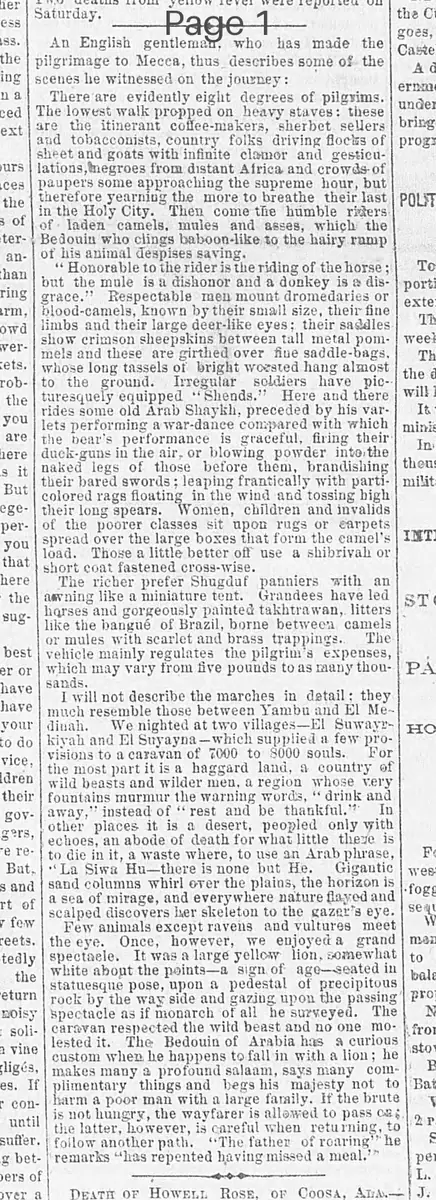
There are evidently eight degrees of pilgrims. The lowest walk propped on heavy staves: these are the itinerant coffee-makers, sherbet sellers and tobacconists, country folks driving flocks of sheep and goats with infinite clamor and gesticulations, negroes from distant Africa and crowds of paupers some approaching the supreme hour, but therefore yearning the more to breathe their last in the Holy City. Then come the humble riders of laden camels, mules and asses, which the Bedouin who clings baboon-like to the hairy rump of his animal despises saving.
"Honorable to the rider is the riding of the horse: but the mule is a dishonor and a donkey is a disgrace." Respectable men mount dromedaries or blood-camels, known by their small size, their fine limbs and their large deer-like eyes: their saddles show crimson sheepskins between tall metal pommels and these are girthed over fine saddle-bags, whose long tassels of bright worsted hang almost to the ground. Irregular soldiers have picturesquely equipped "Shends."
Here and there rides some old Arab Shaykh, preceded by his varlets performing a war-dance compared with which the bear's performance is graceful, firing their duck-guns in the air, or blowing powder into the naked legs of those before them, brandishing their bared swords: leaping frantically with parti-colored rags floating in the wind and tossing high their long spears. Women, children and invalids of the poorer classes sit upon rugs or carpets spread over the large boxes that form the camel's load. Those a little better off use a shibrivah or short coat fastened cross-wise.
The richer prefer Shugduf panniers with an awning like a miniature tent. Grandees have led horses and gorgeously painted takhtrawan, litters like the bangue of Brazil, borne between camels or mules with scarlet and brass trappings. The vehicle mainly regulates the pilgrim's expenses, which may vary from five pounds to as many thousands.
I will not describe the marches in detail: they much resemble those between Yambu and El Medinah.
We nighted at two villages—El Suwayr-kivah and El Suyayna—which supplied a few provisions to a caravan of 2000 to 5000 souls. For the most part it is a haggard land, a country of wild beasts and wilder men, a region whose very fountains murmur the warning words, "drink and away," instead of "rest and be thankful." In other places it is a desert, peopled only with echoes, an abode of death for what little there is to die in it, a waste where, to use an Arab phrase, "La Siwa Hu—there is none but He." Gigantic sand columns whirl over the plains the horizon is a sea of mirage, and everywhere nature flayed and scalped discovers her skeleton to the gazer's eye.
Few animals except ravens and vultures meet the eye. Once, however, we enjoyed a grand spectacle. It was a large yellow lion, somewhat white about the points—a sign of age—seated in statuesque pose, upon a pedestal of precipitous rock by the way side and gazing upon the passing spectacle as if monarch of all he surveyed. The caravan respected the wild beast and no one molested it. The Bedouin of Arabia has a curious custom when he happens to fall in with a lion; he makes many a profound salaam, says many complimentary things and begs his majesty not to harm a poor man with a large family. If the brute is not hungry, the wayfarer is allowed to pass; the latter, however, is careful when returning, to follow another path. "The father of roaring," he remarks, "has repented having missed a meal."
What sub-type of article is it?
What keywords are associated?
Where did it happen?
Foreign News Details
Primary Location
Mecca
Event Details
An English gentleman describes the eight degrees of pilgrims journeying to Mecca, from lowly walkers and riders of camels, mules, and asses, to respectable men on dromedaries, irregular soldiers on Shends, old Arab Shaykhs with varlets, women and children on camel loads, richer pilgrims in Shugduf panniers, and grandees in takhtrawan litters. The marches resemble those between Yambu and El Medinah, nighting at El Suwayr-kivah and El Suyayna. The land is haggard with wild beasts and men, deserts, mirages, and a sighting of a large yellow lion which the caravan respected. Bedouins customarily salaam lions to pass safely.