Thank you for visiting SNEWPapers!
Sign up free
The Daily Worker
Chicago, Cook County, Illinois
What is this article about?
Imperialists and Kuomintang admit at a conference the growing power of Chinese Communists and revolutionary movement, amid Kuomintang bankruptcy, unpaid troops, new taxes, flood damages, and factional divisions threatening unification. Red Armies advance on Hankow.
Clipping
OCR Quality
Full Text
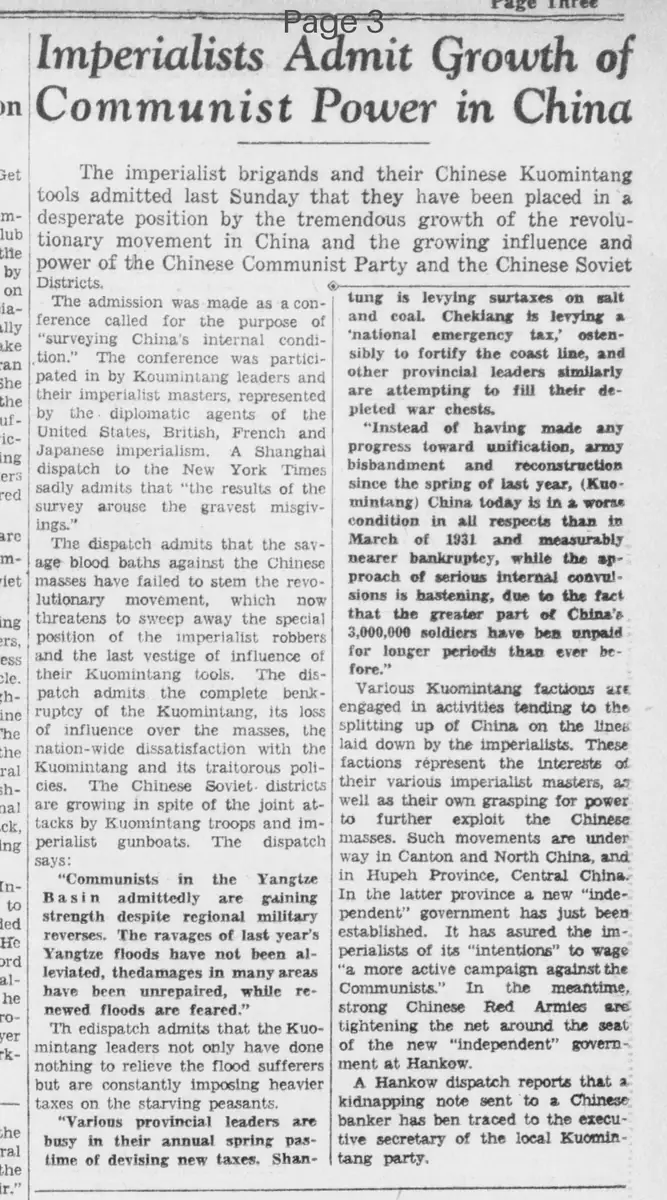
The imperialist brigands and their Chinese Kuomintang tools admitted last Sunday that they have been placed in a desperate position by the tremendous growth of the revolutionary movement in China and the growing influence and power of the Chinese Communist Party and the Chinese Soviet Districts.
The admission was made as a conference called for the purpose of "surveying China's internal condition." The conference was participated in by Kuomintang leaders and their imperialist masters, represented by the diplomatic agents of the United States, British, French and Japanese imperialism.
A Shanghai dispatch to the New York Times sadly admits that "the results of the survey arouse the gravest misgivings."
The dispatch admits that the savage blood baths against the Chinese masses have failed to stem the revolutionary movement, which now threatens to sweep away the special position of the imperialist robbers and the last vestige of influence of their Kuomintang tools. The dispatch admits the complete bankruptcy of the Kuomintang, its loss of influence over the masses, the nation-wide dissatisfaction with the Kuomintang and its traitorous policies.
The Chinese Soviet districts are growing in spite of the joint attacks by Kuomintang troops and imperialist gunboats.
The dispatch says:
"Communists in the Yangtze Basin admittedly are gaining strength despite regional military reverses. The ravages of last year's Yangtze floods have not been alleviated, the damages in many areas have been unrepaired, while renewed floods are feared."
The dispatch admits that the Kuomintang leaders not only have done nothing to relieve the flood sufferers but are constantly imposing heavier taxes on the starving peasants.
"Various provincial leaders are busy in their annual spring pastime of devising new taxes. Shantung is levying surtaxes on salt and coal. Chekiang is levying a 'national emergency tax,' ostensibly to fortify the coast line, and other provincial leaders similarly are attempting to fill their depleted war chests.
"Instead of having made any progress toward unification, army disbandment and reconstruction since the spring of last year, (Kuomintang) China today is in a worse condition in all respects than in March of 1931 and measurably nearer bankruptcy, while the approach of serious internal convulsions is hastening, due to the fact that the greater part of China's 3,000,000 soldiers have been unpaid for longer periods than ever before."
Various Kuomintang factions are engaged in activities tending to the splitting up of China on the lines laid down by the imperialists. These factions represent the interests of their various imperialist masters, as well as their own grasping for power to further exploit the Chinese masses. Such movements are under way in Canton and North China, and in Hupeh Province, Central China.
In the latter province a new "independent" government has just been established. It has assured the imperialists of its "intentions" to wage "a more active campaign against the Communists."
In the meantime, strong Chinese Red Armies are tightening the net around the seat of the new "independent" government at Hankow.
A Hankow dispatch reports that a kidnapping note sent to a Chinese banker has been traced to the executive secretary of the local Kuomintang party.
What sub-type of article is it?
What keywords are associated?
Where did it happen?
Foreign News Details
Primary Location
China
Event Date
Last Sunday
Outcome
imperialists and kuomintang admit desperate position due to growth of communist power; kuomintang bankruptcy, loss of influence, unpaid soldiers, new taxes, factional splits; chinese soviet districts growing despite attacks; red armies tightening net around hankow.
Event Details
Imperialists and Kuomintang leaders at a conference admitted the tremendous growth of the revolutionary movement and Chinese Communist Party influence, placing them in a desperate position. Shanghai dispatch notes failure of blood baths to stem the movement, Kuomintang's complete bankruptcy and loss of mass influence, nation-wide dissatisfaction. Chinese Soviet districts expand despite attacks. Communists gaining strength in Yangtze Basin amid unrepaired flood damages and feared new floods. Kuomintang imposes heavier taxes on peasants, provincial leaders devise new taxes. No progress toward unification, army disbandment, or reconstruction since spring 1931; China worse off, nearing bankruptcy, internal convulsions hastening due to unpaid soldiers. Kuomintang factions splitting China along imperialist lines in Canton, North China, Hupeh; new independent government in Hupeh vows anti-communist campaign. Red Armies surround Hankow government. Kidnapping note traced to Kuomintang secretary.