Thank you for visiting SNEWPapers!
Sign up free
Delaware Gazette And Peninsula Advertiser
Wilmington, New Castle County, Delaware
What is this article about?
Small blackish worms are destroying grass in uplands and pastures of Northborough, Marlborough, Sudbury, and vicinity, leaving thousands of acres barren and resembling a severe drought or winter kill. The pests resemble migratory locusts and are rapidly spreading devastation to vegetation.
Clipping
OCR Quality
Full Text
Messrs. Editors,
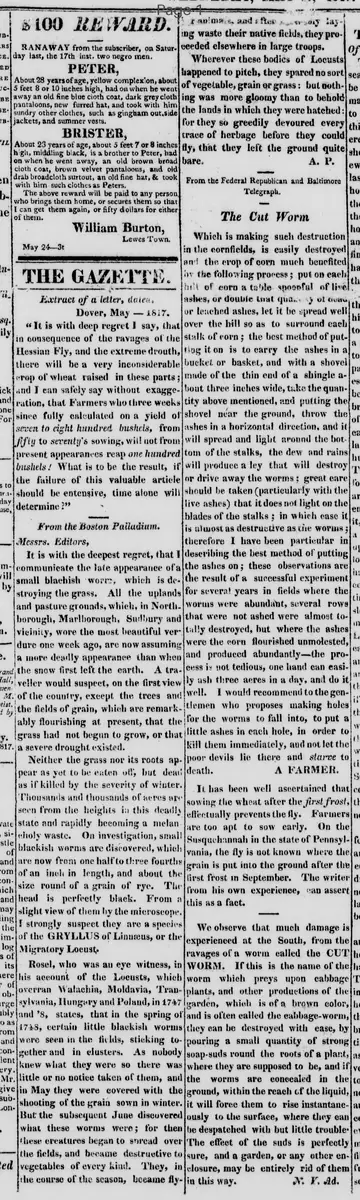
It is with the deepest regret, that I communicate the late appearance of a small blackish worm, which is destroying the grass. All the uplands and pasture grounds, which, in Northborough, Marlborough, Sudbury and vicinity, wore the most beautiful verdure one week ago, are now assuming a more deadly appearance than when the snow first left the earth. A traveller would suspect, on the first view of the country, except the trees and the fields of grain, which are remarkably flourishing at present, that the grass had not begun to grow, or that a severe drought existed.
Neither the grass nor its roots appear as yet to be eaten off, but dead as if killed by the severity of winter. Thousands and thousands of acres are seen from the heights in this deadly state and rapidly becoming a melancholy waste. On investigation, small blackish worms are discovered, which are now from one half to three fourths of an inch in length, and about the size round of a grain of rye. The head is perfectly black. From a slight view of them by the microscope, I strongly suspect they are a species of the GRYLLUS of Linnaeus, or the Migratory Locust.
Rosel, who was an eye witness, in his account of the Locusts, which overran Walachia, Moldavia, Transylvania, Hungary and Poland, in 1747 and '8, states, that in the spring of 1748, certain little blackish worms were seen in the fields, sticking together and in clusters. As nobody knew what they were so there was little or no notice taken of them, and in May they were covered with the shooting of the grain sown in winter. But the subsequent June discovered what these worms were; for then these creatures began to spread over the fields, and became destructive to vegetables of every kind. They, in the course of the season, became flys, and after soon laying waste their native fields, they proceeded elsewhere in large troops.
Wherever these bodies of Locusts happened to pitch, they spared no sort of vegetable, grain or grass: but nothing was more gloomy than to behold the lands in which they were hatched: for they so greedily devoured every trace of herbage before they could fly, that they left the ground quite bare.
A. P.
What sub-type of article is it?
What keywords are associated?
What entities or persons were involved?
Where did it happen?
Domestic News Details
Primary Location
Northborough, Marlborough, Sudbury And Vicinity
Key Persons
Outcome
thousands of acres of uplands and pasture grounds left barren and in a deadly state, with grass appearing dead as if killed by winter; no human casualties mentioned.
Event Details
Small blackish worms, half to three-quarters inch long with black heads, are destroying grass in Northborough, Marlborough, Sudbury, and vicinity. Fields that were verdant a week ago now look barren, sparing trees and grain but devastating pastures. Suspected to be a species of migratory locust, similar to historical infestations that stripped vegetation before flying away.