Thank you for visiting SNEWPapers!
Sign up free
Portland Gazette, And Maine Advertiser
Portland, Cumberland County, Maine
What is this article about?
Excerpts from congressional speeches by Mr. Bleecker of New York and Mr. Tazewell on the impressment of seamen as a cause for the War of 1812, arguing that U.S. employment of British seamen justifies British actions and questioning the war's necessity.
Clipping
OCR Quality
Full Text
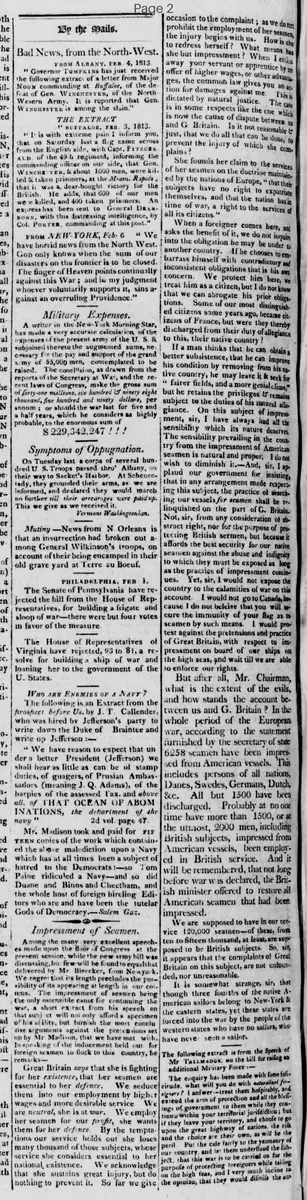
Among the many very excellent speeches made upon the floor of Congress at the present session, while the new army bill was discussing, but few will be found to equal that delivered by Mr. Bleecker, from New York. We regret that its length precludes the possibility of its appearing at length in our columns. The impressment of seamen being the only ostensible cause for continuing the war, a short extract from his speech on that subject will not only afford a specimen of his ability, but furnish the most conclusive arguments against the pretensions set up by Mr Madison, that we have met with.
In speaking of the inducement held out for foreign seamen to flock to this country, he remarks—
Great Britain says that she is fighting for her existence, that her seamen are essential to her defence. We seduce them into our employment by higher wages and more desirable service. We are neutral, she is at war. We employ her seamen for our profit, she wants them for her defence. By the temptations our service holds out she loses many thousand of those subjects, whose service she considers essential to her national existence. We acknowledge that she sustains great injury, but do nothing to prevent it. So far we give occasion to the complaint; as we do not prohibit the employment of her seamen the injury begins with us. How is she to redress herself? What means has she but impressment? When I entice away your servant or apprentice by an offer of higher wages, or other advantages, the common law gives you an action for damages against me.
This is dictated by natural justice.
The case is in some respects like the one which is now the cause of dispute between us and G Britain. Is it not reasonable & just, that we do all that can be done, to prevent the injury of which she complains?
She founds her claim to the services of her seamen on the doctrine maintained by the nations of Europe, "that their subjects have no right to expatriate themselves, and that the nation has in time of war, a right to the services of all its citizens."
When a foreigner comes here, and asks the benefit of it, we do not inquire into the obligation he may be under to another country. If he chooses to embarrass himself with contradictory and inconsistent obligations that is his own concern. We protect him here, we treat him as a citizen, but I do not know that we can abrogate his prior obligations. Some of our most distinguished citizens some years ago, became citizens of France, but were they thereby discharged from their duty of allegiance to this, their native country?
If a man thinks that he can obtain better subsistence, that he can improve his condition by removing from his native country, he may leave it & seek for "fairer fields, and a more genial clime." but he retains the privileges & remains subject to the duties of his natural allegiance. On this subject of impressment, sir, I have always had all the sensibility which its nature deserves. The sensibility prevailing in the country from the impressment of American seamen is natural and proper. I do not wish to diminish it.—And, sir, I applaud our government for insisting that in any arrangement made respecting this subject, the practice of searching our vessels for seamen shall be relinquished on the part of G. Britain. Not, sir, from any consideration of abstract right, nor for the purpose of protecting British seamen, but because it affords the best security for our native seamen against the abuse and indignity to which they must be exposed as long as the practice of impressment continues. Yet, sir, I would not expose the country to the calamities of war on this account. I would not go to Canada, because I do not believe that you will secure the immunity of your flags as to seamen by such means. I would protest against the pretensions and practice of Great Britain, with respect to impressment on board of our ships on the high seas, and wait till we are able to enforce our rights.
But after all, Mr. Chairman, what is the extent of the evils, and how stands the account between us and G. Britain? In the whole period of the European war, according to the statement furnished by the secretary of state 6258 seamen have been impressed from American vessels. This includes persons of all nations. Danes, Swedes, Germans, Dutch, &c. All but 1500 have been discharged. Probably at no one time have more than 1500, or at the utmost, 2000 men, including British subjects, impressed from American vessels, been employed in British service. And it will be remembered, that not long before war was declared, the British minister offered to restore all American seamen that had been impressed.
We are supposed to have in our service 120,000 seamen—of these, from ten to fifteen thousand, at least, are supposed to be British subjects. So, sir it appears that the complaints of Great Britain on this subject, are not unfounded, nor unreasonable.
It is somewhat strange, sir, that though three fourths of the native American sailors belong to New-York & the eastern states, yet these states are forced into the war by the people of the western states who have no sailors, who have never seen a sailor.
The following extract is from the Speech of Mr. Tazewell, on the bill for raising an additional Military Force:
"The enquiry has been made with some solicitude, what will you do with naturalized foreigners? I answer—treat them hospitably, and extend the arm of protection and all the blessings of government to them while they continue within your territorial jurisdiction; but if they leave your territory, and choose to go upon the great highway of nations, the risk and the choice are their own, as will be the peril. Put the case fairly to the yeomanry of our country, and let them understand the subject, that this war is to be carried on for the purpose of protecting foreigners while sailing on the high seas, and I very much incline to the opinion, that they would dislike the au..."
What sub-type of article is it?
What keywords are associated?
What entities or persons were involved?
Where did it happen?
Domestic News Details
Primary Location
Congress
Event Date
Present Session
Key Persons
Outcome
6258 seamen impressed from american vessels during european war, all but 1500 discharged; u.s. employs 10,000-15,000 british subjects among 120,000 seamen.
Event Details
Excerpts from speeches by Mr. Bleecker of New York and Mr. Tazewell in Congress debate on army bill, arguing that U.S. attraction of British seamen justifies their impressment, questioning war necessity over protecting naturalized foreigners at sea.