Thank you for visiting SNEWPapers!
Sign up free
The Liberator
Boston, Suffolk County, Massachusetts
What is this article about?
Reprint of Rev. Samuel J. May's responses to anti-slavery questions from Brooklyn Advertiser, advocating immediate emancipation if possible, equal rights for free blacks, and interracial marriage if mutually loving, countering misrepresentations in Providence Gazette. (198 characters)
Clipping
OCR Quality
Full Text
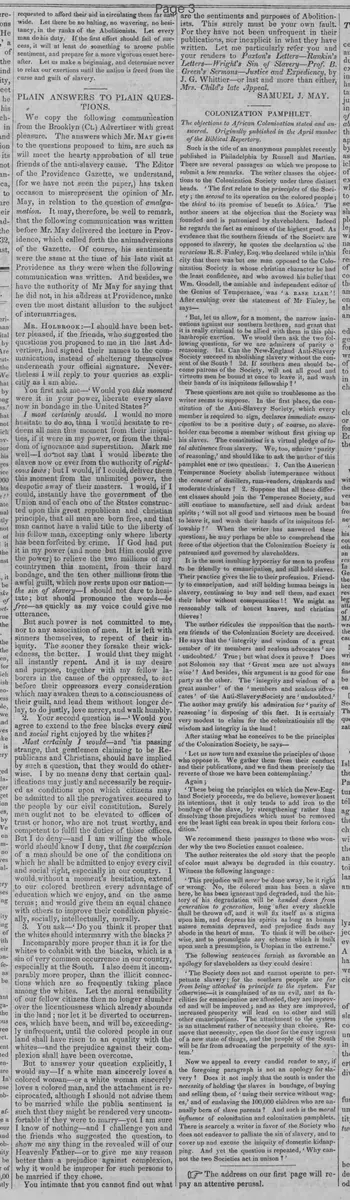
We copy the following communication from the Brooklyn (Ct.) Advertiser with great pleasure. The answers which Mr. May gives to the questions proposed to him, are such as will meet the hearty approbation of all true friends of the anti-slavery cause. The Editor of the Providence Gazette, we understand, (for we have not seen the paper,) has taken occasion to misrepresent the opinion of Mr. May, in relation to the question of amalgamation. It may, therefore, be well to remark, that the following communication was written before Mr. May delivered the lecture in Providence, which called forth the animadversions of the Gazette. Of course, his sentiments were the same at the time of his late visit at Providence as they were when the following communication was written. And besides, we have the authority of Mr May for saying that he did not, in his address at Providence, make even the most distant allusion to the subject of intermarriages.
Mr. Holbrook:-
I should have been better pleased, if the friends, who suggested the questions you proposed to me in the last Advertiser, had signed their names to the communication, instead of sheltering themselves underneath your official signature. Nevertheless I will reply to your queries as explicitly as I am able.
You first ask me—'Would you this moment, were it in your power, liberate every slave now in bondage in the United States?'
I most certainly would. I would no more hesitate to do so, than I would hesitate to redeem all men this moment from their iniquities, if it were in my power, or from the thraldom of ignorance and superstition. Mark me well—I do not say that I would liberate the slaves now or ever from the authority of righteous laws; but I would, if I could, deliver them this moment from the unlimited power, the despotic sway of their masters. I would, if I could, instantly have the government of the Union and of each one of the States constructed upon this great republican and christian principle, that all men are born free, and that man cannot have a valid title to the liberty of his fellow man, excepting only where liberty has been forfeited by crime. If God had put it in my power (and none but Him could give the power) to relieve the two millions of my countrymen this moment, from their hard bondage, and the ten other millions from the awful guilt, which now rests upon our nation—the sin of slavery—I should not dare to hesitate; but should pronounce the words—be free—as quickly as my voice could give me utterance.
But such power is not committed to me, nor to any association of men. It is left with sinners themselves, to repent of their iniquity. The sooner they forsake their wickedness, the better. I would that they might all instantly repent. And it is my desire and purpose, together with my fellow laborers in the cause of the oppressed, to set before their oppressors every consideration which may awaken them to a consciousness of their guilt, and lead them without longer delay, to do justly, love mercy, and walk humbly.
2. Your second question is—'Would you agree to extend to the free blacks every civil and social right enjoyed by the whites?'
Most certainly I would—and 'tis passing strange, that gentlemen claiming to be Republicans and Christians, should have implied by such a question, that they would do otherwise. I by no means deny that certain qualifications may justly and necessarily be required as conditions upon which citizens may be admitted to all the prerogatives secured to the people by our civil constitution. Surely men ought not to be elevated to offices of trust or honor, who are not trustworthy, and competent to fulfil the duties of those offices. But I do deny—and I am willing the whole world should know I deny, that the complexion of a man should be one of the conditions on which he shall be admitted to enjoy every civil and social right, especially in our country. I would without a moment's hesitation, extend to our colored brethren every advantage of education which we enjoy, and on the same terms; and would give them an equal chance with others to improve their condition physically, socially, intellectually, morally.
3. You ask 'Do you think it proper that the whites should intermarry with the blacks?'
Incomparably more proper than it is for the whites to cohabit with the blacks, which is a sin of very common occurrence in our country, especially at the South. I also deem it incomparably more proper, than the illicit connections which are so frequently taking place among the whites. Let the moral sensibility of our fellow citizens then no longer slumber over the licentiousness which already abounds in the land; nor let it be diverted to occurrences, which have been, and will be, exceedingly unfrequent, until the colored people in our land shall have risen to an equality with the whites—and the prejudice against their complexion shall have been overcome.
But to answer your question explicitly, I would say—If a white man sincerely loves a colored woman—or a white woman sincerely loves a colored man, and the attachment is reciprocated, although I should not advise them to be married while the public sentiment is such that they might be rendered very uncomfortable if they were to marry—yet I am sure I know of nothing—and I challenge you and the friends who suggested the question, to show me any thing in the revealed will of our Heavenly Father—or to give me any reason better than a prejudice against complexion, why it would be improper for such persons to be married if they chose.
You intimate that you cannot find out what are the sentiments and purposes of Abolitionists. This surely must be your own fault. For they have not been unfrequent in their publications, nor inexplicit in what they have written. Let me particularly refer you and your readers to Paxton's Letters—Rankin's Letters—Wright's Sin of Slavery—Prof. B. Green's Sermons—Justice and Expediency, by J. G. Whittier—or last and more than either, Mrs. Child's late Appeal.
SAMUEL J. MAY.
What sub-type of article is it?
What themes does it cover?
What keywords are associated?
What entities or persons were involved?
Letter to Editor Details
Author
Samuel J. May
Recipient
Mr. Holbrook
Main Argument
samuel j. may affirms he would immediately liberate all slaves if possible, without violating laws; extend full civil and social rights to free blacks regardless of complexion; and views interracial marriage as morally proper if based on sincere mutual love, superior to illicit cohabitation, with no scriptural prohibition beyond prejudice.
Notable Details