Thank you for visiting SNEWPapers!
Sign up free
Story
April 5, 1852
Daily American Telegraph
Washington, District Of Columbia
What is this article about?
In summer 1800, 14-year-old John Raynor spots a drowning boy in a river near his home, swims to rescue him, and revives him using Humane Society rules for apparent drowning, including artificial respiration and warmth, saving his life after two hours.
Clipping
OCR Quality
98%
Excellent
Full Text
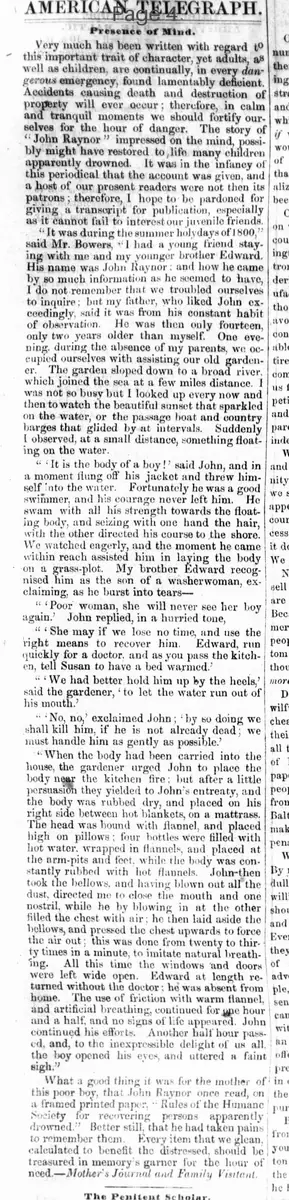
Presence of Mind.
Very much has been written with regard to this important trait of character, yet adults, as well as children, are continually, in every dangerous emergency, found lamentably deficient. Accidents causing death and destruction of property will ever occur; therefore, in calm and tranquil moments we should fortify ourselves for the hour of danger. The story of "John Raynor" impressed on the mind, possibly might have restored to life many children apparently drowned. It was in the infancy of this periodical that the account was given, and a host of our present readers were not then its patrons; therefore, I hope to be pardoned for giving a transcript for publication, especially as it cannot fail to interest our juvenile friends.
"It was during the summer holidays of 1800," said Mr. Bowers, "I had a young friend staying with me and my younger brother Edward. His name was John Raynor; and how he came by so much information as he seemed to have, I do not remember that we troubled ourselves to inquire; but my father, who liked John exceedingly, said it was from his constant habit of observation. He was then only fourteen, only two years older than myself." One evening, during the absence of my parents, we occupied ourselves with assisting our old gardener. The garden sloped down to a broad river, which joined the sea at a few miles distance. I was not so busy but I looked up every now and then to watch the beautiful sunset that sparkled on the water, or the passage boat and country barges that glided by at intervals. Suddenly I observed, at a small distance, something floating on the water.
"It is the body of a boy!" said John, and in a moment flung off his jacket and threw himself into the water. Fortunately he was a good swimmer, and his courage never left him. He swam with all his strength towards the floating body, and seizing with one hand the hair with the other directed his course to the shore. We watched eagerly, and the moment he came within reach assisted him in laying the body on a grass-plot. My brother Edward recognised him as the son of a washerwoman, exclaiming, as he burst into tears--
"Poor woman, she will never see her boy again." John replied, in a hurried tone,
"She may if we lose no time, and use the right means to recover him. Edward, run quickly for a doctor, and as you pass the kitchen, tell Susan to have a bed warmed. We had better hold him up by the heels, said the gardener, 'to let the water run out of his mouth."
"No, no," exclaimed John; "by so doing we shall kill him, if he is not already dead; we must handle him as gently as possible."
When the body had been carried into the house, the gardener urged John to place the body near the kitchen fire: but after a little persuasion they yielded to John's entreaty, and the body was rubbed dry, and placed on his right side between hot blankets, on a mattress. The head was bound with flannel, and placed high on pillows; four bottles were filled with hot water, wrapped in flannels, and placed at the arm-pits and feet, while the body was constantly rubbed with hot flannels. John then took the bellows, and having blown out all the dust, directed me to close the mouth and one nostril, while he by blowing in at the other filled the chest with air: he then laid aside the bellows, and pressed the chest upwards to force the air out: this was done from twenty to thirty times in a minute, to imitate natural breathing. All this time the windows and doors were left wide open. Edward at length returned without the doctor: he was absent from home. The use of friction with warm flannel, and artificial breathing, continued for one hour and a half, and no signs of life appeared. John continued his efforts. Another half hour passed, and, to the inexpressible delight of us all the boy opened his eyes, and uttered a faint sigh."
What a good thing it was for the mother of this poor boy, that John Raynor once read, on a framed printed paper, "Rules of the Humane Society for recovering persons apparently drowned." Better still, that he had taken pains to remember them. Every item that we glean, calculated to benefit the distressed, should be treasured in memory's garner for the hour of need.--Mother's Journal and Family Visitant.
Very much has been written with regard to this important trait of character, yet adults, as well as children, are continually, in every dangerous emergency, found lamentably deficient. Accidents causing death and destruction of property will ever occur; therefore, in calm and tranquil moments we should fortify ourselves for the hour of danger. The story of "John Raynor" impressed on the mind, possibly might have restored to life many children apparently drowned. It was in the infancy of this periodical that the account was given, and a host of our present readers were not then its patrons; therefore, I hope to be pardoned for giving a transcript for publication, especially as it cannot fail to interest our juvenile friends.
"It was during the summer holidays of 1800," said Mr. Bowers, "I had a young friend staying with me and my younger brother Edward. His name was John Raynor; and how he came by so much information as he seemed to have, I do not remember that we troubled ourselves to inquire; but my father, who liked John exceedingly, said it was from his constant habit of observation. He was then only fourteen, only two years older than myself." One evening, during the absence of my parents, we occupied ourselves with assisting our old gardener. The garden sloped down to a broad river, which joined the sea at a few miles distance. I was not so busy but I looked up every now and then to watch the beautiful sunset that sparkled on the water, or the passage boat and country barges that glided by at intervals. Suddenly I observed, at a small distance, something floating on the water.
"It is the body of a boy!" said John, and in a moment flung off his jacket and threw himself into the water. Fortunately he was a good swimmer, and his courage never left him. He swam with all his strength towards the floating body, and seizing with one hand the hair with the other directed his course to the shore. We watched eagerly, and the moment he came within reach assisted him in laying the body on a grass-plot. My brother Edward recognised him as the son of a washerwoman, exclaiming, as he burst into tears--
"Poor woman, she will never see her boy again." John replied, in a hurried tone,
"She may if we lose no time, and use the right means to recover him. Edward, run quickly for a doctor, and as you pass the kitchen, tell Susan to have a bed warmed. We had better hold him up by the heels, said the gardener, 'to let the water run out of his mouth."
"No, no," exclaimed John; "by so doing we shall kill him, if he is not already dead; we must handle him as gently as possible."
When the body had been carried into the house, the gardener urged John to place the body near the kitchen fire: but after a little persuasion they yielded to John's entreaty, and the body was rubbed dry, and placed on his right side between hot blankets, on a mattress. The head was bound with flannel, and placed high on pillows; four bottles were filled with hot water, wrapped in flannels, and placed at the arm-pits and feet, while the body was constantly rubbed with hot flannels. John then took the bellows, and having blown out all the dust, directed me to close the mouth and one nostril, while he by blowing in at the other filled the chest with air: he then laid aside the bellows, and pressed the chest upwards to force the air out: this was done from twenty to thirty times in a minute, to imitate natural breathing. All this time the windows and doors were left wide open. Edward at length returned without the doctor: he was absent from home. The use of friction with warm flannel, and artificial breathing, continued for one hour and a half, and no signs of life appeared. John continued his efforts. Another half hour passed, and, to the inexpressible delight of us all the boy opened his eyes, and uttered a faint sigh."
What a good thing it was for the mother of this poor boy, that John Raynor once read, on a framed printed paper, "Rules of the Humane Society for recovering persons apparently drowned." Better still, that he had taken pains to remember them. Every item that we glean, calculated to benefit the distressed, should be treasured in memory's garner for the hour of need.--Mother's Journal and Family Visitant.
What sub-type of article is it?
Heroic Act
Medical Curiosity
Survival
What themes does it cover?
Bravery Heroism
Recovery
Moral Virtue
What keywords are associated?
Drowning Rescue
Presence Of Mind
Humane Society Rules
Artificial Respiration
Child Revival
What entities or persons were involved?
John Raynor
Edward
The Boy
Washerwoman
Gardener
Susan
Where did it happen?
Garden Sloping To A Broad River
Story Details
Key Persons
John Raynor
Edward
The Boy
Washerwoman
Gardener
Susan
Location
Garden Sloping To A Broad River
Event Date
Summer Holidays Of 1800
Story Details
During summer 1800, 14-year-old John Raynor rescues a drowning boy from a river, rejects improper methods suggested by others, and applies Humane Society rules including gentle handling, warmth, friction, and artificial respiration to revive him after two hours.