Thank you for visiting SNEWPapers!
Sign up free
The Virginian
Lynchburg, Virginia
What is this article about?
Detailed account of Marquis de Lafayette's triumphant visit to Richmond, VA, Oct 27-29, 1824, featuring parades, dinners with toasts, public addresses, school welcomes, a horse race renamed in his honor, and decorative arches honoring Revolutionary heroes. (248 characters)
Merged-components note: These three sequential components form a single continuous narrative article detailing La Fayette's reception, events, toasts, and descriptions of arches and obelisks in Richmond during his visit.
Clippings
1 of 2
OCR Quality
Full Text
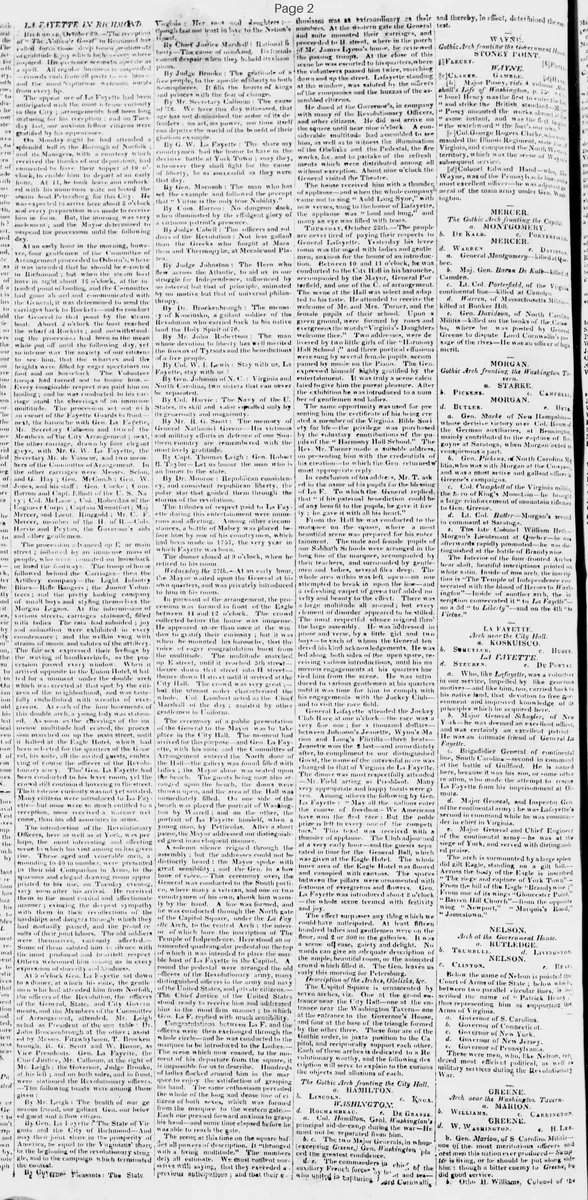
Richmond, October 29.—The reception of "The Nation's Guest" in Richmond has called forth those deep toned sentiments of gratitude & joy which he so justly inspired. His presence seems to act as a spell. All regular business is suspended—crowds rush from all quarters to see him—and the most "rapturous welcomes" burst from every lip.
The appearance of La Fayette had been anticipated with the most intense curiosity in this City; arrangements had been long making for his reception: and on Tuesday last, our anxious fellow citizens were gratified by his appearance.
On Monday night he had attended a splendid ball in the Borough of Norfolk; and its Managers, with a courtesy which received the thanks of our deputation, had consented to have their supper at 10 o'clock, to enable him to depart at an early hour. At 1, he took leave and embarked with his numerous suite on board the steam boat Petersburg for this City. He was expected to arrive here about 2 o'clock and every preparation was made to receive him in form. But, the morning was very inclement; and the Mayor determined to suspend the procession until the following day.
At an early hour in the morning, however, four gentlemen of the Committee of Arrangement proceeded to Osborn's, where it was intended that he should be escorted to Richmond; but when the steam boat hove in sight about 10 o'clock, at the intended point of landing, and the Committee had gone aboard and communicated with the General, it was determined to send the Carriages back to Rocketts—and to conduct the General to that point by the steam boat. About 2 o'clock the boat reached the wharf at Rocketts; and notwithstanding the processions had been in the mean while put off until the following day, yet so intense was the anxiety of our citizens to see him, that the wharves and the heights were filled by eager spectators on foot and on horseback. The Volunteer troops had turned out to honor him. Every imaginable respect was paid him on landing; and he was conducted to his carriage amid the cheerings of an immense multitude. The procession set out with an escort of the Fayette Guards in front—next, the barouche with Gen. La Fayette, Mr. Secretary Calhoun and two of the Members of the City Arrangement; next, the other carriage, drawn by four elegant grays, with Mr. G. W. La Fayette, the Secretary Mr. de Vasseur, and two members of the Committee of Arrangement. In the other carriages were Messrs. Scott, and G. Hay; Gen. McComb; Gen. W. Jones, and his staff; Gen. Cocke; Com. Barron and Capt. Elliott of the U. S. Navy; Col. McLane; Col. Roberdeau of the Engineer Corps: Captain Mountfort: Maj. Mercer, and Lieut. Ringgold; Mr. C. F. Mercer, member of the H. of R.—Cols. Harvie and Peyton, the Governor's aids and other gentlemen.
The procession advanced up E. or main street; followed by an immense mass of people, who were mounted on horseback or lined the footways. The troop of horse followed behind the Carriages—then the Artillery company—the light infantry Blues—Rifle Rangers; the Junior Volunteers; and the pretty looking company of small boys styling themselves the Morgan Legion. At the intersection of various streets, carriages stationed, filled with ladies. The rain had subsided; joy and animation were exhibited in every countenance; and the welkin rung with strains of music and salutes of the artillery. The fair sex expressed their feelings by the waving of handkerchiefs, as the procession passed every window. When it arrived opposite to the Union Hotel, it halted for a moment under the double arch which was erected at that spot by the citizens of the neighborhood, and was tastefully embellished with wreaths of evergreens. At each of the four basements of this double arch, a young lady was stationed. As soon as the cheerings of the immense multitude had ceased, the procession marched on up the main street, until it halted at the Eagle Hotel, which had been fitted up for the quarters of the General, his suite, all the invited guests, embracing of course the officers of the Revolutionary army. Tho' Gen. La Fayette had been conducted to his chamber yet the crowd still continued hovering in the street. Their immense curiosity was not yet satiated. Many citizens were introduced to La Fayette—but none were so much entitled to a reception, none received a warmer welcome, than his old associates in arms.
The introduction of the Revolutionary Officers, here as well as at York, was perhaps, the most interesting and affecting scene to which his visit among us has given rise. These aged and venerable men, amounting to 40 in number, were presented to their old Companion in Arms, in the spacious and elegant drawing room appropriated to his use, on Tuesday evening, very soon after his arrival. He received them in the most cordial and affectionate manner; evincing the deepest sympathy with them in those recollections of the hardships and dangers through which they had mutually passed, and the proud results of their joint labors. The old soldiers were themselves variously affected. Some of them saluted him in silence with the most profound and heartfelt respect. Others welcomed him with long as in every expression of sincerity and kindness.
At 5 o'clock Gen. La Fayette sat down to a dinner, at which his suite, the gentlemen who had attended him from Norfolk, the officers of the Revolution, the officers of the General, State, and City Governments, and the Members of the Committee of Arrangement, attended. Mr. Leigh acted as President of the one table: Dr. John Brockenbrough at the other; assisted by Messrs. Fitzwhylson, T. Brockenbrough, R. G. Scott and W. Roane, as Vice Presidents. Gen. La Fayette, the Chief Justice, Mr. Calhoun, at the right of Mr. Leigh: the Governor, Judge Brooke, at his left; and on both sides, and in front, were stationed the Revolutionary officers.
The following toasts were among those given:
By Mr. Leigh: The health of our generous friend, our gallant Gen. our beloved guest and fellow citizen.
By Gen. La Fayette: The State of Virginia and the City of Richmond—And may their joint share in the prosperity of America, be equal to the Virginian's share in the beginning of the revolutionary struggle, and in the campaign which terminated the contest.
By Governor Pleasants: The State Virginia: Her sons and daughters; Though last not least in love to the Nation's Guest.
By Chief Justice Marshall: Rational Liberty—The cause of mankind. Its friends cannot despair when they behold its champions.
By Judge Brooke: The gratitude of a free people, to the apostle of liberty in both hemispheres. It fills the hearts of kings and princes with the fear of change.
By Mr. Secretary Calhoun: The cause of '76. We have this day witnessed, that age has not diminished the ardor of its defenders: no art, no power, nor time itself can deprive the world of the benefit of their glorious example.
By G. W. La Fayette: The share my countrymen had the honor to have in the decisive battle at York Town; may they whenever they shall fight for the cause of liberty, be as successful as they were that day.
By Gen. Macomb: The man who has set the example and followed the precept that "Virtue is the only true Nobility."
By Com. Barron: No dungeon dark, when illuminated by the effulgent glory of a virtuous patriot's presence.
By Judge Cabell: The officers and soldiers of the Revolution: Not less gallant than the Greeks who fought at Marathon and Thermopylae, at Salamis and Plataea.
By Judge Johnston: The Hero who flew across the Atlantic, to aid us in our struggle for Independence, influenced by no interest but that of principle, animated by no motive but that of universal philanthropy.
By Dr. Brockenbrough: The memory of Kosciusko, a gallant soldier of the Revolution who carried back to his native land the Holy Spirit of '76.
By Mr. John Robertson: The man whose devotion to liberty has well merited the frowns of Tyrants and the benedictions of a free people.
By Col. W. I. Lewis: Stay with us, La Fayette, stay with us?
By Gen. Johnson of N.C.: Virginia and North Carolina, two sisters that can never be separated.
By Col. Harvie: The Navy of the U. States, its skill and valor equaled only by its generosity and magnanimity.
By Mr. R. G. Scott: The memory of General Nathaniel Greene—His virtuous and military efforts in defence of our Southern country are remembered with the most lively gratitude.
By Capt. Thomas Leigh: Gen. Robert B. Taylor—Let us honor the man who is an honor to the state.
By Dr. Monroe: Republican consistency, and consistent republican liberty, the polar star that guided them through the storms of the revolution.
The tributes of respect paid to La Fayette during this entertainment were numerous and affecting. Among other circumstances, a bottle of Malsey was placed before him by one of his countrymen, which had been made in 1757, the very year in which Fayette was born.
The dinner closed at 9 o'clock, when he retired to his room.
Wednesday the 27th.—At an early hour, the Mayor waited upon the General at his own quarters, and was privately introduced to him in his room.
In pursuance of the arrangement, the procession was formed in front of the Eagle between 11 and 12 o'clock. The crowd collected before the house was immense. He appeared more than once at the window to gratify their curiosity; but it was when he mounted his barouche, that the voice of eager congratulation burst from the multitude. The multitude marched up E street, until it reached 5th street—thence down that street into H street—thence down I street until it arrived at the City Hall. The crowd was very great; but the utmost order characterized the whole. Col. Lambert acted as the Chief Marshall of the day; assisted by other gentlemen in uniform.
The ceremony of a public presentation of the General to the Mayor was to take place in the City Hall. The moment had arrived for this purpose—and Gen. La Fayette, with his suite and the Committee of Arrangement entered the North door of the Hall—the gallery was found filled with ladies; the Mayor alone was seated upon the bench. The guests being now also arranged upon the bench, the doors were thrown open, and the area of the Hall was immediately filled. On one side of the bench was placed the portrait of Washington by Warrell; and on the other, the portrait of La Fayette himself, when a young man, by Petticolas. After a short pause, the Mayor addressed our distinguished guest in an eloquent manner.
A solemn silence reigned through the assembly; but the addresses could not be distinctly heard: the Mayor spoke with great sensibility; and the Gen. in a low tone of voice. This ceremony over, the General was conducted to the South portico, where many a veteran, and one or two countrymen of his own, shook him warmly by the hand. A line was formed, and he was conducted through the North gate of the Capitol Square, under the La Fayette Arch, to the central Arch; the interior of which bore the inscription of The Temple of Independence. Here stood an ornamented quadrangular pedestal on the top of which it was intended to place the marble bust of La Fayette in the Capitol. Around the pedestal were arranged the old officers of the Revolutionary army, many distinguished officers in the army and navy of the United States, and private citizens. The Chief Justice of the United States stood ready to receive him and addressed him in the most firm manner; to which Gen. La F. replied with much sensibility.
Congratulations between La F. and the officers were then exchanged through the whole circle—and he was conducted to the marquee to be introduced to the Ladies.—The scene which now ensued, to the moment of his departure from the square, it is impossible for us to describe. Hundreds of ladies flocked around him in the marquee to enjoy the satisfaction of grasping his hand. "The same enthusiasm pervaded the whole of the long and dense line of citizens of both sexes, which was formed from the marquee to the western gate.—Each one pressed forward anxious to grasp his hand—and some time elapsed before he was able to reach the gate,
The scene at this time on the square baffles all powers of description. It "thronged with a living multitude." The numbers defy all estimate. We must content ourselves with saying, that they exceeded previous anticipations; and that their enthusiasm was as extraordinary as their numbers. At the western gate the General and suite mounted their carriages, and proceeded to H. street, where in the porch of Mr. James Lyons's house, he reviewed the passing troops. At the close of this scene he was escorted to his quarters, where the volunteers passed him twice, marching down and up the street. Lafayette standing at the window, was saluted by the officers of the companies and the huzzas of the assembled citizens.
He dined at the Governor's, in company with many of the Revolutionary Officers, and other citizens. He did not arrive on the square until near nine o'clock. A considerable multitude had assembled to see him, as well as to witness the Illumination of the Obelisks and the Pedestal, the fire works, &c. and to partake of the refreshments which were distributed among all without exception. About nine o'clock the General visited the Theatre. The house received him with a thunder of applause—and when the whole company came out to sing "Auld Lang Syne," with new verses, sung to the honor of Lafayette, the applause was "loud and long," and many an eye was filled with tears.
Thursday, October 28th.—The people are never tired of paying their respects to General Lafayette. Yesterday his levee room was thronged with ladies and gentlemen, anxious for the honor of an introduction. Between 10 and 11 o'clock, he was conducted to the City Hall in his barouche, accompanied by the Mayor, General Porterfield, and one of the C. of arrangement. The scene at the Hall was select and adapted to his taste. He attended to receive the welcome of Mr. and Mrs. Turner, and the female pupils of their school. Upon a green ground, were formed by roses and evergreens the words "Virginia's Daughters welcome thee." Two addresses, were delivered by two little girls of the "Harmony Hall School;" and three poetical effusions were sung by several female pupils, accompanied by music on the Piano. The Gen. expressed himself highly gratified by the entertainment. It was truly a scene calculated to give him the purest pleasure. After the exhibition he was introduced to a number of gentlemen and ladies.
The same opportunity was used for presenting him the certificate of his being created a member of the Virginia Bible Society for life—the privilege was purchased by the voluntary contributions of the pupils of the "Harmony Hall School." The Rev. Mr. Turner made a suitable address, on presenting him with the credentials of his creation—to which the Gen. returned a most appropriate reply.
In conclusion of his address, Mr. T. asked in the name of his pupils for the blessing of La F. To which the General replied that "if his paternal benediction could be of any benefit to the pupils, he gave it freely; he gave it with all his heart,"
From the Hall he was conducted to the marquee on the square, where a most beautiful scene was prepared for his entertainment. The male and female pupils of our Sabbath Schools were arranged in the long line of the marquee, accompanied by their teachers, and surrounded by gentlemen and ladies, several files deep. The whole area within was left open—no one attempted to break in upon the line—and a refreshing carpet of green turf added novelty and beauty to the effect. There was a large multitude all around; but every element of disorder appeared to be stilled. The most respectful silence reigned through the large assembly. He was addressed in prose and verse, by a little girl and two boys—to each of whom the General tendered his kind acknowledgements. He was led along both sides of the open space, receiving various introductions, until his numerous engagements at his quarters hurried him from the scene. He was introduced to various gentlemen at his quarters until it was time for him to comply with his engagements with the Jockey Club—and to visit the race field.
General Lafayette attended the Jockey Club Race at one o'clock—the race was a very fine one; for a thousand dollars—between Johnson's Jeanette, Wynne's Marion and Long's Flirtilla—three heats—Jeanette won the 2 last—and immediately after, in compliment to our distinguished Guest, the name of the successful mare was changed to that of Virginia de La Fayette.
The dinner was most respectfully attended—Mr. Field acting as President. Many very appropriate and happy toasts were given. Among others the following by Gen. La Fayette: "May all the nations enter the course of freedom—We Americans have won the first race: But the noble prize is left to every one of the competitors." This toast was received with a thunder of applause. The Club adjourned at a very early hour—and the guests separated in time for the General Ball, which was given at the Eagle Hotel. The whole inner area of the Eagle Hotel was floored and canopied with canvas. The spaces between the pillars were ornamented with festoons of evergreens and flowers. Gen. La Fayette was introduced about 8 o'clock—the whole scene teemed with festivity and joy.
The effect surpasses any thing which we could have anticipated. At least fifteen hundred ladies and gentlemen were on the floor, and 500 in the galleries. It was a scene of ease, gaiety and delight. No words can give an adequate description of the ample, beautiful room, or the animated crowd which filled it. The Gen. leaves us early this morning for Petersburg.
Description of the Arches, Obelisks, &c.
The Capitol Square is ornamented by seven arches, viz. One at the grand entrance near the City Hall—one at the entrance near the Washington Tavern—one at the entrance to the Governor's House, and four at the base of the triangle formed by the other three. These four are of the Gothic order, in juxtaposition to the Capitol, and reciprocally support each other. Each of these arches is dedicated to a Revolutionary worthy, and the following description will serve to explain to the curious the objects and allusions of each.
The Gothic Arch fronting the City Hall,
a. HAMILTON.
b. LINCOLN.
c. KNOX.
WASHINGTON.
d. ROCHAMBEAU.
e. De GRASSE.
a. Col. Hamilton, Genl. Washington's principal aid-de-camp during the war—He must not be separated from him.
b. c. The two Major Generals, in whom (excepting Greene,) Gen. Washington placed the greatest confidence.
d. e. The commanders in chief of the auxiliary French forces by land and sea—who united in capturing Lord Cornwallis, and thereby, in effect, determined the contest.
WAYNE
Gothic Arch fronting the Government House
STONEY POINT.
HEFLEURY.
POSEY,
WAYNE.
[c]CLARKE.
GAMBLE.
4d Glass
1.1
Major Posey, vide 4 volume Marshall's Life of Washington p. and Jonel strike Henry the was the British first standard—Maj to enter the fop saie Posey instant mounted and the was works the almost fist togie at the "the watchword the fort's our own."
[Hf] Col. George Rogers Clarke, whom commanded Virginia the and Illinois conquered Regiment the North state linedf territory, which was the scene of Wayne's subsequent service.
Half Colonel Edward Hand—who, like Wayne was of the Pennsylvania hine excellent ofhicer—he was adjutant gen eral of the main army under Gen. Washington.
MERCER.
The Gothic Arch fronting the Capitol.
a. MONTGOMERY.
b. De Kalb.
c. PORTERFIELD.
MERCER.
d. WARREN
e. DAVIDSON
a. General Montgomery—killed at Quebec.
b. Maj. Gen. Baron De Kalb—killed at Camden.
c. Lt. Col. Porterfield, of the Virginia continental line—killed at Camden
d. Warren, of Massachusetts Militia—killed at Bunker Hill.
e. Gen. Davidson, of North Carolina Militia—killed on the banks of the Catawba, where he was posted by General Greene to dispute Lord Cornwallis's passage of the river—He was an officer of high merit.
MORGAN,
Gothic Arch fronting the Washington Tavern.
a. STARKE.
b. PICKENS.
c. CAMPBELL.
MORGAN.
d. BUTLER.
e. HETH.
a. Gen. Starke of New Hampshire—whose decisive victory over Col. Baum of the German auxiliaries, at Bennington, mainly contributed to the capture of Burgoyne at Saratoga, when Morgan acted so conspicuous a part.
b. Gen. Pickens, of North Carolina Militia, who was with Morgan at the Cowpens, and was a most active and gallant officer in Greene's campaigns.
c. Col. Campbell of the Virginia militia the hero of King's Mountain—he brought a large reinforcement of mountain riflemen to Gen. Greene.
d. Lt. Col. Butler—Morgan's second in command at Saratoga.
e. This late Colonel William Heth—Morgan's Lieutenant at Quebec—he was afterwards rapidly promoted—he was distinguished at the battle of Brandywine
The interior of the four-fronted Arches bear aloft, beautiful inscriptions printed on white satin. Inside of one arch, the inscription is "The Temple of Independence consecrated with the blood of Heroes to Washington"—Inside of another arch, the inscription consecrated it "to La Fayette". on a 3d "to Liberty"—and on the 4th "to Virtue."
LA FAYETTE.
Arch near the City Hall.
a. KOSCIUSKO.
b. SCHUYLER.
c. HUGER.
LA FAYETTE
d. STEUBEN.
e. Du PORTAIL
a. Who, like Lafayette, was a volunteer in our service impelled by like generous motives—and like him, too, carried back to his native land, that devotion to free government and improved knowledge of its principles which he acquired here.
b. Major General Schuyler, of New York—he was deemed an excellent officer, and was certainly an excellent patriot—He was an intimate friend of General La Fayette.
c. Brigadier General of continental line, South Carolina—second in command at the battle of Guilford. He is placed here, because it was his son, or some other relation, who made the attempt to rescue La Fayette from his imprisonment at Olmutz.
d. Major General, and Inspector General of the continental army: he was Lafayette's second in command while he was commander in chief in Virginia.
e. Major General and Chief Engineer of the continental army—he was at the siege of York, and served with distinguished praise.
The arch is surmounted by a large splendid gilt Eagle, standing on a gilt ball.—Across the body of the Eagle is inscribed "The siege and capture of York Town"—From the bill of the Eagle "Brandywine;" From one of its wings "Gloucester Point," "Barren Hill Church"—from the opposite wing "Newport," "Marquis's Road," "Jamestown."
NELSON.
Arch at the Government House.
a. RUTLEDGE.
b. TRUMBULL.
d. LIVINGSTON.
NELSON.
c. CLINTON.
e. REAR.
Below the name of Nelson is painted the Coat of Arms of the State; below which, between two parallel circular lines, is inscribed the name of "Patrick Henry," thus representing him as supporting the Arms of Virginia.
a. Governor of S. Carolina.
b. Governor of Connecticut
c. Governor of New York.
d. Governor of New Jersey.
e. Governor of Pennsylvania.
These were men, who, like Nelson, rendered most efficient political, as well as military services during the Revolutionary War,
GREENE.
Arch near the Washington Tavern
a. MARION.
b. WILLIAMS.
c. CARRINGTON
GREENE.
d. W.
ASHINGTON,
e. H. LEE
b. Gen. Marion, of S Carolina Militia—one of the most meritorious officers and best men this nation ever produced—Sumter is living, or he should be put along side him: though a bitter enemy to Greene, he did good service.
Otho H. Williams, Colonel of the Maryland line.
Maryland line, and Gen. Greene's adjutant general. Lt. Col. of Artillery, and Greene's Q. Master General. Called his right hand. Lt. Col. of Cavalry—whom Greene called his right eye. Lieut. Col. Partizan Legion—whom N. B. Col. Howard is yet living. With glittering stars—and it must be particularly remarked that the Washington arch bears on its front a large portrait of Washington. The fortifications of Stony Point—that of Montgomery—the arch of Wayne, the figure of a rifleman, &c. The Pedestal in the Temple of Independence has 4 fronts: on the side fronting the Fayette gate, is this inscription, "The Virginia Legislature have offered this testimonial to Major General La Fayette, as a lasting monument of his merit and their gratitude." On the other fronts, are emblematical transparencies, on the picture of a dog, to represent vigilance—another, a child inscribed "Lafayette" defending the infant Republic, represented by a child, against a British lion. The other front was a spread eagle. Two Obelisks raised in the area of the other. The first has the names of all the Revolutionary Officers living in Virginia. In transparency. The other one will be better understood from the description of it: Names inscribed in large capital letters on the Obelisk to the west of the principal entrance into the Capitol Square: On the western front: St. George Tucker, Augustus Booker, Abraham Murray, Isaac Hite, John Trabue, Samuel Tinsley, Phil'n Holcombe, Carter Page, Allen McLane, Gabriel Gray, Matt. Wood, George Lambert, John Slaughter, John L. Crut, Samuel Carter, Benj. Overstreet, Jacob Cunningham, Wm. H. Mosely, Wm. Johnston, Ro. H. Saunders, Wm. Eskridge. On the North front: James Barron, Jun. Kilby, Peter Johnson, Joseph Blackwell, Francis Cowherd. John Jordan, Henry Bowser, Charles Woodson, Francis Brooke, Jos. Marshall, Wm. Broadus, Churchill Gibbs, Joseph Morton, Dudley Diggs, Wm. White, Jos. Scott, Robert Beale, Clement Carrington, Nathl. Vasser, Berryman Green, William Brough. On the East front: James Dillard, William Price, Thomas White, Peter Foster, Arch. Perkins, Wade Mosby, John Wyatt, Richard Allen, William Pyatt, John Smith, Hezekiah Morton, Thomas Monte, George Blakenmore, John Woodson, John Moody, Peter Francisco, Joel Jones, Joseph Christian, Isham Allen, Charles Gire, John Long, Matthew Eggleston, David M. Randolph, John Mountcastle. On the South front: Charles Dinkney, Thomas Massie, John Nelson, Charles Hogill, John Watts, Gabriel Long, John Marshall, John Nicholas, John Williams, Robert White, Robert Randolph, Robert Porterfield, Charles Ewell, Chas. Cameron, Joseph Scott, Wm. Wearing, Philip Slaughter, Wm. Robertson, William Evans, James Gibson, Robt. Saunders, Thomas Pemberton, Wm. Worshipam. Inscription on the Pedestal: The citizens of Richmond offer this tribute of gratitude and respect to the surviving heroes of Virginia. The Obelisk to the left of the entrance bore the following inscriptions: On the West front: The Presidents of the old Congress. Peyton Randolph, John Hancock, Henry Laurens, John Jay, Samuel Huntington, John Houston, Elias Boudinot, Mt. Hardy, Thos. McKean, Thos. Mifflin, Richard H. Lee, Cyrus Griffin. On the North front: Members of the first Congress from Va. Peyton Randolph, Richard H. Lee, Washington, Patrick Henry, Jr., Richard Bland, Ben. Harrison, Ed. Pendleton. On the East front: Governors—Henry, Jefferson, N. Harrison, B. Randolph, B. Randolph, Lee, Brooke, Wood, Monroe, Page, Tyler, Cabell, Smith, Barbour, Nicholas, Preston, T.M. Randolph, J. Pleasants. On the South front: Presidents of the Virginia Convention: Peyton Randolph—Edmund Pendleton. We have thrown the name into paragraphs to save space—but on the obelisks themselves, they run one after the other, in separate lines. Each obelisk is surmounted by a beautiful star. The following toast was proposed by Gen. La Fayette, at the Masonic dinner at New York. "The nays and yeas on the question of Masonry, The nays, Francis the Second of Austria, and Ferdinand the Seventh of Spain: The yeas, Washington and Franklin."
What sub-type of article is it?
What themes does it cover?
What keywords are associated?
What entities or persons were involved?
Where did it happen?
Story Details
Key Persons
Location
Richmond, Virginia
Event Date
October 27 29, 1824
Story Details
Enthusiastic reception of General La Fayette in Richmond with parades, dinners, toasts honoring him and Revolutionary heroes, public ceremonies, school presentations, race attendance, and elaborate arches dedicated to war figures.