Thank you for visiting SNEWPapers!
Sign up free
The Nome Nugget
Nome, Nome County, Alaska
What is this article about?
Gen. Maxwell D. Taylor, US Army Chief of Staff, testified that the US must be willing to go to war if necessary to deter the Soviet Union over the Berlin crisis, criticizing the 1948 airlift as a mistake. The censored testimony was released by Sen. Lyndon B. Johnson.
Clipping
OCR Quality
Full Text
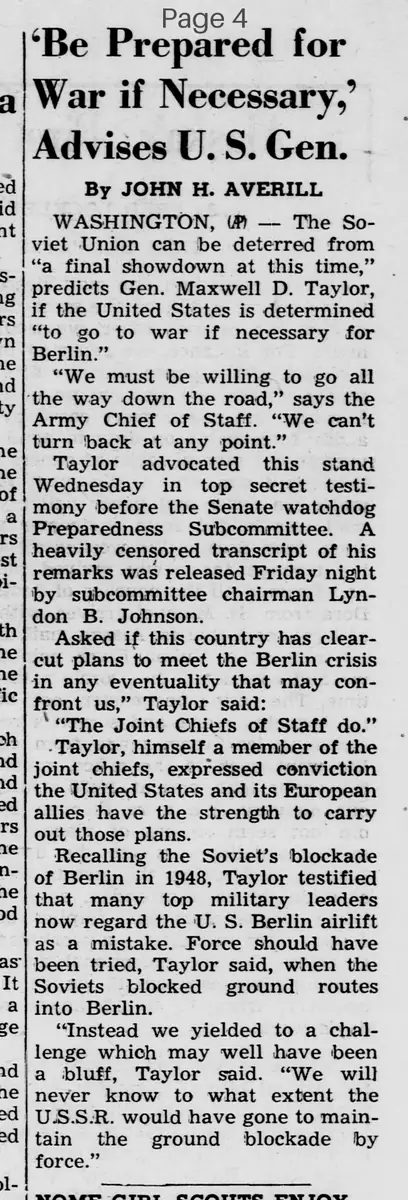
By JOHN H. AVERILL
WASHINGTON. (A) -- The Soviet Union can be deterred from a final showdown at this time, predicts Gen. Maxwell D. Taylor, if the United States is determined "to go to war if necessary for Berlin."
"We must be willing to go all the way down the road," says the Army Chief of Staff. "We can't turn back at any point."
Taylor advocated this stand Wednesday in top secret testimony before the Senate watchdog Preparedness Subcommittee. A heavily censored transcript of his remarks was released Friday night by subcommittee chairman Lyndon B. Johnson.
Asked if this country has clear-cut plans to meet the Berlin crisis in any eventuality that may confront us," Taylor said:
"The Joint Chiefs of Staff do."
Taylor, himself a member of the joint chiefs, expressed conviction the United States and its European allies have the strength to carry out those plans.
Recalling the Soviet's blockade of Berlin in 1948, Taylor testified that many top military leaders now regard the U. S. Berlin airlift as a mistake. Force should have been tried, Taylor said, when the Soviets blocked ground routes into Berlin.
"Instead we yielded to a challenge which may well have been a bluff," Taylor said. "We will never know to what extent the U.S.S.R. would have gone to maintain the ground blockade by force."
What sub-type of article is it?
What keywords are associated?
What entities or persons were involved?
Where did it happen?
Foreign News Details
Primary Location
Berlin
Event Date
Wednesday
Key Persons
Event Details
Gen. Maxwell D. Taylor testified before the Senate Preparedness Subcommittee that the US must be determined to go to war if necessary for Berlin to deter the Soviet Union, stating the Joint Chiefs have plans and the US and allies have strength to execute them. He criticized the 1948 Berlin airlift as yielding to a possible Soviet bluff, advocating force instead.