Thank you for visiting SNEWPapers!
Sign up free
Story
February 25, 1880
The Morristown Gazette
Morristown, Hamblen County, Tennessee
What is this article about?
Horticulturist E. P. Roe advocates for spring cultivation of strawberry plants, contrary to common advice, to loosen packed soil, prevent drought issues, and revitalize the land, detailing a method to rake and cultivate strips while reusing mulch.
Clipping
OCR Quality
96%
Excellent
Full Text
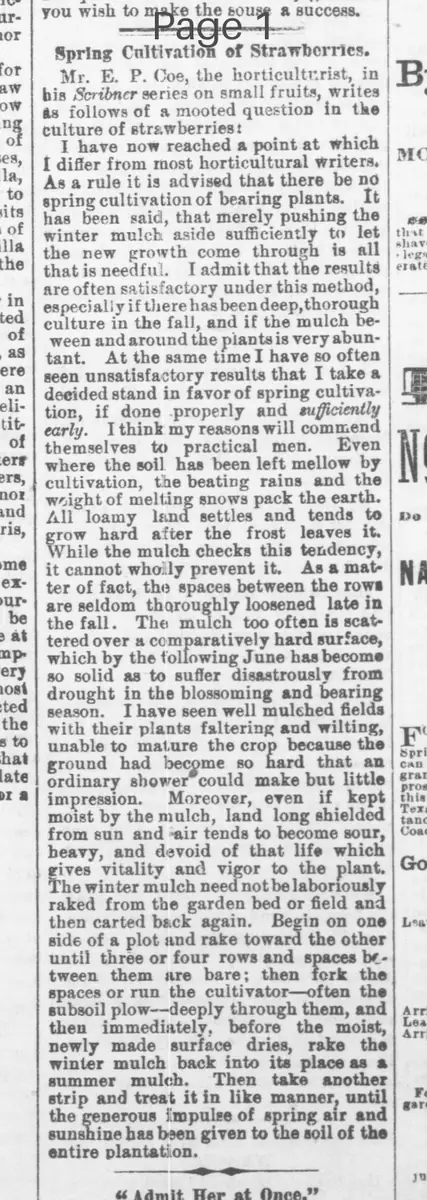
Spring Cultivation of Strawberries.
Mr. E. P. Roe, the horticulturist, in his Scribner series on small fruits, writes as follows of a mooted question in the culture of strawberries
I have now reached a point at which I differ from most horticultural writers. As a rule it is advised that there be no spring cultivation of bearing plants. It has been said, that merely pushing the winter mulch aside sufficiently to let the new growth come through is all that is needful. I admit that the results are often satisfactory under this method, especially if there has been deep, thorough culture in the fall, and if the mulch between and around the plants is very abundant. At the same time I have so often seen unsatisfactory results that I take a decided stand in favor of spring cultivation, if done properly and sufficiently early. I think my reasons will commend themselves to practical men. Even where the soil has been left mellow by cultivation, the beating rains and the weight of melting snows pack the earth. All loamy land settles and tends to grow hard after the frost leaves it. While the mulch checks this tendency, it cannot wholly prevent it. As a matter of fact, the spaces between the rows are seldom thoroughly loosened late in the fall. The mulch too often is scattered over a comparatively hard surface, which by the following June has become so solid as to suffer disastrously from drought in the blossoming and bearing season. I have seen well mulched fields with their plants faltering and wilting, unable to mature the crop because the ground had become so hard that an ordinary shower could make but little impression.
Moreover, even if kept moist by the mulch, land long shielded from sun and air tends to become sour, heavy, and devoid of that life which gives vitality and vigor to the plant.
The winter mulch need not be laboriously raked from the garden bed or field and then carted back again. Begin on one side of a plot and rake toward the other until three or four rows and spaces between them are bare; then fork the spaces or run the cultivator--often the subsoil plow--deeply through them, and then immediately, before the moist, newly made surface dries, rake the winter mulch back into its place as a summer mulch. Then take another strip and treat it in like manner, until the generous impulse of spring air and sunshine has been given to the soil of the entire plantation.
Mr. E. P. Roe, the horticulturist, in his Scribner series on small fruits, writes as follows of a mooted question in the culture of strawberries
I have now reached a point at which I differ from most horticultural writers. As a rule it is advised that there be no spring cultivation of bearing plants. It has been said, that merely pushing the winter mulch aside sufficiently to let the new growth come through is all that is needful. I admit that the results are often satisfactory under this method, especially if there has been deep, thorough culture in the fall, and if the mulch between and around the plants is very abundant. At the same time I have so often seen unsatisfactory results that I take a decided stand in favor of spring cultivation, if done properly and sufficiently early. I think my reasons will commend themselves to practical men. Even where the soil has been left mellow by cultivation, the beating rains and the weight of melting snows pack the earth. All loamy land settles and tends to grow hard after the frost leaves it. While the mulch checks this tendency, it cannot wholly prevent it. As a matter of fact, the spaces between the rows are seldom thoroughly loosened late in the fall. The mulch too often is scattered over a comparatively hard surface, which by the following June has become so solid as to suffer disastrously from drought in the blossoming and bearing season. I have seen well mulched fields with their plants faltering and wilting, unable to mature the crop because the ground had become so hard that an ordinary shower could make but little impression.
Moreover, even if kept moist by the mulch, land long shielded from sun and air tends to become sour, heavy, and devoid of that life which gives vitality and vigor to the plant.
The winter mulch need not be laboriously raked from the garden bed or field and then carted back again. Begin on one side of a plot and rake toward the other until three or four rows and spaces between them are bare; then fork the spaces or run the cultivator--often the subsoil plow--deeply through them, and then immediately, before the moist, newly made surface dries, rake the winter mulch back into its place as a summer mulch. Then take another strip and treat it in like manner, until the generous impulse of spring air and sunshine has been given to the soil of the entire plantation.
What sub-type of article is it?
Horticultural Advice
Agricultural Practice
What keywords are associated?
Strawberry Cultivation
Spring Mulching
Soil Compaction
Horticultural Advice
Winter Mulch
What entities or persons were involved?
Mr. E. P. Roe
Story Details
Key Persons
Mr. E. P. Roe
Story Details
E. P. Roe argues for spring cultivation of strawberries to address soil compaction from winter, prevent drought and souring, and describes a method of raking mulch aside in strips, cultivating deeply, and replacing mulch.