Thank you for visiting SNEWPapers!
Sign up free
Editorial
February 11, 1935
The Times News
Hendersonville, Henderson County, North Carolina
What is this article about?
Editorial warns of increased drunken driving deaths and injuries post-prohibition repeal, citing National Safety Council data showing alcohol's role in 5-10% of accidents (likely underreported), with arrests up 20-100%. Urges all citizens to fight the issue for public safety.
Clipping
OCR Quality
98%
Excellent
Full Text
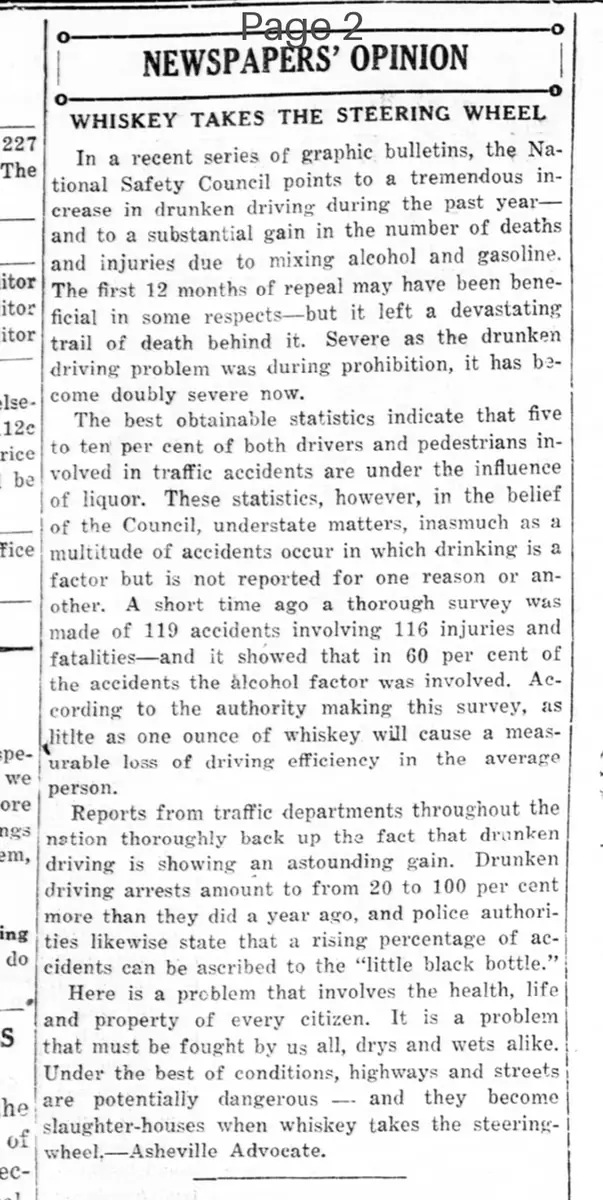
NEWSPAPERS' OPINION
WHISKEY TAKES THE STEERING WHEEL
In a recent series of graphic bulletins, the National Safety Council points to a tremendous increase in drunken driving during the past year—and to a substantial gain in the number of deaths and injuries due to mixing alcohol and gasoline.
The first 12 months of repeal may have been beneficial in some respects—but it left a devastating trail of death behind it. Severe as the drunken driving problem was during prohibition, it has become doubly severe now.
The best obtainable statistics indicate that five to ten per cent of both drivers and pedestrians involved in traffic accidents are under the influence of liquor. These statistics, however, in the belief of the Council, understate matters, inasmuch as a multitude of accidents occur in which drinking is a factor but is not reported for one reason or another. A short time ago a thorough survey was made of 119 accidents involving 116 injuries and fatalities—and it showed that in 60 per cent of the accidents the alcohol factor was involved. According to the authority making this survey, as little as one ounce of whiskey will cause a measurable loss of driving efficiency in the average person.
Reports from traffic departments throughout the nation thoroughly back up the fact that drunken driving is showing an astounding gain. Drunken driving arrests amount to from 20 to 100 per cent more than they did a year ago, and police authorities likewise state that a rising percentage of accidents can be ascribed to the "little black bottle."
Here is a problem that involves the health, life and property of every citizen. It is a problem that must be fought by us all, drys and wets alike.
Under the best of conditions, highways and streets are potentially dangerous—and they become slaughter-houses when whiskey takes the steering wheel.—Asheville Advocate.
WHISKEY TAKES THE STEERING WHEEL
In a recent series of graphic bulletins, the National Safety Council points to a tremendous increase in drunken driving during the past year—and to a substantial gain in the number of deaths and injuries due to mixing alcohol and gasoline.
The first 12 months of repeal may have been beneficial in some respects—but it left a devastating trail of death behind it. Severe as the drunken driving problem was during prohibition, it has become doubly severe now.
The best obtainable statistics indicate that five to ten per cent of both drivers and pedestrians involved in traffic accidents are under the influence of liquor. These statistics, however, in the belief of the Council, understate matters, inasmuch as a multitude of accidents occur in which drinking is a factor but is not reported for one reason or another. A short time ago a thorough survey was made of 119 accidents involving 116 injuries and fatalities—and it showed that in 60 per cent of the accidents the alcohol factor was involved. According to the authority making this survey, as little as one ounce of whiskey will cause a measurable loss of driving efficiency in the average person.
Reports from traffic departments throughout the nation thoroughly back up the fact that drunken driving is showing an astounding gain. Drunken driving arrests amount to from 20 to 100 per cent more than they did a year ago, and police authorities likewise state that a rising percentage of accidents can be ascribed to the "little black bottle."
Here is a problem that involves the health, life and property of every citizen. It is a problem that must be fought by us all, drys and wets alike.
Under the best of conditions, highways and streets are potentially dangerous—and they become slaughter-houses when whiskey takes the steering wheel.—Asheville Advocate.
What sub-type of article is it?
Temperance
Social Reform
What keywords are associated?
Drunken Driving
Prohibition Repeal
Traffic Accidents
Alcohol Influence
National Safety Council
Public Safety
What entities or persons were involved?
National Safety Council
Asheville Advocate
Editorial Details
Primary Topic
Increase In Drunken Driving After Prohibition Repeal
Stance / Tone
Alarmist Call For Collective Action Against Alcohol Related Traffic Dangers
Key Figures
National Safety Council
Asheville Advocate
Key Arguments
Tremendous Increase In Drunken Driving Deaths And Injuries Post Repeal
Problem Doubled In Severity Since Prohibition Ended
5 10% Of Accident Victims Under Liquor Influence, Likely Understated
Survey Shows 60% Of 119 Accidents Involved Alcohol
One Ounce Of Whiskey Impairs Driving Efficiency
Drunken Driving Arrests Up 20 100% Nationwide
Rising Accidents Due To 'Little Black Bottle'
All Citizens, Drys And Wets, Must Fight This Public Safety Issue