Thank you for visiting SNEWPapers!
Sign up free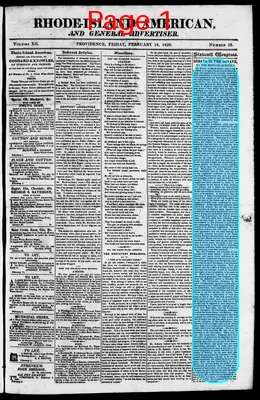
Domestic News
February 18, 1820
The Rhode Island American, And General Advertiser
Providence, Providence County, Rhode Island
What is this article about?
In a Senate debate on the Missouri Question, Mr. Burrill of Rhode Island argues for the constitutionality and necessity of restricting slavery in new states, citing the 1787 Ordinance and constitutional compromises, while refuting opponents' claims of lacking authority.
Clipping

OCR Quality
88%
Good
Full Text
DEBATE IN THE SENATE
ON THE MISSOURI QUESTION.
Mr. Burrill, of Rhode-Island, said, it might
probably be thought, that the very full discussion
which this question had received, rendered it
quite unnecessary to add any thing to the elab-
orate arguments of the honourable gentlemen
who had preceded him: I even think so my-
self, said he; but, having at the last session
taken some share in the debate upon a similar
motion, it would be expected of me that the
same sense of duty which then prompted me
to address you, would still continue its effect,
unless further reflection on the arguments of
honourable gentlemen had produced a change
of opinion. No change of that kind has been
wrought, and longer and more careful consid-
eration has produced a deeper conviction, not
only of the constitutionality, but of the neces-
sity of the proposed restriction. I shall aim,
however, to avoid, as far as possible, the re-
petition of former arguments, or I feel too
much impressed with the very kind and en-
couraging attention which my humble attempts
on this floor have always received from the
Senate, to tax their friendly patience for any
very great length of time.
The objection principally relied upon by
those who have opposed this restriction is, that
the Constitution gives us no power to impose
it; and they call upon us, in a manner which
implies that they feel themselves strong on this
point, to produce the clause or article in which
the power is granted. Objections of a consti-
tutional kind, opposed to a measure of legis-
lations, are entitled to respect, and must be
answered; but they have so frequently been
urged, in Congress and in the States, against
almost every measure proposed or adopted,
that they have lost the importance arising out
of their name and source, and must stand upon
their own merit, or, which is sometimes unfor-
tunately the case, will stand upon the elo-
quence and ability of those who urge them.
In the threshold, I might ask honourable gen-
tlemen whether the burden of this argument
is not thrown upon their shoulders rather than
ours. We propose to subject Missouri to no
other restriction than, in 1787, was imposed
by the "immortal" ordinance, as the gentle-
man from Pennsylvania has, with great force
and propriety, called it, upon the whole North-
western Territory, a restriction which was
readily and freely assented to, under an act
of Congress, by the States of Ohio, Indiana,
and Illinois, and to which the unparalleled
growth and happy condition of the first of those
fertile and extensive States, is, in a great de-
gree, to be ascribed. A restriction, then, the
propriety of which is strengthened by a refer-
ence to the conduct of the old Congress and
of the new, of the States and of the Union.
ought not hastily to be condemned as uncon-
stitutional.
It has often been repeated within
doors and without, that our free and happy
Constitution, in which so many apparent con-
tradictions and jarring interests are reconciled
into a strong and harmonious federal govern-
ment, was, in great part, the fruit of compro-
mise. We have often been reminded, and I
shall not soon forget it, that the small States
are indebted to this principle of conciliation
and compromise, for their equal suffrage in this
branch of the National Legislature. On such
occasions, it is but fair and equal to remind
other gentlemen, that the same friendly and
patriotick principle has given to the Slave-
holding States a representation upon property
in the other House, and that the compensation
intended to have been made by the apportion-
inent of direct taxes, according to the same
ratio, has, owing to the ability or disposition
to dispense with such taxes, except in a very
few instances, never been received.
But, Mr. President, this principle of com-
promise went much farther. Almost all the
States, and nearly every individual in the
Convention, considered Slavery as an evil, as
one of the gentlemen from Georgia has observ-
ed, in the course of this debate, to be tolerated,
because it could not be remedied. They also
agreed, that the traffick in Slaves on the Afri-
can coast was inhuman as well as impolitick,
and ought, as soon as possible, to be suppress-
ed. There was still, however, an unwilling-
ness in some gentlemen, that Congress should
have the immediate power to interdict this
trade. The Convention, therefore, in the
spirit of compromise, agreed to a limitation on
that general power which Congress would, by
the Constitution, have possessed over the immi-
grations and importation of Slaves, and they in-
serted in the 9th Section, 1st Article, that
"the migration or importation of such per-
sons as any of the States now existing shall
think proper to admit, shall not be prohibited
by Congress prior to the year 1808, but a tax
or duty may be imposed on such importation,
not exceeding ten dollars for each person."
It is very observable, that the Convention
have, throughout the Constitution, scrupulously
avoided the words Slaves and Slavery. One
of the most distinguished members of that body
proposed the substitution of other words, and
said he hoped that the time might arrive, dur-
ing the existence of this Constitution, when
Slavery would no longer exist, and he wished
there might be no memorial in the Constitution
itself, that it ever had existed. We have the
evidence of the venerable Mr. Jay, as to the
intention of the Convention. There was, in
fact, this compromise: Congress shall have
the power of preventing the migration and im-
portation of Slaves: but as to the States then
existing, they shall not exercise it till 1808.
As to new States, their power was not even
temporarily restrained. In truth, there was
then, as unfortunately there is not now, a uni-
versal disposition to restrain and limit the ex-
tension of Slavery. In the same spirit was
conceived and enacted the ordinance of 1787,
passed unanimously, assented to by all the
States concerned, and ratified by the first Con-
gress under the new Constitution; an ordi-
nance, too, enacted during the session of the
Convention, by persons, some of whom were
members of both bodies, and having an effect,
not upon the spirit merely, but upon the frame
and phraseology of the Constitution. In short,
those great men considered that henceforth we
had adopted, as a basis, a fundamental princi-
ple of our polity, that domestick Slavery was
not to be further extended.
ON THE MISSOURI QUESTION.
Mr. Burrill, of Rhode-Island, said, it might
probably be thought, that the very full discussion
which this question had received, rendered it
quite unnecessary to add any thing to the elab-
orate arguments of the honourable gentlemen
who had preceded him: I even think so my-
self, said he; but, having at the last session
taken some share in the debate upon a similar
motion, it would be expected of me that the
same sense of duty which then prompted me
to address you, would still continue its effect,
unless further reflection on the arguments of
honourable gentlemen had produced a change
of opinion. No change of that kind has been
wrought, and longer and more careful consid-
eration has produced a deeper conviction, not
only of the constitutionality, but of the neces-
sity of the proposed restriction. I shall aim,
however, to avoid, as far as possible, the re-
petition of former arguments, or I feel too
much impressed with the very kind and en-
couraging attention which my humble attempts
on this floor have always received from the
Senate, to tax their friendly patience for any
very great length of time.
The objection principally relied upon by
those who have opposed this restriction is, that
the Constitution gives us no power to impose
it; and they call upon us, in a manner which
implies that they feel themselves strong on this
point, to produce the clause or article in which
the power is granted. Objections of a consti-
tutional kind, opposed to a measure of legis-
lations, are entitled to respect, and must be
answered; but they have so frequently been
urged, in Congress and in the States, against
almost every measure proposed or adopted,
that they have lost the importance arising out
of their name and source, and must stand upon
their own merit, or, which is sometimes unfor-
tunately the case, will stand upon the elo-
quence and ability of those who urge them.
In the threshold, I might ask honourable gen-
tlemen whether the burden of this argument
is not thrown upon their shoulders rather than
ours. We propose to subject Missouri to no
other restriction than, in 1787, was imposed
by the "immortal" ordinance, as the gentle-
man from Pennsylvania has, with great force
and propriety, called it, upon the whole North-
western Territory, a restriction which was
readily and freely assented to, under an act
of Congress, by the States of Ohio, Indiana,
and Illinois, and to which the unparalleled
growth and happy condition of the first of those
fertile and extensive States, is, in a great de-
gree, to be ascribed. A restriction, then, the
propriety of which is strengthened by a refer-
ence to the conduct of the old Congress and
of the new, of the States and of the Union.
ought not hastily to be condemned as uncon-
stitutional.
It has often been repeated within
doors and without, that our free and happy
Constitution, in which so many apparent con-
tradictions and jarring interests are reconciled
into a strong and harmonious federal govern-
ment, was, in great part, the fruit of compro-
mise. We have often been reminded, and I
shall not soon forget it, that the small States
are indebted to this principle of conciliation
and compromise, for their equal suffrage in this
branch of the National Legislature. On such
occasions, it is but fair and equal to remind
other gentlemen, that the same friendly and
patriotick principle has given to the Slave-
holding States a representation upon property
in the other House, and that the compensation
intended to have been made by the apportion-
inent of direct taxes, according to the same
ratio, has, owing to the ability or disposition
to dispense with such taxes, except in a very
few instances, never been received.
But, Mr. President, this principle of com-
promise went much farther. Almost all the
States, and nearly every individual in the
Convention, considered Slavery as an evil, as
one of the gentlemen from Georgia has observ-
ed, in the course of this debate, to be tolerated,
because it could not be remedied. They also
agreed, that the traffick in Slaves on the Afri-
can coast was inhuman as well as impolitick,
and ought, as soon as possible, to be suppress-
ed. There was still, however, an unwilling-
ness in some gentlemen, that Congress should
have the immediate power to interdict this
trade. The Convention, therefore, in the
spirit of compromise, agreed to a limitation on
that general power which Congress would, by
the Constitution, have possessed over the immi-
grations and importation of Slaves, and they in-
serted in the 9th Section, 1st Article, that
"the migration or importation of such per-
sons as any of the States now existing shall
think proper to admit, shall not be prohibited
by Congress prior to the year 1808, but a tax
or duty may be imposed on such importation,
not exceeding ten dollars for each person."
It is very observable, that the Convention
have, throughout the Constitution, scrupulously
avoided the words Slaves and Slavery. One
of the most distinguished members of that body
proposed the substitution of other words, and
said he hoped that the time might arrive, dur-
ing the existence of this Constitution, when
Slavery would no longer exist, and he wished
there might be no memorial in the Constitution
itself, that it ever had existed. We have the
evidence of the venerable Mr. Jay, as to the
intention of the Convention. There was, in
fact, this compromise: Congress shall have
the power of preventing the migration and im-
portation of Slaves: but as to the States then
existing, they shall not exercise it till 1808.
As to new States, their power was not even
temporarily restrained. In truth, there was
then, as unfortunately there is not now, a uni-
versal disposition to restrain and limit the ex-
tension of Slavery. In the same spirit was
conceived and enacted the ordinance of 1787,
passed unanimously, assented to by all the
States concerned, and ratified by the first Con-
gress under the new Constitution; an ordi-
nance, too, enacted during the session of the
Convention, by persons, some of whom were
members of both bodies, and having an effect,
not upon the spirit merely, but upon the frame
and phraseology of the Constitution. In short,
those great men considered that henceforth we
had adopted, as a basis, a fundamental princi-
ple of our polity, that domestick Slavery was
not to be further extended.
What sub-type of article is it?
Politics
Slave Related
What keywords are associated?
Missouri Question
Senate Debate
Slavery Restriction
Constitutional Argument
Ordinance Of 1787
What entities or persons were involved?
Mr. Burrill
Gentleman From Pennsylvania
Gentleman From Georgia
Mr. Jay
Where did it happen?
United States Senate
Domestic News Details
Primary Location
United States Senate
Key Persons
Mr. Burrill
Gentleman From Pennsylvania
Gentleman From Georgia
Mr. Jay
Event Details
Mr. Burrill of Rhode-Island addresses the Senate in defense of the proposed restriction on slavery in Missouri, arguing its constitutionality based on the Ordinance of 1787 and the framers' intent to limit slavery's extension. He counters objections by emphasizing compromise in the Constitution and historical precedents.