Thank you for visiting SNEWPapers!
Sign up free
The New York Herald
New York, New York County, New York
What is this article about?
The steamship Empire City confirms the failure of Narciso López's 1851 invasion of Cuba. López and his filibusters landed near Havana, faced Spanish resistance, suffered heavy losses, and were captured or killed. López was executed by garrote in Havana on September 1 amid public celebrations. Over 100 prisoners to be sent to Spain; Creoles did not support the invaders.
Merged-components note: These components form a single coherent foreign news story on the Cuban Lopez expedition, execution, and related events, split across columns and including associated tables of names; sequential reading order and content continuity indicate they belong together as one logical unit.
Clippings
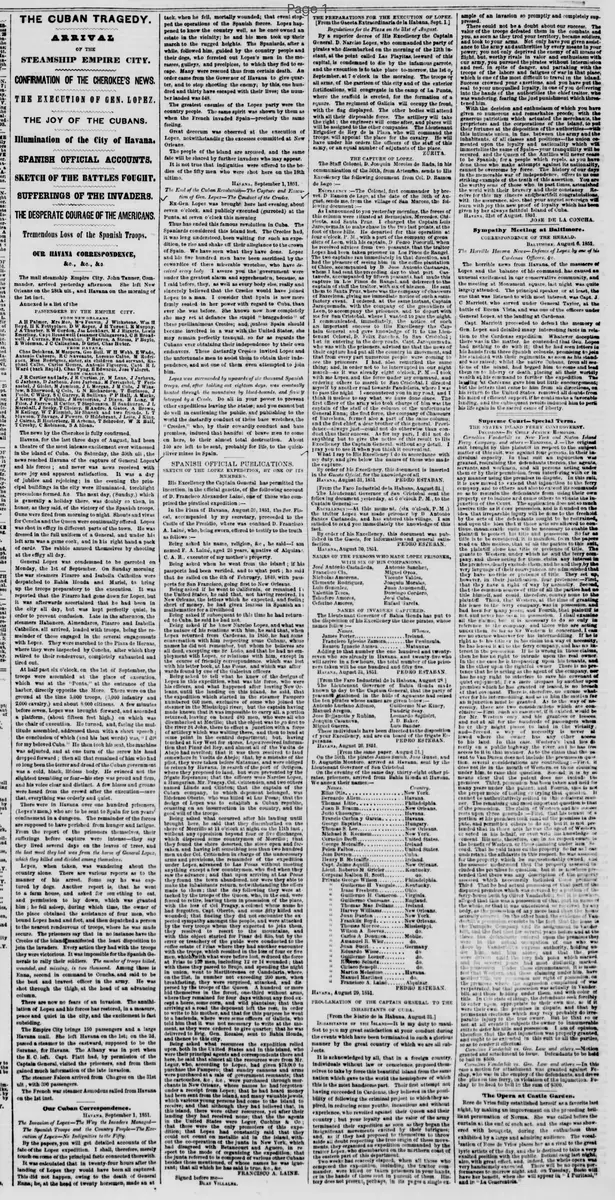
1 of 2
OCR Quality
Full Text
The mail steamship Empire City, John Tanner, Commander, arrived yesterday afternoon. She left New Orleans on the 28th ult., and Havana on the morning of the 1st inst. Annexed is a list of the PASSENGERS BY THE EMPIRE CITY.
FROM NEW ORLEANS
A. H. Palmer, Mrs. Mee, Mrs. Fenwick, J. Wickstone, Wm. H. Boyd, H. K. Fettyplace, D. W. Roper, J. H. Turnell, R. Murphy, J. A. Thurber, R. W. Gordon, Jas. Lockhart, M. J. Rigarta, Lewis Emerling, Capt. Broadwell (steamer Chinguarora), C. B. Broadwell, J. Curran, Mrs. Donahue, P. Barron, & Stross, P. Boyle, E. Wideman, J. C. Callaghan, D. Grief, Chas. Huter.
FROM HAVANA.
Chas. Dickens, M. Maspera, Geo. Bell, W. H. Webb, E. Wade, Antonio Cabrero, R. C. Navarrete, Lorenzo Calvo, M. Rodriguez, auez, Miss Rodriguez, sister, six children and servant, Raphael Calvo, Carlos Gomez, Antonio Figueroa, Capt. Ward (bark Rapid), Chas. Tyng, E. Edwards, Jose Valdes.
FROM CHAGRES
J. R. Curtis and lady, J. R. Curtis, jr., M. Lane, J. Jarhean, G. Jarhean, D. Jarhean, Jose Jarhean, M. Feriazebel, T. Feriazebel, J. Giolet, M. Jamison, J. L. Morgan, J. M. Cole, J. Winslow, S. Sherwood, Q. Cole, L. N. Richardson, T. Berinson, J. Poole, C. Wiley, S. C. Garrey, R. Sullivan, P. P. Hall, A. Marks, J. Kerron, F. Quablin, J. Montecrian, J. Dixon, M. Long, W. Filer, J. Farrow, H. Cutler, T. Stephenson, H. Sandburne, J. L. Marshall, J. Seoby, T. Cloisey, H. Andre, A. Gates, A. Brown, M. Kellogg, W. T. Flemish, Mr. Shanck and two friends, L. T. Slawson, T. Savage, J. Powers, O. Hildebrandt, J. Leitz, J. King, J. Cairns, B. Hosterberg, H. Arbems, T. Schroder, W. R. Ball, T. Crosby, C. Robinson, S. A. Sloan.
The news by the Cherokee is fully confirmed. Havana, for the last three days of August, had been a theatre of the most intense excitement ever witnessed in the island of Cuba. On Saturday, the 30th ult., the news reached Havana of the capture of General Lopez and his forces; and never was news received with more joy and apparent satisfaction. It was a day of jubilee and rejoicing; in the evening the principal buildings in the city were illuminated, torchlight processions formed, &c. The next day, (Sunday,) which is generally a holiday there, was doubly so then, in honor, as they said, of the victory of the Spanish troops. Guns were fired from morning till night. Shouts and vivas for Concha and the Queen were continually offered. Lopez was shot in effigy in different parts of the town. He was dressed in the full uniform of a General, and under his left arm was a game cock, and in his right hand a pack of cards. The rabble amused themselves by shooting at the effigy all day.
General Lopez was condemned to be garroted on Monday, the 1st of September. On Sunday morning the war steamers Pizarro and Isabella Catholica were despatched to Bahia Honda and Mariel, to bring up the troops preparatory to the execution. It was reported that the Pizarro had gone down for Lopez, but it was afterwards ascertained that he had been in the city all day, but was kept perfectly quiet, in order to prevent confusion. Late in the afternoon, the steamers Habanero, Almendares, Pizarro and Isabella Catholica, all arrived, loaded with troops, being the remainder of those engaged in the several engagements with Lopez. They were marched to the Plaza de Armas, where they were inspected by Concha, after which they retired to their rendezvous, completely exhausted and tired out.
At half-past six o'clock, on the 1st of September, the troops were assembled at the place of execution, which was at the "Punta," at the entrance of the harbor, directly opposite the Moro. There were on the ground at the time 5,000 troops, (3,000 infantry and 2,000 cavalry,) and about 800 citizens. A few minutes before seven, Lopez was brought forward, and ascended a platform, (about fifteen feet high,) on which was the chair of execution. He turned, and, facing the multitude assembled, addressed them with a short speech: the conclusion of which (and his last words) was, "I die for my beloved Cuba." He then took his seat, the machine was adjusted, and at one turn of the screw his head dropped forward; then all that remained of him who had so long been the terror and dread of the Cuban government was a cold, black, lifeless body. He evinced not the slightest trembling or fear—his step was proud and firm, and his voice clear and distinct. A few hisses and groans were heard from the crowd after the execution—save that, everything was orderly and quiet.
There were in Havana over one hundred prisoners. (Lopez's men,) who are to be sent to Spain for ten years' confinement in a dungeon. The remainder of the forces are supposed to have perished from hunger and fatigue. From the report of the prisoners themselves, their sufferings before capture were intense—they say they lived several days on the leaves of trees, and the last meal they had was from the horse of General Lopez, which they killed and divided among themselves. Lopez, when taken, was wandering about the country alone. There are various reports as to the manner of his arrest. Some say he was captured by dogs. Another report is, that he went to a farm house, and asked for something to eat, and permission to lay down, which was granted him: he fell asleep, during which time, the owner of the place obtained the assistance of four men, who bound Lopez hand and foot, and then despatched a person to the nearest rendezvous of troops, where he was made secure.
The prisoners say that in no instance have the Creoles of the island manifested the least disposition to join the invaders. Every action they had with the troops they were victorious. It was impossible for the Spanish Generals to rally their soldiers. The number of troops killed, wounded, and missing, is two thousand. Among these is Enna, second in command to Concha, and said to be the best and bravest officer in the army. He was shot through the thigh, at the head of an advancing column.
There are now no fears of an invasion. The annihilation of Lopez and his forces has restored, in a measure, peace and quiet in the city, and the excitement is fast subsiding. The Empire City brings 150 passengers and a large Havana mail. She left Havana on the 1st; on the 2d, passed a steamer to the eastward, supposed to be the Saranac, for Havana. The Albany was in port when the E. C. left. Capt. Platt had, by permission of the Captain General, visited the prisoners, and from them gained much information of the late invasion. The steamer Falcon arrived from Chagres on the 31st ult., with 300 passengers. The French war steamer Asmodeus sailed from Havana on the 1st inst.
Our Cuban Correspondence.
Havana, September 1, 1851.
The Invasion of Lopez—The Way the Invaders Managed— The Spanish Troops and the Country People—The Execution of Lopez—No Indignities to the Fifty
By the papers, you will get detailed accounts of the fate of the Lopez expedition. I shall, therefore, merely touch on some of the principal facts connected therewith. It was calculated that in twenty-four hours after the landing of Lopez they would have been all captured. This did not happen, owing to the death of General Enna; he, at the head of twenty horsemen, made an attack, when he fell, mortally wounded; that event stopped the operations of the Spanish forces. Lopez happened to know the country well, as he once owned an estate in the vicinity; he and his men took up their march to the rugged heights. The Spaniards, after a while, followed him, guided by the country people and their dogs, who ferreted out Lopez's men in the morasses, gulleys, and precipices, to which they fled to escape. Many were rescued thus from certain death. An order came from the Governor of Havana to give quarter, and to stop shooting the enemy; by this, one hundred and thirty have escaped with their lives; the number landed was 548.
The greatest enemies of the Lopez party were the country people. The same spirit was shown by them as when the French invaded Spain—precisely the same feeling. Great decorum was observed at the execution of Lopez, notwithstanding the excesses committed at New Orleans. The people of the island are aroused, and the same fate will be shared by further invaders who may appear. It is not true that indignities were offered to the bodies of the fifty men who were shot here on the 16th ultimo.
Havana, September 1, 1851.
The End of the Cuban Revolution—The Capture and Execution of Gen. Lopez—The Conduct of the Creoles.
Ex-Gen. Lopez was brought here last evening, about seven o'clock, and publicly executed (garroted) at the Punta, at seven o'clock this morning Thus has ended this famous revolution in Cuba. The Spaniards considered this island lost. The Creoles had, it was long understood, been waiting for such an expedition, to rise and shake off their allegiance to the crown of Spain. We have seen what they have done. Lopez and his five hundred men have been sacrificed by the cowardice of these miserable wretches, who have deceived every body. I assure you the government were under the greatest alarm and apprehension, because, as I said before, they, as well as every body else, really and sincerely believed that the Creoles would have joined Lopez to a man. I consider that Spain is now more firmly seated in her power with regard to Cuba, than ever she was before. She knows now how completely she may set at defiance the stupid "braggadocio" of these pusillanimous Creoles; and, unless Spain should become involved in a war with the United States, she may remain perfectly tranquil, so far as regards the Cubans ever obtaining their independence by their own endeavors.
These dastardly Creoles invited Lopez and the unfortunate men to assist them to obtain their independence, and not one of them even attempted to join him. Lopez was surrounded by upwards of six thousand Spanish troops, and, after holding out eighteen days, was eventually hunted through the mountains by blood-hounds, and finally betrayed by a Creole. Do all in your power to prevent other expeditions leaving the states; and you cannot but do well in cautioning the public, and publishing to the world the dastardly conduct of these base wretches, the "Creoles," who, by their cowardly conduct and base promises, induced that handful of brave men to come on here, to their almost total destruction. About 140 are left to be sent, probably for life, to the quick silver mines in Spain.
SPANISH OFFICIAL PUBLICATIONS.
SKETCH OF THE LOPEZ EXPEDITION, BY ONE OF ITS MEMBERS.
His Excellency the Captain General has permitted the insertion, in the official gazette, of the following account of D. Francisco Alexander Laine, one of those who comprised the piratical expedition:—
In the Plaza of Havana, August 30, 1851, the Senor Fiscal, accompanied by my secretary, proceeded to the Castle of the Presidio, where was confined D. Francisco A. Laine, who, being sworn, offered to testify to the truth as follows:—
Being asked his name, religion, &c., he said—I am named F. A. Laine, aged 26 years, native of Alquiza: C. A. K., executor of my mother's property. Being asked when he went from the island; if his passports had been verified, and to what port; he said that he sailed on the 4th of February, 1849, with passports for San Francisco, going first to New Orleans. Being asked if he went to California, or remained in the United States, he said that, not having received, in New Orleans, the letters which he expected, and feeling short of money, he had given lessons in Spanish and mathematics for a livelihood Being asked if subsequent to this time he had returned to Cuba, he said he had not. Being asked if he knew Narciso Lopez, and what was the nature of his relations with him, he said that, when Lopez returned from Cardenas, in 1850, he had some conversation with him respecting some Cubans, whose names he did not remember, but whom he believes are all dead, excepting one Sr. Lopez, and that he had no employment with Lopez, or relations with him, except in the course of friendly correspondence, which was lost with his letter book, at Las Posas, and which was afterwards found by one of the Galician officers Being asked to tell what he knew of the designs of Lopez in this expedition, what was his force, who were his officers, and what happened after leaving New Orleans, until the landing on this island, he said, that the expedition which started in the steamer Pampero numbered 400 men, exclusive of some who joined the steamer in the Mississippi river; but the captain having made known that it was impossible to carry all, a portion returned, leaving on board 450 men, who were all who disembarked at Morillo; that the object was to go first to the river St. John, there to effect a junction with a force of artillery which was waiting there, and then to land at some point in the central department; but, having touched at Key West for stores, Lopez received information that Pinar del Rio, and almost all of the Vuelta de Abejo had revolted; that it was then resolved to land somewhere in Vuelta de Abejo; that, by a mistake of the pilot, they were taken before Matanzas, and were obliged to return by Havana, in search of the port of Ortigosa, where they proposed to land, but were prevented by the frigate Esperanza; that the officers were Narciso Lopez, a Hungarian, Mr. Pragay, Col. Crittenden, and two others named Llinds and Clinton; that the captain of the Cuban company, to which deponent belonged, was Ildefonso Oberto, who was killed at Las Posas; that the design of Lopez was to establish a Cuban republic, counting on an insurrection in the country, and the good will of the troops.
Being asked what occurred after his landing until brought here, he said that they disembarked on the shore of Morrillo at 11 o'clock at night on the 11th inst., without any opposition beyond four or five discharges, which dispersed some countrymen of Morrillo; that they found the shore deserted, the store open and forsaken, and having left something less than two hundred men under Col. Crittenden in charge of the unnecessary arms and provisions, the remainder of the expedition under Lopez, advanced to Las Posas without meeting anything except a few countrymen, who fled when they saw the advance; and that upon arriving at Las Posas they found the town abandoned, nor were they able to make the inhabitants return, notwithstanding the offers made to them; that the day following they were attacked by the troops of the Queen, who, in the end, were forced to retire, leaving them in possession of the place, with the loss of Col. Pragay, a colonel whose name he had forgotten, Capt. Oberto, and some fifty killed and wounded; that finding they did not encounter the expected sympathy amongst the people, and were attacked by the very troops whom they expected to join them, they resolved to resort to the mountains, and with this object started for Pinar del Rio, but by the error or treachery of the guide were conducted to the coffee estate of Frias where they had another encounter with the troops, which resulted in the loss of four or five men, which, with what were before lost, reduced the force at Frias to 220 men, including 12 or 14 wounded; that with these they passed to Brujo, and spending the night in union, went to Marti Tornea or Candelaria, where, on the 21st, in number not exceeding 200 men, when breakfasting, they were surprised, attacked, and dispersed by the troops of the Queen A hundred or more hid themselves in the forest, one-third without arms, where they remained for four days without any food except a horse, some corn, and wild plantains; that then arriving at a road the deponent left the rest, in order to write to his mother, and that for this purpose he went to a hacienda, where were some officers of Galicia, who told him that it was not necessary to write at the moment, as they were ordered to give quarter; that he was delivered to Brig. Gen. Rosales; sent to Bahia Honda and thence to this city.
Being asked what resources the expedition relied upon, both in the United States and in this island, who were their principal agents and correspondents there and here, he said that almost all the resources were from Mr. Legue, who, according to Lopez, had given $75,000 to purchase the Pampero; that sundry cannons and arms were purchased at a sale of government remnants; that the cartouches, &c., &c., were purchased through merchants in New Orleans, whose names he had forgotten under a receipt from Lopez; that he had heard money had been sent from the island, and many valuable jewels, which various young persons had come to the island to receive; and that although they had believed that, in this island, there were other resources, yet after their landing they had received none; that the agents in the United States were Legue, Cuchins & Co; that these were the only promoters of this expedition; that Lopez had constantly said that they could not count on metallic aid in the island, without the co-operation of the junta in New York, which had disagreed with Betancourt and Aguero, in respect to the mode of organizing the expedition, that the junta referred to is composed of various other Cubans besides those mentioned, of whose names he was ignorant; that all which he has said is true, &c., &c.
Francisco A. Laine
Sworn before me—
Blas Villalva,
| WITH SIX OF HIS COMPANIONS. | |
| José Antonio Castaneda, | Antonio Sanchez, |
| Francisco Cia, | Miguel Oyoa, |
| Nicholas Amorena, | Vicente Valdes, |
| Clemente Rodriguez, | Joaquín Morales, |
| Luis Gonzalez, | Juan Asusmendi, |
| Valentin Tesca, | Domingo Cordero, |
| Teleforo Amores, | José Cuba, |
| Céferino Amores, | Rafael García |
THE PREPARATIONS FOR THE EXECUTION OF LOPEZ.
[From the Gaceta Extraordinaria de la Habana, Sept. 1.]
Regulations for the Plaza on the 31st of August.
By a superior decree of His Excellency the Captain General, D. Narciso Lopez, who commanded the party of pirates who disembarked on the morning of the 12th instant, at the point called Las Playitas, leeward of this capital, is condemned to die by the infamous garrote, and the execution is to take place to-morrow, the 1st of September, at 7 o'clock in the morning. The troops of all arms, of the garrison of this city and of the exterior fortifications, will congregate in the camp of La Punta, where the scaffold is erected, for the formation of a square. The regiment of Galicia will occupy the front, with the flag displayed. The other bodies will attend with all their disposable force. The artillery will take the right: the engineers will come after, and places will be assigned to the other companies. The Lieutenant Brigadier de Rey de la Plaza, who will command the troops, will appoint the place for the cavalry. He will have under his orders the officers of the staff of this army, or an equal number of adjutants of the place.
ZURITA.
THE CAPTURE OF LOPEZ.
The Staff Colonel, D. Joaquin Moroles de Rada, in his communication of the 30th, from Artemisa, sends to His Excellency the following document from Col. D. Ramon de Lago:—
Excellency: The Colonel, first commander by brevet, D. Ramon de Lago, at the date of the 30th of August, sends me, from the village of San Marcos, the following document:—
As I announced to you yesterday morning, the forces of this column were situated at Bermejales, Mercedes, Chiricota, and Santa Cruz. I charged the Captain Luis Jarequemada to make chase in the two last points, at the foot of those hills. He departed for this operation at four o'clock, P. M., with a part of the company of grenadiers of Leon, with his captain, D. Pedro Pocorull, when he received advices from two peasants, that the traitor Lopez had been taken prisoner in Los Pinos de Rangel. The two captains ran immediately in that direction, and had the pleasure of seeing him in the coffee plantation of Chico, accompanied by D. Jose Antonio Castaneda, whom I had sent the preceding day to that part. Castaneda, accompanied by fifteen peasants, had made this capture in Los Pinos de Rangel, and delivered to the captain of staff the traitor, with six of his men. He sent them to Santa Cruz, where was the company of chasseurs of Barcelona, giving me immediate notice of such a satisfactory event. I ordered, at the same instant, Captain Jarequemada, with the company of the grenadiers of Leon, to accompany the prisoners, and to depart with me for San Cristobal, where I wanted to pass the night. I communicated, immediately, the notice of such an important success to His Excellency the Captain General and gave knowledge of it to the Lieutenant Colonel, D. Felix Sanchez, in San Cristobal; but in entering in the deep roads, Capt. Jarequemada, who was with the prisoners, advised me that the news of their capture had put all the country in movement, and that from every part numerous people were coming to see the prisoners. I had also remarked the same thing; and, in order not to be interrupted in our night march—as it was already eight o'clock, P. M.—I took with me Lopez, and the force under my command, and ordering others to march to San Cristobal, I directed myself by another road towards Candelaria, where I was to pass the night. I encountered you in my road, and I think it useless to say what we have done since.
The first officer of the army who took charge of him was the captain of the staff of the column of the unfortunate General Enna; the first force, the company of Chasseurs of Barcelona, formed also a part of the same column; and the first chief, a dear brother of this general. Providence—always just—could not do otherwise than conduct thus their success. As for my part, I did not do anything but to give the notice of this result to His Excellency the Captain General, without any detail. I pray you to use it when you think it convenient. What I say to His Excellency I do in accordance with my duty, and give below the names of those who made the capture.
By order of his Excellency, this document is inserted in the Gaceta Oficial, for the knowledge of all Havana, August 31, 1851
PEDRO ESTEBAN.
[From the Faro Industrial de la Habana, August 31.]
The Lieutenant Governor of San Cristobal sent the following document yesterday, at 6 o'clock P. M., to the Captain General:—
Excellency:—At this moment, (six o'clock, P.M.) the traitor Lopez was made prisoner by D. Antonio Santos Castaneda, and has entered this village. I am satisfied to send you immediately the knowledge of this fact.
By order of his Excellency, this document was published in the Gaceta, for information and general satisfaction.
PEDRO ESTEBAN.
Havana, August 30, 1851.
NAMES OF THE PERSONS WHO MADE LOPEZ PRISONER.
NAMES OF INVADERS CAPTURED.
The Lieutenant Governor of Bahia Honda has put to the disposition of his Excellency the three pirates, whose names follow:—
Names. Whence.
James Porter.............. Ireland.
Francisco Iglesias Zamora........the Peninsula
Ramon Ignacio Amasa. ...... Matanzas
Adding to that number the one hundred and twenty-seven who are already in Havana, and twenty five who will arrive in a few hours, the total number of the prisoners taken will be one hundred and fifty five
Havana, August 31, 1851.
PEDRO ESTEBAN.
[From the Faro Industrial de la Habana, August 28 ]
The Lieutenant Governor of Bahia Honda made known to day to the Captain General, that the party of peasants stationed in the hills of Auguste had seized the ten pirates whose names are given below:—
Antonio Luciano Alfonso, Guillermo Mac Kincy
Manuel Aragon, Patrick Seay.
Jose Boijanotie y Rubina, Leonardo Sujllolrt,
Joaquin Casanova, J.D. Baker,
Miguel Guerra, Luis Bapder
These individuals have been directed to the disposition of your Excellency, and are on board of the frigate Esperanza.
PEDRO ESTEBAN.
Havana, August 26, 1851.
[From the same paper, August 31.]
On the 30th, the pirates James Smith, Jose Gunst, and D. Augustin Montoro, arrived at Havana, sent by the Lieutenant Governor of San Cristobal On the evening of the same day, thirty-eight other pirates, prisoners, arrived from Bahia Honda at Havana. We annex their names:—
Havana, August 29, 1851.
PROCLAMATION OF THE CAPTAIN GENERAL TO THE INHABITANTS OF CUBA.
[From the Diario de la Habana, August 31.]
Inhabitants of The Island—It is my duty to manifest to you my great satisfaction at your conduct during the events which have been terminated in such a glorious manner by the great country of which we are all subjects. It is acknowledged by all, that in a foreign country individuals without law or conscience, proposed themselves to take by force this beautiful island from the same nation which gave to the world the hemisphere of which this is the most handsome part. Their first attempt not having succeeded in Cardenas, they believed in the possibility of following the criminal project to which they aspired, in seducing some youths, incautious and without experience, who revolted against their Queen and their country; but your loyalty and the valor of the army terminated their expedition as soon as they began the insignificant movements excited by their intrigues; and, as if they had proposed to themselves to throw aside all doubt respecting the true origin of these movements, they organized an expedition commanded by the traitor Lopez, who disembarked on the northern coast of the eastern part of this department. Two weeks had scarcely elapsed, when all those who composed the expedition, including the traitor commander, were killed or taken prisoners in your hands, or in the hands of those sent in pursuit of them. History does not present, perhaps, in its pages a single example of an invasion so promptly and completely suppressed. There could not be a doubt about our success. The valor of the troops defeated them in the combats, and you, as soon as they trod your territory, became soldiers, and took to your arms. Not only have you given assistance to the army and authorities by every means in your power; you not only deprived the enemy of all means of flight, but, worthy rivals in valor and enthusiasm with our army, you pursued the pirates without intermission and rest, in spite of danger, and partaking with the troops of the labors and fatigues of war in that place, which is one of the most difficult to travel in the island. Success crowned your exertions, and you have put the seal to your unequalled loyalty, in one of you delivering into the hands of the authorities the chief traitor, who was wandering, fearing the just punishment which threatened him. With the decision and enthusiasm of which you have given so numerous and remarkable proofs; with the generous patriotism which actuated the merchants, the proprietors and the corporations of the island, to put their fortunes at the disposition of the authorities—with this intimate union, in fine, between the army and the inhabitants, of all classes and positions—the union cemented upon the loyalty and nationality which will immortalize the name of Spain—your tranquillity will be secured, and the Queen of the Antilles will never cease to be Spanish; for a people which repels, as you have done those who make attempts against its nationality, cannot be overcome by force. The history of our day in the memorable war of independence, offers to us one striking example of the truth of this assertion. You are the worthy sons of those who, in past times, astonished the world with their bravery and their constancy. Receive for this my sincere and heartfelt congratulations with the assurance, also, that your august sovereign will learn with joy this new proof of loyalty which has been given by her always faithful Island of Cuba.
Havana, 31st of August, 1851
JOSE DE LA CONCHA.
| Kilas Otis | New York. |
| Bernardo Allem | Havana. |
| Thomas Litte | Philadelphia. |
| Juan B. Braum | New Orleans. |
| Julio Chassagne | Havana. |
| Francis Curbia y Gareia | Havana. |
| George Baptista | Hungary. |
| Thomas S. Lee | New Orleans. |
| Michael S. Keem | New York. |
| Cornelio Derft | United States. |
| George Metcalfe | Ireland. |
| Pelen Falbos | United States. |
| Jose Dovren | Cuba. |
| Ilenry B. Metcalfe | Ireland. |
| Capt. Jaime Aquilli | New Orleans. |
| Lieut. Roberto M. Gricier | Kentucky. |
| Corperal Malbon H. Scott | ao. |
| Private George Wilson | Philadelphia. |
| Guilermo H. Vaugale | Kentucky. |
| Isaac Freeborn | Ohio. |
| Guillermo H. Cameron | Virginia. |
| Guillermo Caussans | England. |
| Thomas Mac Dellans | Ireland. |
| Harvey Williams | New Orleans. |
| Juan Danton | New York. |
| Franklin Boyd | New Orleans. |
| Thomas Morroe | Mississippi. |
| Wilson A. Reeves | do. |
| Carlos A. Donumen | Mobile. |
| Amanuel R. Wier | do. |
| Juan Suci | Germany. |
| Eduardo Wisse | do. |
| Guillermo Losner | do. |
| Roberto Seluzzi | do. |
| Cirisco Senepli | do. |
| Martin Melesimo | Havana. |
| Manuel Martinez | do. |
| Francesco A. Laine | Alguizar. |
| PEDRO ESTESAN. |
Sympathy Meeting at Baltimore.
CORRESPONDENCE OF THE HERALD.
Baltimore, August 6, 1851.
The Horrible Havana News—Defence of Lopez by one of his Cardenas Officers, &c.
The horrible news from Havana, of the massacre of Lopez and the balance of his command, has caused an unusual excitement in our conservative community, and the meeting at Monument square, last night was quite largely attended. The principal speaker or at least, the one that was listened to with most interest, was Capt. J. C. Marriott, who served under General Taylor, at the battle of Buena Vista, and was one of the officers under General Lopez, at the landing at Cardenas. Capt. Marriott proceeded to defend the memory of Gen. Lopez and detailed many interesting facts in relation to the Cardenas expedition. Whatever deception there was in the matter, he contended that Gen. Lopez had nothing to do with it; that he had seen letters in his hands from three Spanish colonels, promising to join his standard with their regiments as soon as his standard was raised; whilst the native Cubans, from all sections of the island, had begged him to come and lead them on to liberty or death, placing all their worldly wealth at his command to further the expedition. The landing at Cardenas gave him but little encouragement; but the letters that came to him from all directions, on his return to the United States, removed all doubts from his mind of efficient support, if he could make a favorable landing, and the subsequent revolts induced him to peril his life again in the sacred cause of liberty.
Arrival of the Empire City-Confirmation
of Previous News-Annihilation of the Lo-
pez Invasion.
By the arrival of the steamship Empire City at
this port, yesterday, we received confirmation of
the news from Cuba, which we published in yester-
day's paper, and which was conveyed to New Or-
leans by the steamer Cherokee.
All doubt is now at an end in regard to the fate
of the expedition which sailed from New Orleans,
under the command of General Lopez. We have
at length received reliable intelligence concerning
the invading army; and of a melancholy character
it is. Numbers were killed; many were captured,
and are about being sent to Spain, and Lopez
himself has been garroted. Of this there can be no
question. Thus has ended the expedition of the
Pampero.
We cannot but feel for the friends of the brave
spirits who lost their lives in this ill-judged attempt
to accomplish Cuban independence. He who says
that a majority of them were not actuated by the
best and holiest of motives, in our opinion says
what is not true. They were unsuccessful-they
were mistaken-they placed too much reliance on
the reports that reached them of the willingness of
the creoles to rise as soon as they landed, and
strike for independence. In such matters a mis-
take is worse than a crime. Indeed, there is the
best reason to believe that Lopez himself was de-
ceiv ed. That he was a brave man-rashly brave—no one can deny.
The creoles of Cuba either do not wish indepen-
dence, or they wish it, but are too cowardly to run
any risk in obtaining it. They may wish it, but
they may not be willing to peril their lives in
struggling for it. They may wish to hire out the
acquisition of liberty as a job. Our citizens are not
Hessians, and when the time comes, as come it will
in the nature of things, when Cuba will be incor-
porated with the United States, the creoles will not
be consulted in the matter. There is every reason
to suppose that the men composing the expedition
which sailed in the Pampero, were lured to under-
take it by creole promises and creole professions.
Faith was broken; and, no doubt those who glori-
fied and huzzaed most at the execution of the Ame-
ricans at Havana, contributed most to waris fitting
out the expedition.
The whole affair was a cruel deception, from the
commencement to the end.
What sub-type of article is it?
What keywords are associated?
What entities or persons were involved?
Where did it happen?
Foreign News Details
Primary Location
Havana, Cuba
Event Date
August 11 September 1, 1851
Key Persons
Outcome
lopez executed by garrote on september 1; approximately 400 of 548 invaders killed or died from hardship; over 100 prisoners captured and to be sent to spain for imprisonment; spanish losses: 2,000 killed, wounded, missing including gen. enna wounded; no creole support, invasion suppressed.
Event Details
Narciso López led 450 filibusters from New Orleans on the Pampero, landing near Morillo, Cuba on August 11, 1851, expecting Creole uprising and troop defections. They captured Las Posas briefly but faced Spanish resistance, retreated to mountains, suffered battles at Frias and Candelaria, dispersed on August 21. López captured August 30 by peasants led by Jose Antonio Castaneda, executed publicly in Havana September 1 before 5,000 troops. Creoles and locals aided Spanish forces; public celebrations in Havana.