Thank you for visiting SNEWPapers!
Sign up free
The New Hampshire Gazette
Portsmouth, Rockingham County, New Hampshire
What is this article about?
French General Kleber reports to the Directory on signing a treaty for the evacuation of Egypt on January 30, 1800, amid Ottoman advances, lack of French reinforcements, and internal threats. He details the dire military situation, a victory at Damietta, and negotiations via Sir Sydney Smith.
Clipping
OCR Quality
Full Text
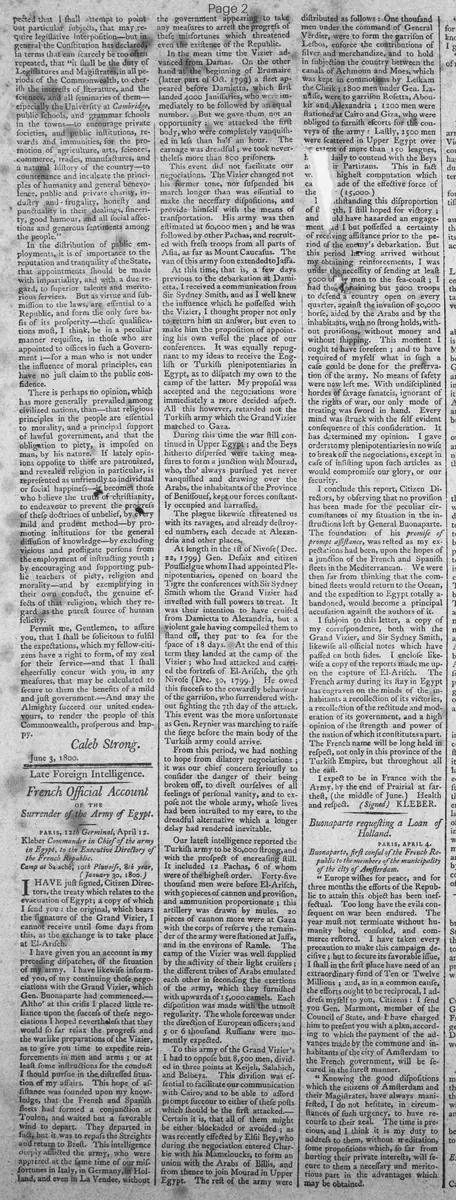
French Official Account
OF THE
Surrender of the Army of Egypt.
PARIS, 12th Germinal, April 12.
Kleber Commander in Chief of the army in Egypt, to the Executive Directory of the French Republic.
Camp at Salaché, 10th Pluviose, 8th year, (January 30, 1800.)
I HAVE just signed, Citizen Directors, the treaty which relates to the evacuation of Egypt; a copy of which I send you : the original, which bears the signature of the Grand Vizier, I cannot receive until some days from this, as the exchange is to take place at El-Arish.
I have given you an account in my preceding dispatches, of the situation of my army. I have likewise informed you, of my continuing those negotiations with the Grand Vizier, which Gen. Buonaparte had commenced.
Altho' at this crisis I placed little reliance upon the success of these negotiations I hoped nevertheless that they would so far relax the progress and the warlike preparations of the Vizier, as to give you time to expedite reinforcements in men and arms ; or at least some instructions for the conduct I should pursue in the distressed situation of my affairs. This hope of assistance was founded upon my knowledge, that the French and Spanish fleets had formed a conjunction at Toulon, and waited but a favorable wind to depart. They departed in fact, but it was to repass the Straits and return to Brest. This intelligence deeply afflicted the army, who were apprized at the same time of our misfortunes in Italy, in Germany, in Holland, and even in La Vendee, without the government appearing to take any measures to arrest the progress of these misfortunes which threatened even the existence of the Republic.
In the mean time the Vizier advanced from Damascus. On the other hand at the beginning of Brumaire (latter part of Oct. 1799) a fleet appeared before Damietta, which first landed 4000 Janizaries, who were immediately to be followed by an equal number. But we gave them not an opportunity : we attacked the first body, who were completely vanquished in less than half an hour. The carnage was dreadful ; we took nevertheless more than 800 prisoners.
This event did not facilitate our negotiations. The Vizier changed not his former tone, nor suspended his march longer than was essential to make the necessary dispositions, and provide himself with the means of transportation. His army was then estimated at 60,000 men; and he was followed by other Pachas, and recruited with fresh troops from all parts of Asia, as far as Mount Caucasus. The van of this army soon extended to Jaffa.
At this time, that is, a few days previous to the debarkation at Damietta, I received a communication from Sir Sydney Smith, and as I well knew the influence which he possessed with the Vizier, I thought proper not only to return him an answer, but even to make him the proposition of appointing his own vessel the place of our conferences. It was equally repugnant to my ideas to receive the English or Turkish plenipotentiaries in Egypt, as to dispatch my own to the camp of the latter. My proposal was accepted and the negotiations wore immediately a more decided aspect.
All this however, retarded not the Turkish army which the Grand Vizier marched to Gaza.
During this time the war still continued in Upper Egypt ; and the Beys hitherto dispersed were taking measures to form a junction with Mourad, who, tho' always pursued yet never vanquished and drawing over the Arabs, the inhabitants of the Province of Benisouef, kept our forces constantly occupied and harassed.
The plague likewise threatened us with its ravages, and already destroyed numbers, each decade at Alexandria and other places.
At length in the 1st of Nivose (Dec. 22, 1799) Gen. Desaix and citizen Pouffielgue whom I had appointed Plenipotentiaries, opened on board the Tigre the conferences with Sir Sydney Smith whom the Grand Vizier had invested with full powers to treat. It was their intention to have cruised from Damietta to Alexandria, but a violent gale having compelled them to stand off, they put to sea for the space of 18 days. At the end of this term they landed at the camp of the Vizier : who had attacked and carried the fortress of El-Arish, the 9th Nivose (Dec. 30, 1799.) He owed this success to the cowardly behaviour of the garrison, who surrendered without fighting the 7th day of the attack.
This event was the more unfortunate as Gen. Reynier was marching to raise the siege before the main body of the Turkish army could arrive.
From this period, we had nothing to hope from dilatory negotiations ; it was our chief concern seriously to consider the danger of their being broken off, to divest ourselves of all feelings of personal vanity, and to expose not the whole army, whose lives had been intrusted to my care, to the dreadful alternative which a longer delay had rendered inevitable.
Our latest intelligence reported the Turkish army to be 80,000 strong, and with the prospect of increasing still. It included 12 Pachas, 6 of whom were of the highest order. Forty-five thousand men were before El-Arich, with 50 pieces of cannon and provision, and ammunition proportionate ; this artillery was drawn by mules. 20 pieces of cannon more were at Gaza with the corps of reserve; the remainder of the army were stationed at Jaffa, and in the environs of Ramle. The camp of the Vizier was well supplied by the activity of their light cruizers ; the different tribes of Arabs emulated each other in seconding the exertions of the army, which they furnished with upwards of 15,000 camels. Each disposition was made with the utmost regularity. The whole force was under the direction of European officers; and 5 or 6 thousand Russians were momentarily expected.
To this army of the Grand Vizier's I had to oppose but 13,500 men, divided in three points at Keir, Salahieh, and Belbeis. This division was essential to facilitate our communication with Cairo, and to be able to afford prompt succour to either of these posts which should be the first attacked.
Certain it is, that all of them might be either blockaded or avoided ; as was recently effected by Elfi Bey, who during the negotiation entered Cairo with his Mamelukes, to form an union with the Arabs of Bilbeis, and from thence to join Mourad in Upper Egypt. The rest of the army were distributed as follows : One thousand men under the command of General Verdier, were to form the garrison of Damietta, enforce the contributions of silver and merchandize, and to hold in subjection the country between the canals of Achmoun and Moes, which was kept in commotions by Leskam the Sheik : 1800 men under Gen. Lanies, were to garrison Rosetta, Aboukir and Alexandria ; 1200 men were stationed at Cairo and Giza, who were obliged to furnish escorts for the convoys of the army : Lastly, 2500 men were scattered in Upper Egypt over an extent of more than 150 leagues, daily to contend with the Beys and their Partizans.
This in fact was the highest computation which could be made of the effective force of the army—(13,000.)
Notwithstanding this disproportion of force, I still hoped for victory ; and would have hazarded an engagement had I but possessed a certainty of receiving assistance prior to the period of the enemy's debarkation. But this period having arrived without my obtaining reinforcements, I was under the necessity of sending at least 5000 of my men to the sea-coast ; I had then remaining but 3000 troops to defend a country open on every quarter, against the invasion of 30,000 horse, aided by the Arabs and by the inhabitants, with no strong holds, without provisions, without money and without shipping. This moment I ought to have foreseen ; and to have required of myself what in such a case could be done for the preservation of the army. No means of safety were now left me. With undisciplined hordes of savage fanatics, ignorant of the rights of war, our only mode of treating was sword in hand. Every mind was struck with the self-evident consequence of this consideration. It has determined my opinion. I gave orders to my plenipotentiaries in no wise to break off the negotiations, except in case of insisting upon such articles as would compromise our glory, or our security.
I conclude this report, Citizen Directors, by observing that no provision has been made for the peculiar circumstances of my situation in the instructions left by General Buonaparte. The foundation of his promise of prompt assistance, was rested as my expectations had been, upon the hopes of a junction of the French and Spanish fleets in the Mediterranean. We were then far from thinking that the combined fleets would return to the Ocean, and the expedition to Egypt totally abandoned, would become a principal accusation against the authors of it.
I subjoin to this letter, a copy of my correspondence, both with the Grand Vizier, and Sir Sydney Smith, likewise all official notes which have passed on both sides. I enclose likewise a copy of the reports made me upon the capture of El-Arish. The French army during its stay in Egypt has engraven on the minds of the inhabitants a recollection of its victories, a recollection of the rectitude and moderation of its government, and a high opinion of the strength and power of the nation of which it constitutes a part. The French name will be long held in respect, not only in this province of the Turkish Empire, but throughout all the east.
I expect to be in France with the Army, by the end of Prairial at farthest, (the middle of June.) Health and respect. (Signed) KLEBER.
What sub-type of article is it?
What keywords are associated?
What entities or persons were involved?
Where did it happen?
Foreign News Details
Primary Location
Egypt
Event Date
January 30, 1800
Key Persons
Outcome
treaty signed for evacuation of egypt; french army to return to france by mid-june 1800; 800 ottoman prisoners taken at damietta with heavy casualties; el-arish fortress captured by ottomans.
Event Details
Kleber reports signing a treaty for evacuating Egypt due to Ottoman army of 80,000 advancing, lack of French reinforcements, plague, and internal revolts. Details failed fleet support, victory over 4,000 Janizaries at Damietta, negotiations via Sir Sydney Smith, and Ottoman capture of El-Arish. French forces reduced to 13,000 effective men.