Thank you for visiting SNEWPapers!
Sign up free
Danbury Times
Danbury, Fairfield County, Connecticut
What is this article about?
Account of the exciting departure of steamships British Queen and Great Western, along with packet ships, from New York harbor, drawing massive crowds; minor collision delayed the Queen; speculation on their transatlantic race.
Clipping
OCR Quality
Full Text
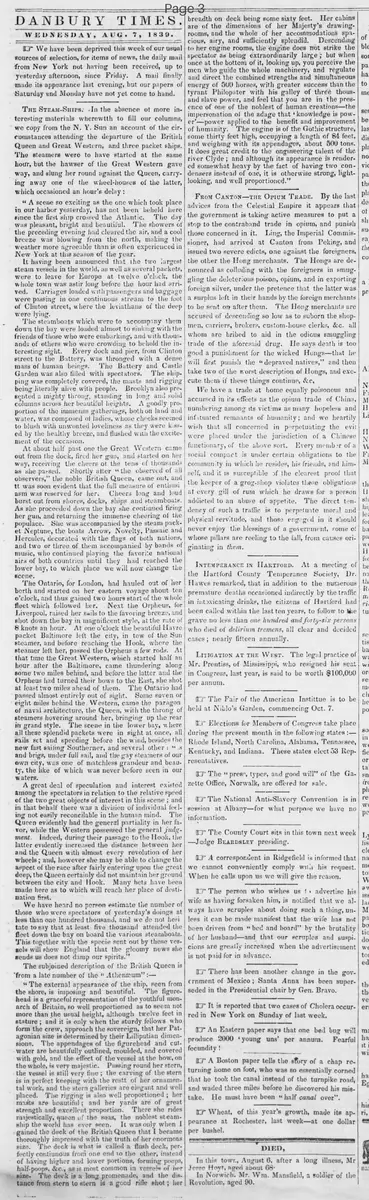
THE STEAM-SHIPS:—In the absence of more interesting materials wherewith to fill our columns, we copy from the N. Y. Sun an account of the circumstances attending the departure of the British Queen and Great Western, and three packet ships.
The steamers were to have started at the same hour, but the hawser of the Great Western gave way, and slung her round against the Queen, carrying away one of the wheel-houses of the latter, which occasioned an hour's delay:
"A scene so exciting as the one which took place in our harbor yesterday, has not been beheld here since the first ship crossed the Atlantic. The day was pleasant, bright and beautiful. The showers of the preceding evening had cleared the air, and a cool breeze was blowing from the north, making the weather more agreeable than is often experienced in New York at this season of the year.
It having been announced that the two largest steam vessels in the world, as well as several packets were to leave for Europe at twelve o'clock, the whole town was astir long before the hour had arrived. Carriages loaded with passengers and baggage were passing in one continuous stream to the foot of Clinton street, where the leviathans of the deep were lying.
The steamboats which were to accompany them down the bay were loaded almost to sinking with the friends of those who were embarking, and with thousands of others who were crowding to behold the interesting sight. Every dock and pier, from Clinton street to the Battery, was thronged with a dense mass of human beings. The Battery and Castle Garden was also filled with spectators. The shipping was completely covered, the masts and rigging being literally alive with people. Brooklyn also presented a mighty throng, standing in long and solid columns across her beautiful heights. A goodly proportion of the immense gatherings, both on land and water, was composed of ladies, whose cheeks seemed to blush with unwonted loveliness as they were kissed by the healthy breeze, and flushed with the excitement of the occasion.
At about half past one the Great Western came out from the dock, fired her gun, and started on her way, receiving the cheers of the tens of thousands as she passed. Shortly after "the observed of all observers," the noble British Queen, came out, and it was soon evident that the full measure of enthusiasm was reserved for her. Cheers long and loud burst out from shores, docks, ships and steamboats.
As she proceeded down the bay she continued firing her gun, and returning the immense cheering of the populace. She was accompanied by the steam packet Neptune, the boats Arrow, Novelty, Passaic and Hercules, decorated with the flags of both nations, and two or three of them accompanied by bands of music, who continued playing the favorite national airs of both countries until they had reached the lower bay, to which place we will now change the scene.
The Ontario, for London, had hauled out of her berth and started on her eastern voyage about ten o'clock, and thus gained two hours start of the whole fleet which followed her. Next the Orpheus, for Liverpool, raised her sails to the favoring breeze, and shot down the bay in magnificent style, at the rate of 8 knots an hour. "At one o'clock the beautiful Havre packet Baltimore left the city, in tow of the Sun steamer, and before reaching the Hook, where the steamer left her, passed the Orpheus a few rods. At that time the Great Western, which started half an hour after the Baltimore, came thundering along some two miles behind, and before the latter and the Orpheus had turned their bows to the East, she shot at least two miles ahead of them. The Ontario had passed almost entirely out of sight. Some seven or eight miles behind the Western, came the paragon of naval architecture, the Queen, with the throng of steamers hovering around her, bringing up the rear in grand style. The scene in the lower bay, where all these splendid packets were in sight at once, all sails set and speeding before the wind, besides the new fast sailing Southerner, and several other ships and brigs, under full sail, and the gay steamers of our own city, was one of matchless grandeur and beauty, the like of which was never before seen in our waters.
A great deal of speculation and interest existed among the spectators in relation to the relative speed of the two great objects of interest in this scene; and in that behalf there was a division of individual feeling not easily reconcilable in the human mind. The Queen evidently had the general partiality in her favor, while the Western possessed the general judgment. Indeed, during their passage to the Hook, the latter evidently increased the distance between her and the Queen with almost every revolution of her wheels; and, however she may be able to change the aspect of the race after fairly entering upon the great deep, the Queen certainly did not maintain her ground between the city and Hook. Many bets have been made here as to which will reach her place of destination first.
We have heard no person estimate the number of those who were spectators of yesterday's doings at less than one hundred thousand, and we do not hesitate to say that at least five thousand attended the fleet down the bay on board the various steamboats.
This together with the specie sent out by these vessels will show England that the gloomy news she sends us does not damp our spirits.
The subjoined description of the British Queen is from a late number of the "Atheneum":—
"The external appearance of the ship, seen from the shore, is imposing and beautiful. The figure-head is a graceful representation of the youthful monarch of Britain, so well proportioned as to seem not more than the usual height, although twelve feet in stature; and it is only when the sturdy fellows who form the crew, approach the sovereign, that her Patagonian size is determined by their Lilliputian dimensions. The appendages of the figurehead and cut-water are beautifully outlined, moulded, and covered with gold, and the effect of the vessel at the bow, on the whole, is very majestic. Passing round her stern, the vessel is still very fine; the carving of the stern is in perfect keeping with the rest of her ornamental work, and the stern galleries are elegant and well placed. The rigging is also well proportioned; her masts are beautiful; and her yards are of great strength and excellent proportion. There she rides majestically, queen of the seas, the noblest steam-ship the world has ever seen. It was only when I gained the deck of the British Queen that I became thoroughly impressed with the truth of her enormous size. The deck is what is called a flush deck, perfectly continuous from one end to the other, instead of having higher and lower portions, forming poops, half-poops, &c., as is most common in vessels of her size. The deck is a long promenade, and the distance from stern to stern is a good rifle shot; her breadth on deck being some sixty feet. Her cabins are of the dimensions of her Majesty's drawing-rooms, and the whole of her accommodations spacious, airy, and sufficiently splendid. Descending to her engine rooms, the engine does not strike the spectator as being extraordinarily large; but when once at the bottom of it, looking up, you perceive the men who guide the whole machinery, and regulate and direct the combined strengths and simultaneous energy of 500 horses, with greater success than the tyrant Philopater with his galley of three thousand slave power, and feel that you are in the presence of one of the noblest of human creations—the impersonation of the adage that 'knowledge is power'—power applied to the benefit and improvement of humanity. The engine is of the Gothic structure, some thirty feet high, occupying a length of 84 feet, and weighing with its appendages, about 500 tons. It does great credit to the engineering talent of the river Clyde; and although its appearance is rendered somewhat heavy by the fact of having two condensers instead of one, it is otherwise strong, light-looking, and well proportioned."
What sub-type of article is it?
What keywords are associated?
Where did it happen?
Domestic News Details
Primary Location
New York
Event Date
Yesterday
Outcome
hawser of great western gave way, slinging her against british queen and carrying away one of queen's wheel-houses, causing an hour's delay; great western gained lead over queen during passage to hook; bets made on which reaches destination first; over 100,000 spectators.
Event Details
British Queen and Great Western steamers, along with packet ships Ontario, Orpheus, Baltimore, departed New York harbor for Europe amid massive crowds and excitement; accompanied by steamboats; minor collision delayed start; scene of grandeur in lower bay with all vessels in sight.