Thank you for visiting SNEWPapers!
Sign up free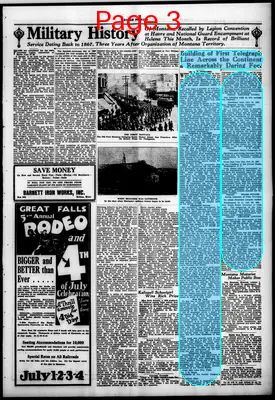
The Ronan Pioneer
Ronan, Lake County, Montana
What is this article about?
Edward Creighton led the daring construction of the first transcontinental telegraph line from Omaha to Salt Lake City in 1861, connecting East and West amid gold rushes, with telegrams exchanged upon completion involving Brigham Young, J.H. Wade, and Abraham Lincoln, boosting Creighton's fortune.
Clipping
OCR Quality
Full Text
When gold was discovered in California, the state of Illinois was the western frontier. This was but two years after the great Mormon exodus from Nauvoo, Illinois, to Omaha in 1846 and their memorable journey across the great American desert in 1847.
At that time a number of bold men braved the hardships of an overland trip across the Indian infested plains to the Pacific coast; but by far the greater exodus to the new Eldorado was by water and the Isthmus of Panama. But even this water trip took nearly three months time.
This large influx of people to the Pacific coast made it imperative that quicker intercourse with that wonderful country be had. In response to this demand the pony express was organized in 1860 which provided a weekly ten-day service between Leavenworth and Sacramento. This section brought California in closer touch with the eastern states. But even this great reduction in time was not sufficient.
The discoveries of gold and silver in Colorado in 1858 and 1859 caused another stampede to the golden west; emigration was stimulated and the border cities increased enormously.
Creighton in Limelight
It was just at this time that Edward Creighton, of Omaha, stepped into the limelight with his proposition.
Mr. Creighton built the first telegraph line into Omaha early in 1859 from Leavenworth. He had also built many lines of telegraph in other parts of the country. He had entertained for a long time an idea of building a telegraph line from Omaha to the Pacific coast. And immediately after completing the line into Omaha he took up the matter with friends of his in the east. Through these friends he secured the money to make a preliminary survey during the early summer of 1860
About this time a movement was started in California for the building of a telegraph line east to connect with any line which might be headed westward. After reaching Salt Lake with his survey, in 1860, Mr. Creighton pushed on to California, where he arrived after encountering untold hardships. Mr. J. H. Wade, of Cleveland, Ohio, Mr. Creighton's associate, also went to California via the Panama route to assist in interesting the people there in the line from Omaha. They received much encouragement in San Francisco and entered into a contract with the California company, to construct a telegraph line from Julesburg to Salt Lake and connect with the California line there. Messrs. Wade and Creighton returned east via the Panama route, arriving at Omaha early in the spring of 1861.
Anticipated Success
Mr. Creighton had anticipated the success of the California visit and already had made his arrangements for a hasty construction of his telegraph line from Julesburg to Fort Sanders. His outfits were ordered to various points along the proposed line. The United States government had taken an interest in the undertaking and congress had passed a bill giving the telegraph line a bonus of $40,000 per year for ten years.
In making his plans for distributing his forces for crowding the construction of the line, in the summer of 1861, Mr. Creighton sent out as far as Fort Sanders, in the late fall of 1860, something like a hundred and fifty oxen. He had also instructed his men to locate timber and arrange for supplies for the next season. They reached Fort Sanders in November. The greatest problem confronting them was to find feed for these cattle through the winter, there not being forage enough provided at the government post to care for this additional lot of stock. It was finally decided to turn these oxen out in a protected valley about 16 miles southwest of that place where there was fine feed, and let the cattle hustle for themselves through the winter.
In the spring when they were ready to start work on the line, Mr. Creighton sent out one of his men from Fort Sanders to learn how many of these cattle had pulled through and were fit for use: intending to send out others from Omaha to take the place of those lost by the severe weather. To the surprise of everybody, and Mr. Creighton in particular, the cattle were found nearly all alive and fat. They were far better than any that could be sent from Omaha. Mr. Creighton remarked then that he now knew what these western valleys were good for, and this was the real beginning of large investments in cattle in later years.
Was Big Task
To any one at all familiar with the difficulties of transporting supplies across the Indian infested country and the great distances which the material and supplies had to be taken, this undertaking of Mr. Creighton's to build a line of telegraph across a desert in one season, would seem an impossibility. Even at this late date, with a modern railway crossing this great American desert with transportation at command, it is exceedingly doubtful if any contractor could assemble and distribute the material, haul the poles, dig the holes and string the wire over a stretch of nearly 700 miles within a four months period in which the records show that Mr. Creighton built the line from Julesburg to Salt Lake.
The work was started early in the spring of 1861 and so well had it been planned that despite the many seemingly insurmountable obstacles encountered, he reached Salt Lake with his line October 17, 1861, just one week ahead of the completion of the line from the west into Salt Lake.
Telegrams Exchanged
Immediately upon the completion of the line into Salt Lake City the following telegrams were exchanged between Brigham Young and J. H. Wade president of the Pacific Telegraph company and Acting Governor of Utah Frank Fuller, and Abraham Lincoln, president of the United States:
Great Salt Lake City, Utah.
Hon. J. H. Wade,
President of the Pacific Telegraph Co.
Cleveland, Ohio.
Sir:--Permit me to congratulate you upon the completion of the Overland Telegraph line west to this city. To command the energy displayed by yourself and associates in the rapid and successful prosecution of a work so beneficial, and to express the wish that its use may ever tend to promote the true interests of the dwellers on both the Atlantic and Pacific slopes of our continent. Utah has not seceded, but is firm for the constitution and laws of our once happy country and is warmly interested in such useful enterprises as the one so far completed.
(Signed) BRIGHAM YOUNG.
The following reply to this message was received:
Cleveland, Ohio, Oct. 19, 1861.
Hon. Brigham Young, President.
Great Salt Lake City, Utah
Sir: I have the honor to acknowledge the receipt of your message of last evening which was in every way gratifying, not only in the announcement of the completion of the Pacific Telegraph to your enterprising and prosperous city, but that yours, the first message to pass over the line, should express so unmistakably the patriotism and union loving sentiments of yourself and people. I join with you in the hope that this enterprise may tend to promote the welfare and happiness of all concerned and that the annihilation of time in our means of communication may also tend to annihilate prejudice and strengthen them at once and again into a happy union With just consideration for your high position and due respect for your personality, I am your obedient servant,
(Signed)
J. H. WADE,
President Pacific Telegraph Co.
Secretary and Acting Governor Fuller of Utah sent the following message of congratulation to President Abraham Lincoln:
Great Salt Lake City, Oct. 18, 1861.
To the President of the United States
Washington, D. C.
Utah, whose citizens strenuously resist all imputations of disloyalty, congratulate the president upon the completion of an enterprise which spans a continent, unites two oceans and connects with nerve of iron the remote extremities of the body politic with the government heart. May the whole system speedily thrill with the quickened pulsations of the heart as a parricide hand is palsied, treason is punished and the entire sisterhood of states join hands in glad reunion around the national firesides.
(Signed)
FRANK FULLER,
Acting Governor of Utah Territory.
To which President Lincoln replied:
Washington, D. C., Oct. 20, 1861.
Hon. Frank Fuller, Governor of Utah.
Sir: The completion of the Telegraph to Great Salt Lake City, Utah, is auspicious of the stability and union of the republic. The government reciprocates your congratulation.
(Signed)
ABRAHAM LINCOLN.
Interested in the construction of this Pacific Telegraph line with Edward Creighton, was his brother Count John D. Creighton and W. H. Hibbard, as well as the eastern parties represented by J. H. Wade, which was largely the Western Union.
Edward Creighton was the owner of $100,000 of the stock in the company, which made him a one-tenth owner. The Western Union, who held control, doubled the capital stock of their own company and trebled the stock of the Pacific Telegraph company. This action made Mr. Creighton one of the wealthiest men in Omaha.
In 1866 Mr. Creighton extended the telegraph line from Salt Lake City to Virginia City, Montana, at the very time that Alder Gulch was the Mecca for the great rush of miners. Alder Gulch had a reputation the world over as being one of the richest placer mining camps ever known. It was the discoveries there that first placed Montana on the map. It was at this same camp where the Vigilantes of Montana organized.
What sub-type of article is it?
What themes does it cover?
What keywords are associated?
What entities or persons were involved?
Where did it happen?
Story Details
Key Persons
Location
From Omaha To Salt Lake City Across The American Continent
Event Date
1860 1861
Story Details
Edward Creighton organized and built the first overland telegraph line from Omaha to the Pacific coast, completing it to Salt Lake City on October 17, 1861, amid gold rushes and the need for faster communication, leading to his wealth and exchanges of congratulatory telegrams with national figures.