Thank you for visiting SNEWPapers!
Sign up free
Ypsilanti Sentinel
Ypsilanti, Washtenaw County, Michigan
What is this article about?
Commodore David Conner's official letter reports the failure of a U.S. naval attempt to enter the Alvarado River on October 15, 1846, due to shallow bar, strong currents, and Mexican batteries. Accompanied by Commodore Perry's Mississippi, smaller vessels could not overcome obstacles. No casualties reported; second such failure.
Clipping
OCR Quality
Full Text
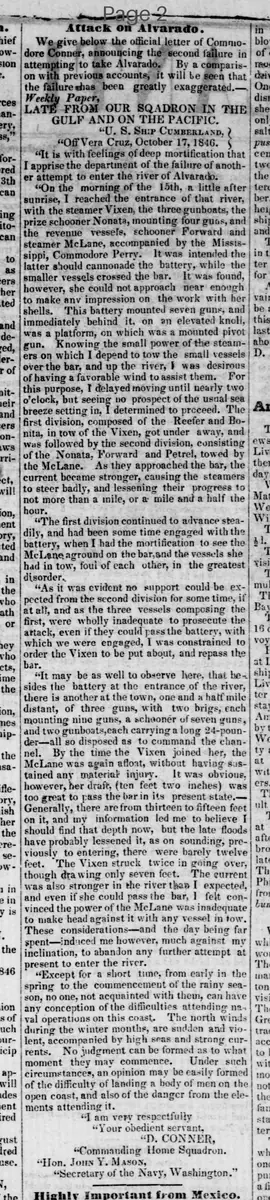
We give below the official letter of Commodore Conner, announcing the second failure in attempting to take Alvarado.
By a comparison with previous accounts, it will be seen that the failure has been greatly exaggerated.— Weekly Paper,
LATE FROM OUR SQUADRON IN THE GULF AND ON THE PACIFIC.
"U. S. SHIP CUMBERLAND,"
"Off Vera Cruz, October 17, 1846.
"It is with feelings of deep mortification that I apprise the department of the failure of another attempt to enter the river of Alvarado.
"On the morning of the 15th, a little after sunrise, I reached the entrance of that river, with the steamer Vixen, the three gunboats, the prize schooner Nonata, mounting four guns, and the revenue vessels, schooner Forward and steamer McLane, accompanied by the Mississippi, Commodore Perry. It was intended the latter should cannonade the battery, while the smaller vessels crossed the bar. It was found, however, she could not approach near enough to make any impression on the work with her shells. This battery mounted seven guns, and immediately behind it, on an elevated knoll, was a platform, on which was a mounted pivot gun. Knowing the small power of the steamers on which I depend to tow the small vessels over the bar, and up the river, I was desirous of having a favorable wind to assist them. For this purpose, I delayed moving until nearly two o'clock, but seeing no prospect of the usual sea breeze setting in, I determined to proceed. The first division, composed of the Reefer and Bonita, in tow of the Vixen, got under way, and was followed by the second division, consisting of the Nonata, Forward and Petrel, towed by the McLane. As they approached the bar, the current became stronger, causing the steamers to steer badly, and lessening their progress to not more than a mile, or a mile and a half the hour.
"The first division continued to advance steadily, and had been some time engaged with the battery, when I had the mortification to see the McLane aground on the bar, and the vessels she had in tow, foul of each other, in the greatest disorder.
"As it was evident no support could be expected from the second division for some time, if at all. and as the three vessels composing the first, were wholly inadequate to prosecute the attack, even if they could pass the battery, with which we were engaged, I was constrained to order the Vixen to be put about, and repass the bar.
"It may be as well to observe here, that besides the battery at the entrance of the river, there is another at the town, one and a half mile distant, of three guns, with two brigs, each mounting nine guns, a schooner of seven guns, and two gunboats, each carrying a long 24-pounder—all so disposed as to command the channel. By the time the Vixen joined her, the McLane was again afloat, without having sustained any material injury. It was obvious. however, her draft, (ten feet two inches) was too great to pass the bar in its present state.— Generally, there are from thirteen to fifteen feet on it, and my information led me to believe I should find that depth now, but the late floods have probably lessened it, as on sounding, previously to entering, there were barely twelve feet. The Vixen struck twice in going over, though drawing only seven feet. The current was also stronger in the river than I expected, and even if she could pass the bar, I felt convinced the power of the McLane was inadequate to make head against it with any vessel in tow. These considerations—and the day being far spent—induced me however, much against my inclination, to abandon any further attempt at present to enter the river.
"Except for a short time, from early in the spring to the commencement of the rainy season, no one, not acquainted with them, can have any conception of the difficulties attending naval operations on this coast. The north winds during the winter months, are sudden and violent, accompanied by high seas and strong currents. No judgment can be formed as to what moment they may commence.
Under such circumstances, an opinion may be easily formed of the difficulty of landing a body of men on the open coast, and also of the danger from the elements attending it,
"I am very respectfully
"Your obedient servant.
"D. CONNER.
"Commanding Home Squadron.
"Hon. JOHN Y. MASON,
"Secretary of the Navy, Washington."
What sub-type of article is it?
What keywords are associated?
What entities or persons were involved?
Where did it happen?
Foreign News Details
Primary Location
Alvarado
Event Date
October 15, 1846
Key Persons
Outcome
failure to enter the river due to shallow bar, strong currents, and enemy batteries; no material injury to vessels; second such attempt.
Event Details
U.S. naval force under Commodore Conner, including steamer Vixen, gunboats Reefer, Bonita, Petrel, schooner Nonata, vessels Forward and McLane, accompanied by Mississippi under Commodore Perry, attempted to cross the bar at Alvarado river entrance. First division engaged battery but second division grounded; inadequate support led to withdrawal. Additional defenses inside river included batteries, brigs, schooner, and gunboats.