Thank you for visiting SNEWPapers!
Sign up free
Literary
September 1, 1790
Gazette Of The United States
New York, New York County, New York
What is this article about?
An essay critiquing the free giving of advice, arguing it is often valueless and inferior to personal judgment and experience. Distinguishes advice from instruction and information, warns against following others' counsel in business, and illustrates with an anecdote of a lawyer's ruin.
Clipping
OCR Quality
75%
Good
Full Text
THE TABLET.-No. 141.
"Men are of nothing so liberal as of their advice."
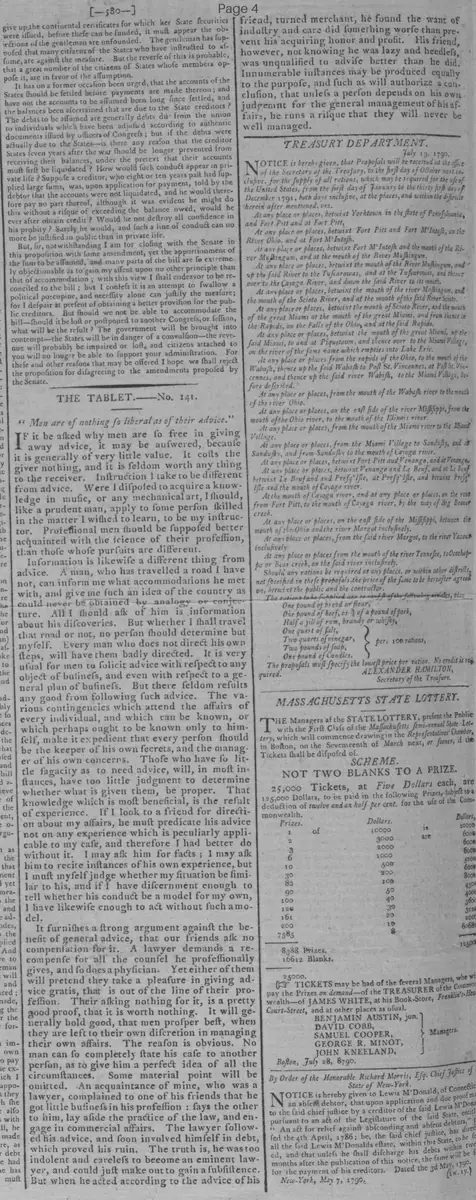
IF it be asked why men are so free in giving it away, it may be answered, because it is generally of very little value. It costs the giver nothing, and it is seldom worth any thing to the receiver. Instruction I take to be different from advice. Were I disposed to acquire a knowledge in music, or any mechanical art, I should, like a prudent man, apply to some person skilled in the matter I wished to learn, to be my instructor. Professional men should be supposed better acquainted with the science of their profession, than those whose pursuits are different. Information is likewise a different thing from advice. A man, who has travelled a road I have not, can inform me what accommodations he met with, and give me such an idea of the country as could never be obtained by analogy or conjecture. All I should ask of him is information about his discoveries. But whether I shall travel that road or not, no person should determine but myself. Every man who does not direct his own steps, will have them badly directed. It is very usual for men to solicit advice with respect to any object of business, and even with respect to a general plan of business. But there seldom results any good from following such advice. The various contingencies which attend the affairs of every individual, and which can be known, or which perhaps ought to be known only to himself, make it expedient that every person should be the keeper of his own secrets, and the manager of his own concerns. Those who have so little sagacity as to need advice, will, in most instances, have too little judgment to determine whether what is given them, be proper. That knowledge which is most beneficial, is the result of experience. If I look to a friend for direction about my affairs, he must predicate his advice not on any experience which is peculiarly applicable to my case, and therefore I had better do without it. I may ask him for facts; I may ask him to recite instances of his own experience, but I must myself judge whether my situation be similar to his, and if I have discernment enough to tell whether his conduct be a model for my own, I have likewise enough to act without such a model. It furnishes a strong argument against the benefit of general advice, that our friends ask no compensation for it. A lawyer demands a recompense for all the counsel he professionally gives, and so does a physician. Yet either of them will pretend they take a pleasure in giving advice gratis, that is out of the line of their profession. Their asking nothing for it, is a pretty good proof, that it is worth nothing. It will generally hold good, that men prosper best, when they are left to their own discretion in managing their own affairs. The reason is obvious. No man can so completely state his case to another person, as to give him a perfect idea of all the circumstances. Some material point will be omitted. An acquaintance of mine, who was a lawyer, complained to one of his friends that he got little business in his profession: says the other to him, lay aside the practice of the law, and engage in commercial affairs. The lawyer followed his advice, and soon involved himself in debt, which proved his ruin. The truth is, he was too indolent and careless to become an eminent lawyer, and could just make out to gain a subsistence. But when he acted according to the advice of his friend, turned merchant, he found the want of industry and care did something worse than prevent his acquiring honor and profit. His friend, however, not knowing he was lazy and heedless, was unqualified to advise better than he did. Innumerable instances may be produced equally to the purpose, and such as will authorize a conclusion, that unless a person depends on his own judgment for the general management of his affairs, he runs a risk that they will never be well managed.
"Men are of nothing so liberal as of their advice."
IF it be asked why men are so free in giving it away, it may be answered, because it is generally of very little value. It costs the giver nothing, and it is seldom worth any thing to the receiver. Instruction I take to be different from advice. Were I disposed to acquire a knowledge in music, or any mechanical art, I should, like a prudent man, apply to some person skilled in the matter I wished to learn, to be my instructor. Professional men should be supposed better acquainted with the science of their profession, than those whose pursuits are different. Information is likewise a different thing from advice. A man, who has travelled a road I have not, can inform me what accommodations he met with, and give me such an idea of the country as could never be obtained by analogy or conjecture. All I should ask of him is information about his discoveries. But whether I shall travel that road or not, no person should determine but myself. Every man who does not direct his own steps, will have them badly directed. It is very usual for men to solicit advice with respect to any object of business, and even with respect to a general plan of business. But there seldom results any good from following such advice. The various contingencies which attend the affairs of every individual, and which can be known, or which perhaps ought to be known only to himself, make it expedient that every person should be the keeper of his own secrets, and the manager of his own concerns. Those who have so little sagacity as to need advice, will, in most instances, have too little judgment to determine whether what is given them, be proper. That knowledge which is most beneficial, is the result of experience. If I look to a friend for direction about my affairs, he must predicate his advice not on any experience which is peculiarly applicable to my case, and therefore I had better do without it. I may ask him for facts; I may ask him to recite instances of his own experience, but I must myself judge whether my situation be similar to his, and if I have discernment enough to tell whether his conduct be a model for my own, I have likewise enough to act without such a model. It furnishes a strong argument against the benefit of general advice, that our friends ask no compensation for it. A lawyer demands a recompense for all the counsel he professionally gives, and so does a physician. Yet either of them will pretend they take a pleasure in giving advice gratis, that is out of the line of their profession. Their asking nothing for it, is a pretty good proof, that it is worth nothing. It will generally hold good, that men prosper best, when they are left to their own discretion in managing their own affairs. The reason is obvious. No man can so completely state his case to another person, as to give him a perfect idea of all the circumstances. Some material point will be omitted. An acquaintance of mine, who was a lawyer, complained to one of his friends that he got little business in his profession: says the other to him, lay aside the practice of the law, and engage in commercial affairs. The lawyer followed his advice, and soon involved himself in debt, which proved his ruin. The truth is, he was too indolent and careless to become an eminent lawyer, and could just make out to gain a subsistence. But when he acted according to the advice of his friend, turned merchant, he found the want of industry and care did something worse than prevent his acquiring honor and profit. His friend, however, not knowing he was lazy and heedless, was unqualified to advise better than he did. Innumerable instances may be produced equally to the purpose, and such as will authorize a conclusion, that unless a person depends on his own judgment for the general management of his affairs, he runs a risk that they will never be well managed.
What sub-type of article is it?
Essay
What themes does it cover?
Moral Virtue
Social Manners
What keywords are associated?
Advice
Self Reliance
Judgment
Experience
Personal Affairs
Business
Instruction
Information
Literary Details
Title
The Tablet. No. 141.
Key Lines
"Men Are Of Nothing So Liberal As Of Their Advice."
It Costs The Giver Nothing, And It Is Seldom Worth Any Thing To The Receiver.
Every Man Who Does Not Direct His Own Steps, Will Have Them Badly Directed.
That Knowledge Which Is Most Beneficial, Is The Result Of Experience.
Unless A Person Depends On His Own Judgment For The General Management Of His Affairs, He Runs A Risk That They Will Never Be Well Managed.