Thank you for visiting SNEWPapers!
Sign up free
Literary
December 5, 1877
The Central Presbyterian
Richmond, Virginia
What is this article about?
This is a Sunday school lesson from December 9, 1877, on Paul's shipwreck and stay in Melita (Malta) from Acts 28:1-10. It includes questions for verses 1-10, the Golden Text from Romans 1:14, a Shorter Catechism reference, and detailed explanatory notes on the events, emphasizing hospitality, miracles, and divine providence.
Clipping
OCR Quality
98%
Excellent
Full Text
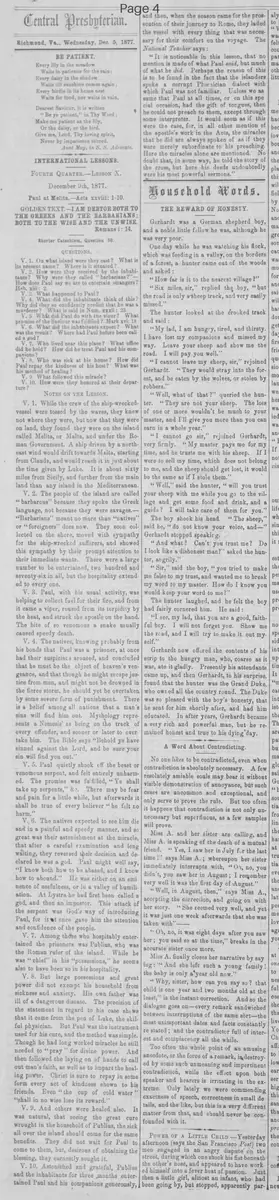
INTERNATIONAL LESSONS.
FOURTH QUARTER. LESSON X.
December 9th, 1877.
Paul at Melita. - Acts xxviii: 1-10.
GOLDEN TEXT.- I AM DEBTOR BOTH TO
THE GREEKS AND THE BARBARIANS;
BOTH TO THE WISE AND THE UNWISE.
Romans i:14.
Shorter Catechism, Question 36
QUESTIONS.
V. 1. On what island were they cast? What is
its present name? Where is it situated?
V. 2. How were they received by the inhabitants? Why were they called barbarians?
How does Paul say we are to entertain strangers?
Heb. xiii: 2.
V.3. What happened to Paul?
V. 4. What did the inhabitants think of this?
Why did they so confidently predict that he was a
murderer? What is said in Num. xxxii: 23
V. 5. What did Paul do with the viper? What
promise of the Saviour was fulfilled? Mark xvi: 18
V. 6. What did the inhabitants expect? What
was the result? Where had Paul before been called
a god?
V. 7. Who lived near this place? What office
did he hold?
How did he treat Paul and his companions?
V. 8. Who was sick at his house? How did
Paul repay the kindness of his host? What was
his method of healing?
V. 9. What followed this miracle?
V. 10. How were they honored at their departure?
Notes on the Lesson.
V. 1. While the crew of the ship-wrecked
vessel were tossed by the waves, they knew
not where they were, but now that they were
on land, they found they were on the island
called Melita, or Malta, and under the Roman
Government. A ship driven by a north
east wind would drift towards Malta, starting
from Clauda, and would reach it in just about
the time given by Luke. It is about sixty
miles from Sicily, and further from the main
land than any island in the Mediterranean.
V. 2. The people of the island are called
"barbarous" because they spoke the Greek
language, not because they were savages.—
"Barbarians" meant no more than "natives"
or "foreigners" does now. They soon collected on the shore, moved with sympathy
for the ship-wrecked sufferers, and showed
this sympathy by their prompt attention to
their immediate wants. There were a large
number to be entertained, two hundred and
seventy-six in all, but the hospitality extended to every one.
V. 3. Paul, with his usual activity, was
helping to collect fuel for their fire, and from
it came a viper, roused from its torpidity by
the heat, and struck the apostle on the hand.
The bite of so venomous a snake usually
caused speedy death.
V. 4. The natives, knowing probably from
his bonds that Paul was a prisoner, at once
had their suspicions aroused, and concluded
that he must be the object of heaven's vengeance, and that though he might escape justice from men, and might not be drowned in
the fierce storm, he should yet be overtaken
by some severe form of punishment. There
is a belief among all nations that a man's
sins will find him out. Mythology represents a Nemesis as being on the track of
every offender, and sooner or later to overtake him. The Bible says "Behold ye have
sinned against the Lord, and be sure your
sin will find you out."
V. 5. Paul quietly shook off the beast or
venomous serpent, and felt entirely unharmed. The promise was fulfilled, "Ye shall
take up serpents," &c. There may be fear
and pain for a little while, but afterwards it
shall be true of every believer "he felt no
harm."
V. 6. The natives expected to see him die
and in a painful and speedy manner, and so
great was their astonishment at the miracle,
that after a careful examination and long
waiting, they reversed their decision and declared he was a god. Paul might well say,
"I know both how to be abased, and I know
how to abound." He was either on an eminence of usefulness, or in a valley of humiliation. At Lystra he had first been called a
god, and then an impostor. This attack of
the serpent was God's way of introducing
Paul, for it at once gave him the attention
and confidence of the people.
V. 7. Among those who hospitably entertained the prisoners was Publius, who was
the Roman ruler of the island. While he
was "chief" in his "possessions," he seems
also to have been so in his hospitality.
V. 8. But large possessions and great
power did not exempt his household from
sickness and anxiety. His own father was
ill of a dangerous disease. The precision of
the statement in regard to his case shows
that it came from the pen of Luke, the skillful physician. But Paul was the instrument used for his cure, and the method was simple. Though he had long worked miracles he still
needed to "pray" for divine power. And
then followed the laying on of hands to call
out man's faith, as well as to impart the healing power. Christ is sure to repay in some
form every act of kindness shown to his
friends. Even "the cup of cold water"
"shall in no wise lose its reward."
V. 9. And others were healed also. It
was natural, that seeing the great cure
wrought in the household of Publius, the sick
all over the island should come for the same
benefits. They did not wait for Paul to
come to them, but, desirous of obtaining the
blessing, they earnestly sought it.
V. 10. Astonished and grateful, Publius
and the inhabitants for three months entertained Paul and his companions generously,
and then, when the season came for the prosecution of their journey to Rome, they laded
the vessel with every thing that was necessary for their comfort on the voyage. The
National Teacher says:
"It is noticeable in this lesson, that no
mention is made of what Paul said, but much
of what he did. Perhaps the reason of this
is to be found in the fact that the islanders
spoke a corrupt Phoenician dialect with
which Paul was not familiar. Unless we assume that Paul at all times, or on this special occasion, had the gift of tongues, then
he could not preach to them, except through
some interpreter. It would seem as if this
were the case, for, in all other mention of
the apostle's work in the Acts, the miracles
that he did are always spoken of as if they
were merely subordinate to his preaching.
Here the miracles alone are mentioned. No
doubt that, in some way, he told the story of
the cross, but here his deeds undoubtedly
were his most powerful sermons."
FOURTH QUARTER. LESSON X.
December 9th, 1877.
Paul at Melita. - Acts xxviii: 1-10.
GOLDEN TEXT.- I AM DEBTOR BOTH TO
THE GREEKS AND THE BARBARIANS;
BOTH TO THE WISE AND THE UNWISE.
Romans i:14.
Shorter Catechism, Question 36
QUESTIONS.
V. 1. On what island were they cast? What is
its present name? Where is it situated?
V. 2. How were they received by the inhabitants? Why were they called barbarians?
How does Paul say we are to entertain strangers?
Heb. xiii: 2.
V.3. What happened to Paul?
V. 4. What did the inhabitants think of this?
Why did they so confidently predict that he was a
murderer? What is said in Num. xxxii: 23
V. 5. What did Paul do with the viper? What
promise of the Saviour was fulfilled? Mark xvi: 18
V. 6. What did the inhabitants expect? What
was the result? Where had Paul before been called
a god?
V. 7. Who lived near this place? What office
did he hold?
How did he treat Paul and his companions?
V. 8. Who was sick at his house? How did
Paul repay the kindness of his host? What was
his method of healing?
V. 9. What followed this miracle?
V. 10. How were they honored at their departure?
Notes on the Lesson.
V. 1. While the crew of the ship-wrecked
vessel were tossed by the waves, they knew
not where they were, but now that they were
on land, they found they were on the island
called Melita, or Malta, and under the Roman
Government. A ship driven by a north
east wind would drift towards Malta, starting
from Clauda, and would reach it in just about
the time given by Luke. It is about sixty
miles from Sicily, and further from the main
land than any island in the Mediterranean.
V. 2. The people of the island are called
"barbarous" because they spoke the Greek
language, not because they were savages.—
"Barbarians" meant no more than "natives"
or "foreigners" does now. They soon collected on the shore, moved with sympathy
for the ship-wrecked sufferers, and showed
this sympathy by their prompt attention to
their immediate wants. There were a large
number to be entertained, two hundred and
seventy-six in all, but the hospitality extended to every one.
V. 3. Paul, with his usual activity, was
helping to collect fuel for their fire, and from
it came a viper, roused from its torpidity by
the heat, and struck the apostle on the hand.
The bite of so venomous a snake usually
caused speedy death.
V. 4. The natives, knowing probably from
his bonds that Paul was a prisoner, at once
had their suspicions aroused, and concluded
that he must be the object of heaven's vengeance, and that though he might escape justice from men, and might not be drowned in
the fierce storm, he should yet be overtaken
by some severe form of punishment. There
is a belief among all nations that a man's
sins will find him out. Mythology represents a Nemesis as being on the track of
every offender, and sooner or later to overtake him. The Bible says "Behold ye have
sinned against the Lord, and be sure your
sin will find you out."
V. 5. Paul quietly shook off the beast or
venomous serpent, and felt entirely unharmed. The promise was fulfilled, "Ye shall
take up serpents," &c. There may be fear
and pain for a little while, but afterwards it
shall be true of every believer "he felt no
harm."
V. 6. The natives expected to see him die
and in a painful and speedy manner, and so
great was their astonishment at the miracle,
that after a careful examination and long
waiting, they reversed their decision and declared he was a god. Paul might well say,
"I know both how to be abased, and I know
how to abound." He was either on an eminence of usefulness, or in a valley of humiliation. At Lystra he had first been called a
god, and then an impostor. This attack of
the serpent was God's way of introducing
Paul, for it at once gave him the attention
and confidence of the people.
V. 7. Among those who hospitably entertained the prisoners was Publius, who was
the Roman ruler of the island. While he
was "chief" in his "possessions," he seems
also to have been so in his hospitality.
V. 8. But large possessions and great
power did not exempt his household from
sickness and anxiety. His own father was
ill of a dangerous disease. The precision of
the statement in regard to his case shows
that it came from the pen of Luke, the skillful physician. But Paul was the instrument used for his cure, and the method was simple. Though he had long worked miracles he still
needed to "pray" for divine power. And
then followed the laying on of hands to call
out man's faith, as well as to impart the healing power. Christ is sure to repay in some
form every act of kindness shown to his
friends. Even "the cup of cold water"
"shall in no wise lose its reward."
V. 9. And others were healed also. It
was natural, that seeing the great cure
wrought in the household of Publius, the sick
all over the island should come for the same
benefits. They did not wait for Paul to
come to them, but, desirous of obtaining the
blessing, they earnestly sought it.
V. 10. Astonished and grateful, Publius
and the inhabitants for three months entertained Paul and his companions generously,
and then, when the season came for the prosecution of their journey to Rome, they laded
the vessel with every thing that was necessary for their comfort on the voyage. The
National Teacher says:
"It is noticeable in this lesson, that no
mention is made of what Paul said, but much
of what he did. Perhaps the reason of this
is to be found in the fact that the islanders
spoke a corrupt Phoenician dialect with
which Paul was not familiar. Unless we assume that Paul at all times, or on this special occasion, had the gift of tongues, then
he could not preach to them, except through
some interpreter. It would seem as if this
were the case, for, in all other mention of
the apostle's work in the Acts, the miracles
that he did are always spoken of as if they
were merely subordinate to his preaching.
Here the miracles alone are mentioned. No
doubt that, in some way, he told the story of
the cross, but here his deeds undoubtedly
were his most powerful sermons."
What sub-type of article is it?
Essay
What themes does it cover?
Religious
What keywords are associated?
Bible Lesson
Paul Melita
Acts Xxviii
Shipwreck Malta
Viper Miracle
Publius Hospitality
Divine Healing
Literary Details
Title
Paul At Melita. Acts Xxviii: 1 10.
Subject
International Lessons, Fourth Quarter, Lesson X, December 9th, 1877
Form / Style
Biblical Lesson With Questions And Explanatory Notes
Key Lines
Golden Text. I Am Debtor Both To The Greeks And The Barbarians; Both To The Wise And The Unwise. Romans I:14.
Behold Ye Have Sinned Against The Lord, And Be Sure Your Sin Will Find You Out.
Ye Shall Take Up Serpents," &C.
I Know Both How To Be Abased, And I Know How To Abound."